Edo people, Benin, Queen Mother Pendant Mask: Iyoba, 16th century
Collection Metropolitan Museum of Art, Object history
1897: taken from Benin City, The Michael C. Rockefeller Memorial Collection, Gift of Nelson A. Rockefeller, 1972.
Edo people, Benin, Queen Mother Pendant Mask: Iyoba, 16th century
Collection Metropolitan Museum of Art, Object history
1897: taken from Benin City, The Michael C. Rockefeller Memorial Collection, Gift of Nelson A. Rockefeller, 1972. SUMMARY

Screenshot from Bee TV November 5, 2025 Protest over opening of MOWAA.
On November 9th, 2025, as 250 Nigerian and international guests – donors, diplomats, and the heads of national cultural agencies – gathered in Benin City at the new Museum of West African Art’s opening event, protesters in red baseball caps broke into the museum, forcing its closure. The protesters insulted the guests and accused the museum of usurping the rights of the Oba of Benin to the hundreds of Benin artifacts returned by foreign museums to Nigeria. The museum staff were able to calm the situation and the building and exhibits were not damaged, but the guests were evacuated by police and the planned opening hasn’t yet been rescheduled. A week later, the museum remains shut.
The political furor surrounding the custodianship of the Benin Bronzes has entered a new phase, marked by competing museum visions, claims of corruption and foreign influence, and political gamesmanship over the future of the new Museum of West African Art (MOWAA) in Nigeria.
The MOWAA crisis has become a textbook example of how different political and institutional actors in Nigeria – and especially in Edo State – are spinning the same sequence of events into completely different stories.
There are multiple sides in this essentially political battle.
The Peoples Democratic Party (PDP) is currently the primary opposition party in Nigeria and the underdog in the contest. It is allied with the museum’s director, Philip Ihenacho and the former governor Obaseki, also one of the founders of MOWAA ) The museum frames the disruption of the museum opening as the work of “hooligans,” “derelicts” and “mental hobos,” an uncivil mob that disgraced Benin and Nigeria in front of foreign guests.

MOWAA campus under construction, Courtesy of the Museum of West African Art (MOWAA)
At the same time, the museum insists that the Oba of Benin could not possibly be behind such bad behavior, that the king stands for civility, not “barbarism,” and that anyone claiming loyalty to him while attacking a museum is either ignorant or being manipulated. Responsibility is pushed instead onto the current All Progressives Congress state government, which is accused of weaponizing street anger and failing to protect foreign diplomats and visitors. The museum has been careful to disclaim any intent to hold repatriated artifacts and to portray itself instead as a creative incubator for contemporary art and a resource for training in conservation, research and study of African art.
The museum’s critics are aligned with the All Progressives Congress or APC, the party in power in Nigeria since 2015. APC-aligned figures are critical of the museum, of Ihenacho, and Obaseki. They tell an opposite story:
To them, the mobilization against MOWAA is authentic, justified outrage expressed by Edo youth defending the Oba, the kingdom, and the “King’s jewels” against a “Lagos gang” of corporate raiders that is using MOWAA to profit from its foreign funding and take the Benin bronzes from its lawful owner, the Oba. The protests and Edo Governor Okpebholo’s sudden November 10 announcement of revocation of MOWAA’s land title are framed as stopping an elite “heist” of Edo’s heritage, treasury and public land.

Screenshot from Bee TV of November 5, 2025 protest against opening of MOWAA.
Both these narratives deliberately separate the protests from a direct connection to the Oba’s palace, despite the fact that demonstrators chanted royalist slogans and explicitly demanded control by the Oba, and even though well-organized street protests had been ongoing and escalating from 5th November, without contradiction from him. Indeed, protesters shouted “Long live the King” while the museum’s guests were evacuated.
In the APC’s telling, the protesters are not thugs but heroes: they “rose in righteous indignation to defend our heritage,” and Edo State Governor Okpebholo is the leader finally aligning with the Oba and “restoring” the museum to its “rightful purpose” as the Benin Royal Museum.
So, while PDP surrogates downplay any link between the street demonstrations and the throne, APC voices lean into that link, using loyalty to the Oba as a political weapon against Ihenacho, Obaseki and anyone associated with them.
MOWAA’s official response adds another layer of spin. In fresh statements, the museum insists it has never claimed ownership of Benin Bronzes and never presented itself as the Benin Royal Museum, stressing a broader West African mandate and pointing out that there are no ancient bronzes on display and there never have been. International coverage likewise notes that, as of November 2025, repatriated bronzes will not be shown at MOWAA. Really, that can’t happen, because it doesn’t hold any returned artifacts.
What really happened.
But historically, the original EMOWAA (Edo Museum of West African Art) concept was explicitly tied to ambitions to host Benin Bronzes – but according to the plans of the Benin Dialog Group in 2017 – objects on long term loan from foreign museums. The sophisticated, modern museum was to be managed as an international partnership with the Nigerian government, with the input of trustees that included the family of the Oba of Benin, local Edo State government representatives and major international foundations, aided by museum experts. This depiction of EMOWAA as a flagship home for loaned Benin artifacts, backed by Edo State, was a selling point in 2020–2022 planning documents and press and a means of encouraging repatriation from cautious Western museums.
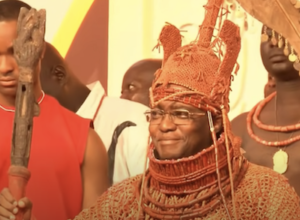
Screenshot of the Coronation of Oba Euware II of Benin in 2016. Prior to becoming Oba, he served as Nigeria’s Ambassador to Angola and Sweden, with accreditation to Norway, Denmark and the Republic of Finland, and as Ambassador to Italy.
The plan fell apart because the Oba objected insistently and publicly to any museum but his own yet-to-be-constructed Royal Museum holding the artifacts. In March 2023, Nigeria’s outgoing President Bukhari formally recognized the Oba as the rightful custodian of all repatriated bronzes.
EMOWAA’s plans were quietly adjusted; EMOWAA was rebranded as MOWAA, and the discourse shifted to “we never intended to hold the bronzes; we’re about broader West African art.”
The public face of the conflict is full of distracting details: EMOWAA, MOWAA and the Oba’s planned Benin Royal Museum are explained as, and of course are, different institutions with different mandates, but that’s not the point. MOWAA’s denial of any original intention to hold bronzes is less about historical accuracy and more about legal and political damage control now that the Oba’s custodianship has been entrenched in law and public opinion.
In reality, the dispute is about who controls and administers the restituted artifacts: a palace-centered Benin Royal Museum under the Oba, or a semi-autonomous, internationally funded institution in which the state and foreign partners have more say.
How does this affect the status of more than two hundred artifacts so far returned to Nigeria by Western museums and private collectors? What happens to the approximately 1,300 artifacts in the restitution pipeline, almost all of which have had their title legally transferred either to the Nigerian government’s Commission on Museums and Monuments or to the personal ownership of the Oba of Benin?
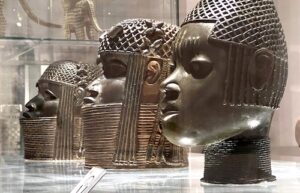
The British Museum’s display of Benin Bronze Heads, photo courtesy Mike Wells.
Layered over all this is the Oba’s own position. For years he has stated emphatically that the bronzes belong to him and his descendants, and the Buhari-era decision naming him legal custodian has strengthened that claim. While he has not publicly supported the protests, he has not condemned them either as they escalated from sign-waving marches to his palace gates on 5th November to the museum’s forced shutdown on the 9th, and even as protesters invoked his authority and framed themselves as acting in his defense.
That silence functions politically in two ways: it allows royalist and APC actors to present the mobilization as a legitimate defense of the throne, and it allows PDP allies and institutional voices (MOWAA, federal officials) to insist that “the Oba has nothing to do with thugs,” because he has not openly endorsed the violence either. Thus, the palace benefits from the pressure the protests create, without having to own the discourtesy and embarrassment to Nigeria resulting from the protests. All these spins orbit the same unspoken issues: control over restitution, money, and symbolic authority wrapped up in the Benin Bronzes.
The Long Read – the Benin Bronzes and Repatriation
The story of repatriation of Benin artifacts from Western museums is complex. Key moments include the initiation of the international Benin Dialogue Group fifteen years ago, formed to foster cooperation between Western museums and Nigerian cultural and political entities, and eventually, the building of a foreign-funded Edo Museum of West African Art (EMOWAA) designed by British Ghanaian architect David Adjaye.
The Benin Dialogue Group
Established in 2010, the Benin Dialogue Group began as the principal forum for discussion of the future of Benin artworks in Western museum collections. It brought together the heads of major holding institutions in the United Kingdom, Germany, Austria, the Netherlands, and the United States, together with Nigerian stakeholders including family members of the Royal Court of Benin, members of the Edo State Government, and representatives of Nigeria’s National Commission for Museums and Monuments (NCMM). A July 2019 statement issued by the group elaborated on its goal to “work together to establish a museum in Benin City that will facilitate a permanent display reuniting Benin works of art dispersed in collections around the world.”
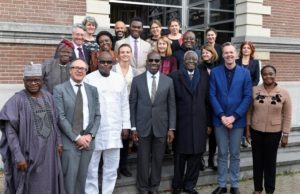
Benin Dialog Group meeting at the Nationaal Museum van Wereldculturen, Netherlands, 19 October 2018.
The Benin Dialogue Group’s founding ambition was the creation of a major museum in Benin City capable of housing and exhibiting artworks from foreign collections, initially with the expectation that objects would be loaned. As the 2019 statement continued:
“The vision is to establish a new Royal Museum to reunite in Benin City the most significant of Benin’s historical artefacts, currently in various locations around the world. The Museum will showcase the rich history and culture of the Benin Kingdom from the earliest archaeological evidence to contemporary creative expressions, in recognition of the fact that Benin City continues to be a vibrant artistic centre. The museum will be founded as a place of remembrance, education and inspiration for the people of the Benin Kingdom and audiences from around the world.”
However, the group faced structural problems from its inception. The British Museum held a large collection of objects taken in the 1897 British punitive expedition. It was subject to a 1963 Act of Parliament that prohibited deaccessioning but would enable long term loans – and despite the considerable goodwill that made it a founding member of the group, the museum was cautious about making a permanent commitment to a yet to be defined project. A number of Germany’s museums were ardent repatriationists, while U.S. museums, which are largely independently operated under separate trusts, held more cautious opinions, although the Smithsonian Institution in Washington, DC wrote a new ‘ethical returns’ policy to justify sending its Benin bronzes to Nigeria in 2022.
Over time, the Benin Dialog Group’s actions would be superseded by individual museums’ decisions regarding their collections, and in some cases, by public pressure to repatriate rather than to loan objects from existing collections.
As part of the planned building project, EMOWAA partnered with the British Museum, the German Archaeological Institute, Wessex Archaeology, and the University of Cambridge to undertake pre-construction archaeological work at the museum site. Early press releases described this work as “foundational” for building a facility intended to accommodate the world’s most comprehensive display of repatriated bronzes.
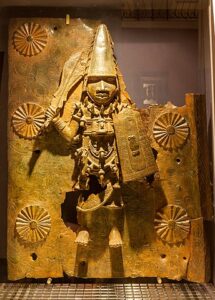
Benin bronze plaque. Photo by Mike Peel, Horniman Museum and Gardens, 21 February 2010. CC-BY-SA-4.0.
The Edo Museum of West African Art began as a private foundation in 2020 as an initiative of then governor of Edo State Godwin Obaseki and Nigerian-British entrepreneur Philip Ihenacho. (Ihenacho still heads MOWAA.) Media attention surged with the announcement that architect David Adjaye would design a flagship institution intended to house Benin bronzes and exhibitions from major museums. EMOWAA rapidly attracted international funding from the U.S., Europe and United Kingdom. As funding accumulated and the building took shape, and many more objects were repatriated to the Government of Nigeria starting in 2021-2022, the relationship between the Oba and EMOWAA began to fracture.
Despite its international success, EMOWAA never received acknowledgement of its legitimacy as holder of Benin artifacts from the Nigerian government’s National Commission for Museums and Monuments or from the Royal Court of the Oba. The NCMM repeatedly expressed concern about EMOWAA’s status as a non-federal, initially private vehicle and promises to donors about its operations that implied that the museum would follow Western museum standards for conservation and security that distanced it from NCMM oversight. Conflicts between EMOWAA and the Oba and his royal family became more vocal and frequent. The continued presence of the Oba’s eldest son on EMOWAA’s board was interpreted by Western museums as tacit royal approval, but this proved misleading.
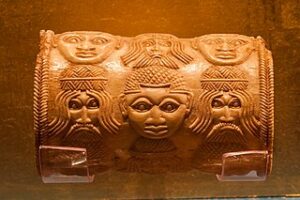
Ivory armlet, Benin Kingdom, Photo by Mike Peel, Horniman Museum and Gardens, 21 February 2010. CC-BY-SA-4.0.
In 2023, a surprise declaration by outgoing Nigerian President Muhammadu Buhari stated that the hereditary Oba of Benin had lawful control and custodianship of all Benin artifacts repatriated to Nigeria. Questions about the Oba’s control over the bronzes’ history and their role in the west African slave trade, and over his personal ownership of objects returned to the Nigerian government intensified debates about the future of repatriated bronzes.
The most recent Nigerian government federal action, a February 12, 2025 agreement granting the National Commission for Museums and Monuments (NCMM) management authority over the bronzes together with the Royal Court of the Oba, signaled a new partnership between the NCMM and the Oba but by no means a final resolution.
Repatriations from Western museums and collectors
Physical returns of Benin artifacts to Nigeria from Western museums are on the order of at least 206 Benin-related objects. Legal transfers of title where the objects stayed temporarily or on loan in Western museums involve over 1,300 objects (mostly from Germany, plus part of the Horniman collection). There is no single, official database of returned and transferred objects. Some returns, including the first from UK collector Mark Walker in 2014, have been from private collections. Because there’s no single official, up-to-date database, these numbers are conservative, not a perfect census.
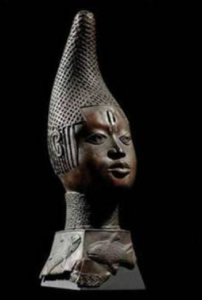
Bust of Queen-Mother Idia, Benin, Nigeria, Humboldt Forum, Berlin, Germany.
The majority of returns began in 2021: the Metropolitan Museum of Art in New York returned two 16th-century Benin brass plaques and one 14th-century Ife head. The University of Aberdeen in Scotland returned a bronze head of an Oba and Jesus College, Cambridge in England a famous cockerel statue.
Then in 2022, there were major returns from Germany, England and the United States, and title to many more objects was transferred to Nigeria. In July 2022, Germany and the Government of Nigeria signed a Joint Declaration transferring ownership of around 1,100 Benin bronzes in German public collections; two bronzes were handed over at the signing. Twenty more bronzes were delivered to Nigeria in December 2022. London’s Horniman Museum formally transferred ownership of 72 Benin objects in November 2022. Washington DC’s National Museum of African Art delivered 20 Benin bronzes to Abuja in October 2022 and the National Gallery returned a plaque. Glasgow Life Museums returned 19 Benin bronzes to Nigeria by 2023.
The first direct USA to Oba restitutions came from the Stanley Museum of Art at the University of Iowa in July 2024. The Museum of Fine Arts, Boston returned two works, a head of an Oba and a plaque in person to Oba Ewuare II, in a ceremony at Nigeria House in New York City in June 2025. A very large direct return to the Oba came from the Dutch national collection and the City of Rotterdam in June 2025: 119 Benin bronzes were handed over in Lagos and Edo State.
The tension between EMOWAA and the Oba
Altogether, the tensions between federal and state authorities and the Oba and the museum created an unstable battleground for the territorial, moral, and institutional claims that emerged in Nigeria in the 2020s. However, repatriations began to slow only when the lack of consensus among Nigerian political and traditional leaders over who was the rightful custodian of returned artworks became clear in 2022-2023.

A European museum official attends a formal ceremony in which visitors honor the monarch Omo n’Oba n’Edo Uku Akpolokpolo Ewuare II.
The Oba of Benin, Ewuare II, presides as a ‘first-class,’ i.e. top-level unelected traditional ruler of Benin City. His lineage traces directly to Oba Ovonramwen N’Ogbaisi, deposed by British forces in 1897. The Royal Court has consistently argued that the bronzes taken from the royal palace remain the personal property of the Oba and his people.
Tensions between Governor Obaseki, a founder of EMOWAA, and the Oba were amplified by historical memory: Obaseki is a descendant of Agho Obaseki, who served as the British-appointed paramount chief during the interregnum (1897–1914) before the return of the exiled Oba’s family to Benin. This rivalry deepened suspicion that EMOWAA represented a political counterweight to the Royal Court’s own museum project.
Outgoing President Muhammadu Buhari’s 2023 Presidential Gazette declared unequivocally that ownership of repatriated Benin artefacts was vested in the Oba of Benin; all repatriated artifacts must be transferred directly to the Oba, and the Federal Government retained responsibility for ensuring secure housing for returned artifacts through the NCMM.
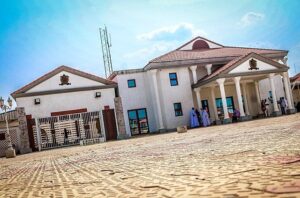
The Royal Palace of the Oba of Benin. Its classic style was a preferred model for a museum under the Oba’s auspices. Originally built by Oba Ewedo (1255AD – 1280AD), the palace is located at the heart of the old City of Benin. It was rebuilt by Oba Eweka II (1914–1932) after the 1897 war. Photo Kelechukwu Ajoku. 13 February 2018. CCA-SA 4.0 license.
The Gazette undermined any possible claim by EMOWAA to house the bronzes. International media framed the decree as transferring national heritage repatriated to the government of Nigeria to a “private individual,” which it explicitly did under Nigerian law. Other observers felt that this characterization overlooked the Oba’s traditional authority and were not disturbed by the granting of rights of interpretation and absolute control over the museum narrative – or the ownership and title of objects formerly in museum collections to an individual.
Following publication of the Gazette, EMOWAA pivoted toward promoting Nigerian contemporary art and artists, continuing archaeological research and training of archaeologists and museum studies and skills, and pursuing international cultural programming such as the Nigeria Pavilion at the 2024 Venice Biennale. This shift attempted to preserve institutional purpose while sidestepping the contested issue of repatriated bronzes. EMOWAA removed “Edo” from its name and rebranded itself as the Museum of West African Art (MOWAA).
The landscape of Nigerian repatriation, primarily an international legal and ethical debate, thus shifted into domestic contests among Nigeria’s federal agencies, traditional authorities, state governments, and new cultural institutions. The postponement of the Museum of West African Art’s opening in November 2025 following the protests simply underscored the volatile collision of heritage, politics, and identity in Benin City.
The accepted narrative and questioning the ethics of return
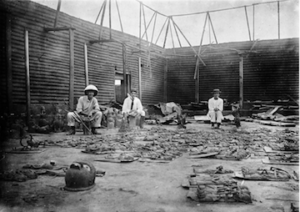
Palace of Benin, destroyed by fire. Photo 1897. Public domain.
There are still other issues having to do with transparency and museums’ obligations to tell the story behind the objects presented. It is well-known that many Benin artworks in Western collections were seized by British forces during their 1897 punitive raid on the Benin Kingdom. The raid followed the killing of members of a British-African diplomatic and trading mission the previous year, an expedition believed to have threatened a major royal festival involving large-scale human sacrifice. At the time, Benin’s rulers were important slave traders known for ritual killings in which the blood of victims was used to anoint royal bronzes. British accounts describe having to chip away thick layers of dried blood from these objects.
The Smithsonian Institution and other museums have framed the return of such bronzes as an act of reparative justice, restoring cultural heritage to Nigeria. The Restitution Study Group (RSG), representing descendants of enslaved Africans in the U.S. and led by attorney Deadria Farmer-Paellman, challenged the Smithsonian’s plan to return twenty-nine Benin bronzes.
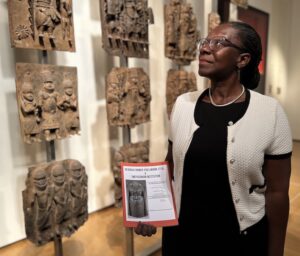
Deadria Farmer-Paellman at the British Museum, photo courtesy Mike Wells.
The RSG argued that as products of the slave trade, the bronzes also formed part of the heritage of descendants of slaves sold by Benin’s Obas, now resident in Brazil, the Caribbean, the UK and elsewhere and should remain accessible to them. They also argued that the history of the bronzes’ creation from the metal manilla currency of the slave trade would not be conveyed to the public if the bronzes were sent to Nigeria. RSG argued that Benin artifacts in the Smithsonian belong to the American people – Smithsonian not being a private museum – and that its trustees had no right to donate the Benin pieces to anyone without public consultation. The US Supreme Court declined to hear RSG’s challenge but RSG has not dropped its opposition.
In March 2022, the Smithsonian announced it would work with Nigeria’s National Commission for Museums and Monuments to repatriate its bronzes. In October 2022, it formally deaccessioned twenty-nine works and has since returned them to Nigeria.
However, some international and U.S. institutions took the concerns raised by the Restitution Study Group very seriously, rewriting accompanying didactic materials to acknowledge the role of the Benin rulers in the slave trade and the frequent practice of human sacrifice in royal ritual.
Archaeology and rediscovery

The excavation in progress at Benin City. Photo copyright: Caleb Folorunso et al. Courtesy MOWAA Archaeology Project.
Credit should be given to MOWAA for successfully taking on the task of presenting important works by contemporary and emerging West African artists; it is truly unfortunate that its worthy opening exhibition has been overshadowed by the protests.
MOWAA has also achieved notable success with its MOWAA Archaeology Project. The training, educational and excavation work by MOWAA and its collaborating institutions represents the most significant archaeological work in Benin City in over fifty years. More than sixty Nigerian archaeologists and technicians participated, a number of them receiving advanced training abroad. The excavations took place at two sites, the MOWAA Institute and the Rainforest Galley locations.
Using ground-penetrating radar, stratigraphic test-pit sampling, and open-area excavations, archaeologists and staff-in-training revealed 1.5–3 meters of cultural deposits dating from the first millennium AD to the post-independence era. Radiocarbon evidence indicated occupation of the area predating the rise of the Benin Kingdom, pushing the timeline of urban development back over 1,000 years.

Finds at MOWAA excavations. Photo copyright: Caleb Folorunso et al. Courtesy MOWAA Archaeology Project.
Discoveries included architectural features indicating large-sized buildings suitable for an urban elite, together with ritual shrines marked by pottery, chalk (nzu), and cowries and craft workshops associated with brass and bronze casting. Evidence of metalworking traditions were found including crucible fragments, lead slag, and copper-alloy residues dating between the 14th-17th centuries. Layers of burning associated with the 1897 invasion, a European cemetery, and remains of early colonial structures mapped the city’s traumatic transition into British rule.
Detailed analysis of metal contents from the excavation were not available, but information from other archaeological research has confirmed that the source of metal used to make the classic, early Benin bronzes is the same as that of the Portuguese period manilla bracelets exchanged for slaves by Benin rulers of the period.
Additional archaeological evidence tying the Benin bronzes to the West African slave trade

Two Okhapo variety of Manillas from Nigeria. Author Rosser1954, 11 April 2007, public domain.
In 2023, Tobias Skowronek, a geochemist at the Technical University of Georg Agricola in Bochum, Germany, published metallurgical analyses establishing this connection. A research team led by Skowronek analyzed a wide range of manillas dating from the fifteenth to nineteenth centuries that had been recovered from five shipwrecks and three land sites across West Africa, Western Europe, and the eastern coast of the United States. At least some of the shipwrecks that produced these manillas are believed to have been part of the Triangle Trade, in which manillas were traded for enslaved West Africans who were transported to the Americas, after which the ships returned to Europe with commodities such as sugar, cotton, and tobacco.
By examining the lead isotope ratios of specific manilla types, Skowronek’s team determined that the brass used in the type of manillas called tacoais was the same material used to produce the Benin Bronzes. The team also observed that the lead isotope ratios of the tacoais manillas closely matched those of lead-zinc ores mined in Germany’s Rhineland, and because brass smelting typically occurred close to zinc sources, they concluded that the tacoais manillas were manufactured in that region.
Skowronek argues that Edo metalsmiths recognized the superior qualities of tacoais manillas and likely insisted on receiving them in trade. These early Portuguese-traded manillas possessed a high-lead brass alloy that was easy to smelt and, due to its excellent flow properties when molten, was particularly well suited for crafting the Benin Bronzes.
2025 update on the management and custody of the Benin artifacts
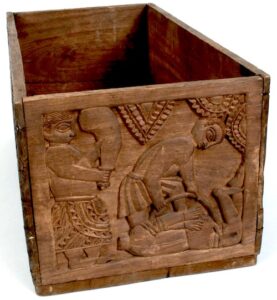
A scorched wooden box in MARKK Museum, Hamburg, showing the decapitation of a victim, with an executioner holding a severed head, one of relatively few wooden pieces to have survived the fire at Benin.
On 12 February 2025, a landmark agreement granted the Nigerian Commission on Museums and Monuments “full management authority” over repatriation, conservation, storage, and exhibition of returned Benin artifacts in coordination with the Oba of Benin as cultural owner. This arrangement formalized a joint state/royal custodianship, aligning federal oversight with traditional ownership claims of the royal court and addressing at least some of the concerns of both domestic and international institutions over Nigerian national government involvement in future repatriations. In some respects, this structure achieves an appropriate balance: international institutions expect to return cultural objects through government-to-government channels, yet political conditions in Nigeria can shift quickly and in unexpected ways.
Nigeria’s current President, Bola Ahmed Tinubu, has ordered the establishment of a Presidential Committee charged with creating a comprehensive framework for a lasting resolution. MOWAA, in turn, has issued a statement asserting that it has never claimed, nor implied, that it is the Benin Royal Museum for the purpose of obtaining funding. Both are skirting the issues.
The struggle over the future of the Benin Bronzes and their meaning, location, and interpretation has become a very visible microcosm of Nigeria’s broader contestations over heritage, authority, and postcolonial governance. The Benin Dialog Group set the stage for a museum to bring together collections from around the world and to enable both Nigerians and a global audience to see and appreciate Benin’s artistic greatness. However, competing museum visions, lineage politics, legal ambiguities, and the powerful cultural authority of the Oba continue to complicate its implementation. EMOWAA/MOWAA’s evolution from restitution-oriented museum to archaeological and contemporary art institution reflects both an adaptive strategy and ongoing uncertainty. The continuation of MOWAA as a trust under Nigerian and foreign partnership depends on maintaining a very delicate balance.
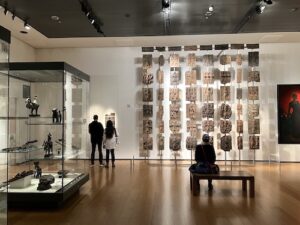
The British Museum’s display of Benin Bronze Plaques and Sculptures, photo courtesy Mike Wells.
The future use of the bronzes – as documents of human trafficking or objects valorizing royal dominance – or both – is by no means resolved. That the scheduled opening of MOWAA in November 2025 was halted is not a good sign. Nor is it good that demonstrators and government officials have accused the museum of corruption and of illegitimately positioning itself as the rightful home of repatriated artifacts. Nor is it a good sign that the Oba Ewuare II himself feels that the purpose of MOWAA and the original intent of its foreign donors was for it to be a Benin Royal Museum under his exclusive direction and control. These are not only dubious claims – they are not in any way useful as a way forward.
It is hoped that it will be possible to build a transparent custodial framework for the Benin bronzes already in Nigeria, to make the history of Benin an integral part of their presentation and to make them widely accessible to a global public. It is hoped that the Nigerian government, the Oba and his court, international museums, activists representing slave descendants, and MOWAA supporters will find many ways to work together in the future. It is important that they do or the museum’s key purpose, to enable a public dialog on an extraordinary heritage, will be lost.
RELATED READING

Screenshot of Bee TV coverage of November 5, 2025 protest against opening of MOWAA.
Key Issues in Return of Benin Artifacts, Cultural Property News, August 27, 2017
“Benin Dialogue Group: Building and Filling a New Museum in Benin” Cultural Property News, 10 Feb 2019
Press Statement of the Meeting of the Benin Dialogue Group, Wereldmuseum Amsterdam, 11 July 2019.
“Benin Bronzes | British Museum”
Where will Benin bronzes go? Nigerian government, Edo Museum or Oba?, Cultural Property News, October 4, 2022
Nick Merriman, Returning the Benin Bronzes: A Case Study of the Horniman’s restitution (Cham: Springer, 2024).
“MOWAA Archaeology Project (Benin City, Nigeria) | British Museum”
Nigeria Gives Benin Ruler Exclusive Ownership of Bronzes, Cultural Property News, April 26, 2023.
Tobias B. Skowronek, German brass for Benin Bronzes: Geochemical analysis insights into the early Atlantic trade, April 5, 2023
Brigitta Hauser-Schäublin, Return of Benin Bronzes: Why are the victims of slavery hushed up?, Cultural Property News, September 1, 2023
U.S. Supreme Court Denies Hearing to Restitution Study Group on Benin Bronzes, Cultural Property News, October 14, 2024
“Nigeria’s museum agrees with royal ruler on custody of Benin Bronzes” Reuters, 26 Feb 2025