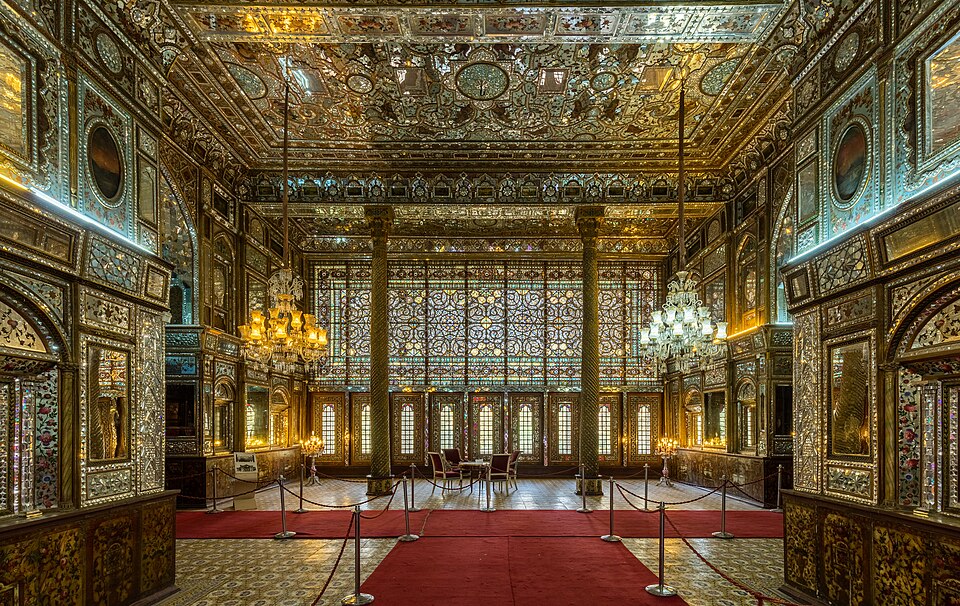
 Mirrored Mosaic interior walls of Golestan Palace, Tehran, Iran, 17 September 2016, Attribution: Diego Delso, CCA-SA 4.0 International license.
 The 2026 war on Iran has caused damage not only to military and state infrastructure, but also to a number of historically significant cultural and religious sites across the country. As reports from UNESCO, Iranian heritage authorities, and preservation experts accumulate, the conflict is raising questions about how modern warfare affects cultural heritage even when sites are not intentionally targeted.
War shatters everything, skylines, manuscripts, prayer halls, along with the memory of what was there before. In the 2026 war on Iran, U.S. and Israeli strikes have so far hit not only military and state targets; they have also damaged some of the most historically resonant places in the Iranian world.
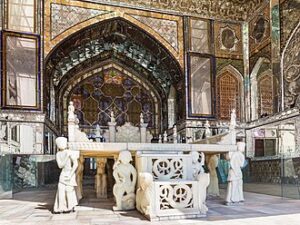
Marble throne in the Golestan Palace, Tehran, Iran, 17 September 2016, Attribution: Diego Delso, CCA-SA 4.0 International license.
An existential threat to Iranian/Persian heritage has been in the background for longer than most people are aware. In January 2020, when Iran responded with threats after a U.S. drone strike targeted and killed Iranian military commander Qasem Soleimani at Baghdad airport, Donald Trump threatened to target Iranian cultural sites if Americans were attacked in reprisal. He said that the U.S. had identified 52 Iranian sites – equal to the number of 52 American hostages taken in 1979. There was worldwide criticism for this open threat to commit war crimes, but Trump doubled down. “They’re allowed to use roadside bombs and blow up our people. And we’re not allowed to touch their cultural sites? It doesn’t work that way.”
Six years later, Trump’s rhetoric is more muted, and the U.S. and Israeli missiles and bombs may not have deliberately targeted cultural sites, but even so, collateral damage has already accounted for significant losses to historic and artistic heritage in Iran. UNESCO has publicly confirmed damage to several major sites, noting that it had supplied the geographic coordinates of World Heritage properties and nationally significant monuments to all parties in order to help prevent such harm. It reminded belligerents that cultural property is protected under international law, in particular under the 1954 Hague Convention and the 1972 World Heritage Convention.
Nonetheless, Iran’s Ministry of Cultural Heritage reportedly counted dozens of damaged sites in the first weeks, later rising above one hundred. Scholars, conservators, and archaeologists have warned that some losses could be irreversible.
No Apologies
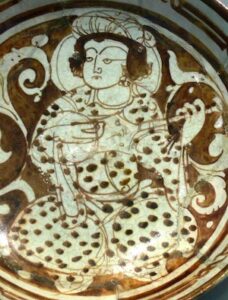
A 13th century lusterware ceramic bowl depicting a rabab player from Rayy in Iran, 5 April 2012, photo by Wolfgang Sauber, CCA-SA 3.0 unported license.
On March 2, 2026, questioned about noncombatant deaths and damage to civilian infrastructure, U.S. Defense Secretary Pete Hegseth defended the opening phase of the war, saying that the U.S. was operating with “no stupid rules of engagement.” Yet rules of engagement are the mechanism through which civilian and cultural protections are implemented in practice.
The Israel Defense Forces said in some cases it was “unfamiliar” with claims involving UNESCO sites, while in other cases it stated targets were Iranian military or command facilities and that heritage damage was collateral rather than intentional.
Iranian cultural heritage authorities say more than 130 historical sites have been damaged, while Iran’s Culture Ministry previously reported damage to at least 56 museums and monuments. UNESCO has confirmed damage to several major heritage locations and warned that some losses may be irreversible.
UNESCO currently recognizes 29 World Heritage Sites in Iran, including Golestan Palace, Masjed-e Jame of Isfahan, Naqsh-e Jahan Square, Persepolis, and the Historic City of Yazd. In addition, Iran has 57 sites on UNESCO’s Tentative List awaiting possible future inscription.
Golestan Palace, Tehran – Royal Memory
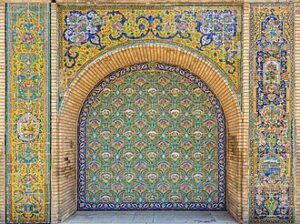
Exterior, Golestan Palace, Tehran, Iran, 17 September 2016, Attribution: Diego Delso, CCA-SA 4.0 International license.
Golestan Palace is Tehran’s great Qajar royal complex, a UNESCO World Heritage Site and one of the capital’s oldest surviving monumental ensembles. It is an intensely precious, layered, embellished and altogether over-the-top building. In Qajar art and architecture, more is always better; here there were pavilions, throne halls, gardens, painted ceilings, and famously dazzling mirror mosaics that fracture light into thousands of stars.
UNESCO reported that on March 2 the palace was damaged by debris and shockwaves from an airstrike in nearby Arg Square. AP described shattered mirrored ceilings, broken archways, blown-out windows, and glass carpeting the floors.
Within Iran, the symbolic injury was immense. Golestan is a place where coronations were held, diplomacy performed, where Western models were embraced and elaborated on.
Chehel Sotoun Palace, Isfahan – Reflected Beauty
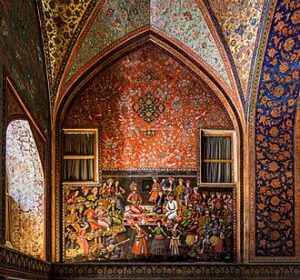
Shah Abbas I receives the Uzbek ruler Vali Muhammad Khan” painting in Chehel Sotoun Palace, Isfahan, Iran, photo by Amir Pashael, 29 September 2019, CCA-SA 4.0 Int’l license.
Chehel Sotoun Palace was commissioned by Shah Abbas II of the Safavid Dynasty in the early 17th century. The palace takes its name – “Forty Columns” – from the reflection of its twenty wooden columns in the long pool before it. Built in the Safavid golden age, it contains banquet halls with wall paintings depicting royal receptions, battles, and courtly life.
The palace is all about craftsmanship and elaborate, delicate surfaces that form an unending series of mosaics constructed from lacquer, wood, mirrors, and paint.
UNESCO verified damage here during strikes on Isfahan. Reports have described broken lattice windows, damaged ceilings, and vibration effects that may continue destabilizing the interior’s fragile fabric long after the blasts.
Masjid-e Jāme of Isfahan – Continuous Community
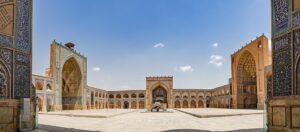
Jāme’ Mosque of Isfahān, also known as the Atiq Mosque. The mosque has reconstruction, additions and renovations from around 771 to the end of the 20th century. Photo Ninara, 15 May 2024, CCA 2.0 Generic license.
The Jame (Friday) Mosque of Isfahan is a monument of global importance – among the greatest mosques of the Islamic world. Every kingdom in the mosque’s thousand-year history has left its record in the mosque’s brick and tile construction and decoration: Abbasid foundations, Seljuk domes, Ilkhanid stucco, Timurid repairs, and Safavid embellishments. UNESCO has reported damage to both its structure and decorative elements from blast-waves in strikes in March.
Naqsh-e Jahan Square (Meidan Emam), Isfahan – Civic Grandeur
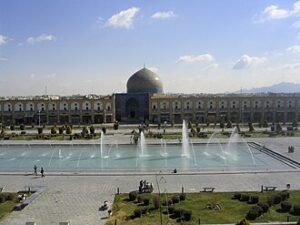
Naqsh-i Jahan Square, and Sheikh Lotf Allah Mosque, Isfahan, Iran, photo Meisam, 23 February 2007, CCA-SA 4.0 Int’l license.
Naqsh-e Jahan Square is one of the monumental urban spaces of the early modern world. Vast and geometric, it is bordered by mosques and bazaars. Reports from Iranian and heritage outlets said attacks affecting Isfahan also damaged structures around the square, including adjacent monuments. Once an emphatic assertion of the city’s commercial and administrative importance, its vulnerability shows how exposed city-centers and civilian infrastructure are to modern aerial war.
Falak-ol-Aflak Castle, Khorramabad – Endurance
Falak-ol-Aflak Castle rises above Khorramabad, a massive stone citadel on a steep hill. Often linked to the Sasanian era, the fortress dominates a mountain-ringed valley and later served many roles, including as prison and museum.
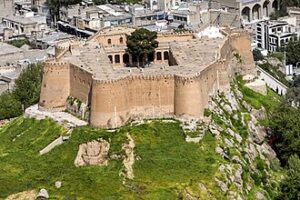
Falak ol Aflak Castle, Khoramabad, Luristan, Arosha-photo (Reza Sobhai), CCA-SA 4.0 Int’l license.
Thick walls, towers, and commanding views once served as defensive architecture; but stone forts cannot defend themselves from missiles. Reports indicated sections of walls have been damaged, its museum destroyed, and staff injured despite its Blue Shield cultural-protection markings.
Khorramabad Valley Prehistoric Sites – Antiquity
Khorramabad Valley contains caves and shelters preserving evidence of Middle and Upper Paleolithic occupation. UNESCO reporting damage to buildings near the protected zone. This is heritage of a different, much more ancient and human scale. Bombing has resulted in damage to our understanding of ancient development in the territory of Iran.
Rafi’-Nia Synagogue, Tehran – Shared Religious Space
This synagogue is of recent build but was nonetheless a home to a specific Jewish community. One of many synagogues in Tehran, Rafi’-Nia served members of the Khorasani Jewish community in Tehran. On April 7, it was reported completely destroyed in an Israeli strike on an adjacent target. Israeli authorities reportedly said the synagogue itself was not the intended target and expressed regret. Iranian Jewish representatives condemned the loss, including Torah scrolls reportedly trapped beneath rubble. Two persons were rescued from the collapsed building. Its destruction reminds the world that Iranian heritage is also Jewish heritage, and that Iran’s history survives in living communities, not only museums.
In sum
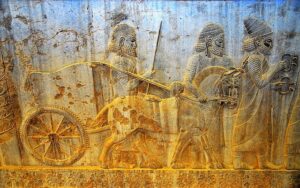
Relief in Persepolis, Iran, Author Pawel Ryszawa, 18 May 2015, CCA 3.0 Unported license.
The 2026 war has demonstrated a central fact of twenty-first century conflict: precision weapons do not guarantee precise outcomes. Shockwaves, debris, collapsing neighboring structures, and disregard for dense historic urban fabric can devastate heritage even when cultural landmarks are not the declared targets. Scholars warn that many of these losses — to architecture, archives, mosaics, manuscripts, and communal memory — may never be fully repaired.
UNESCO has warned again and again – but if leaders do not listen – then many more places worth preserving will disappear.