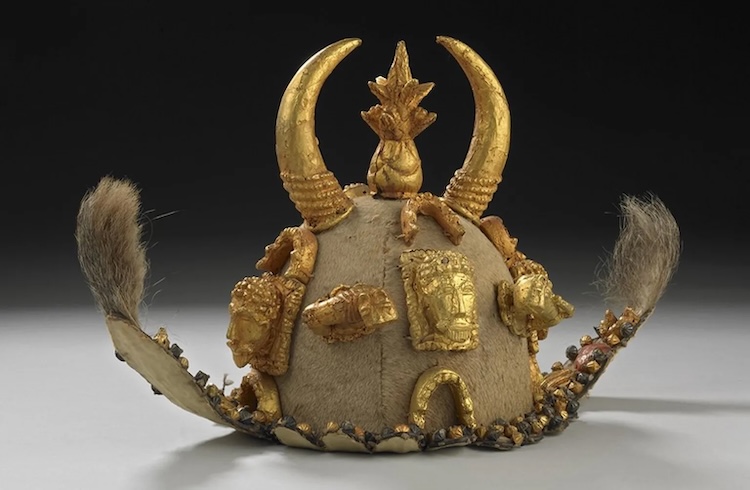
 A ceremonial cap worn by courtiers at coronations is among the items that loaned back to Ghana by The Trustees of the British Museum and The Victoria and Albert Museum.
 The proposed restitution of Asante-linked instruments from Los Angeles to Ghana exposes the limits of standard repatriation narratives, particularly when provenance is uncertain and human remains are involved. Rather than resolving historical injustice, the case highlights competing claims, ethical ambiguities, and the need for negotiated, context-specific outcomes.
Restitution: Asante objects, African claims

The Fowler Museum, UCLA, Los Angeles, 10 July 2008, photo by Fuzzy901, CCA-SA 3.0 Unported license. The Fowler Museum has never published or displayed the two instruments that include human skulls.
The proposed return of two West African musical instruments from Los Angeles to Ghana has been framed, predictably, as another step in the broader restitution movement. The objects – a drum and an ivory trumpet held by the Fowler Museum at UCLA – were reportedly taken by British troops in Kumasi during the late nineteenth-century Anglo-Asante campaigns. On paper, the case appears to fit a now-familiar template: colonial seizure, Western custody, then eventual return.
But that narrative is complicated by the objects’ sometimes uncertain history and by the fact that each of the instruments have human skulls attached. The trumpet has a male skull attached, with injuries indicating he died violently. The drum has a cranium identified as that of a woman attached. She may have been fifty years old and have died of old age. These human elements have been integral to the objects for at least a century, and possibly longer.
In this case, restitution is a not a straightforward matter or an obvious moral ‘correction’ to the past. The key questions are what exactly is being returned – and to whom.
The historical context: Asante power and British intervention

Umbrella finial made of wood covered with gold leaf and surmounted by five sankofa birds, 1800s. Purchased for the Museum in 1934 by the Trustees of the Christy Fund, it had previously been in the collection of Sir Cecil Armitage who had served in the 1895–6 and 1900 Anglo-Asante Wars. Armitage associated this piece with the Asantehene Prempeh I. Image courtesy of The Trustees of the British Museum. CC BY-NC-SA 4.0 license.
The Asante kingdom, centered in Kumasi, was one of the most powerful states in West Africa in the eighteenth and nineteenth centuries. Its political authority rested on both its military strength and on a rich material culture in which prestige items were important to ruling rituals. Gold regalia, swords, stools, drums and other objects were instruments of governance as well as symbols of wealth and power.
In 1874, British forces invaded Kumasi during the third Anglo-Asante war, looted the royal palace of Asantehene Kofi Karikari and destroyed it. Further incursions in 1896 and 1900 resulted in additional seizures of gold and luxury objects. These events are well documented: military reports, auction records and museum acquisition files provide a reasonably clear chain of removal for many objects.
The British military seized regalia and ritual items that symbolized the Ashante ruler’s authority. Some were sold as soon as troops arrived back in England; others entered institutional collections through later donation or purchase. The British Museum, the Victoria and Albert Museum, regimental collections, private collections and, eventually, institutions outside Britain such as Los Angeles’ Fowler Museum acquired objects taken at this time.
The Fowler instruments: provenance and ambiguity
The drum and trumpet in Los Angeles are thought to have been taken during the late nineteenth-century military operations in Kumasi, then sold in London in 1919and 1930 before being acquired by Henry Wellcome and later transferred to the Fowler in 1965. This provenance history is typical of many colonial-era objects: the military seized objects to offset the costs of expeditions, their actions justified under ‘laws of war’ at the time. The objects were later sold, circulated in a secondary market and finally acquired by museums through purchase or private donation.
The presence of human remains in the drum and trumpet assemblages raises additional questions about their return. Perhaps the greatest concern is whether the remains came from captured enemies, especially from communities that are now neighbors of the Ashante in Ghana.
Asante practices did include the display of enemy remains in certain contexts, particularly in warfare and ritual humiliation. Research on the trumpet suggests the skull belonged to a man who suffered a fatal blow from a sharp instrument. However, attaching a full skull to a trumpet is not widely seen in Asante material culture. Jawbones appear more commonly and carry symbolic meaning related to defeated enemies.
The drum’s cranium, when analyzed, unexpectedly turned out to be that of a woman. This raised immediate historical questions. The incorporation of a female skull on the drum was inconsistent with known Asante practices. In both cases, the inclusion of skulls could indicate that they was added in the late nineteenth or early twentieth century, possibly to increase the objects’ appeal to European collectors, giving them a sensational, ghoulish quality. If that case, the instruments are not truly Asante objects but hybrid artifacts – pastiches or actual fakes.
Restitution to whom?

Asante gold pendant (akrafokonmu) made using the lost-wax process. Presented to the Museum in 1818 by Thomas Bowdich following his visit to Kumasi on a diplomatic (trade) mission from Britain. Image courtesy of The Trustees of the British Museum. CC BY-NC-SA 4.0 license.
In 2024, the Fowler returned seven Asante objects without human remains to the Manhyia Palace Museum in Kumasi. But the presence of skulls introduces questions outside of the usual ‘national identity’ framework of repatriation. If the skulls belonged to individuals from communities conquered or fought by the Asante, then returning them to Asante custody places the remains of possible victims with the people historically associated with their defeat. Some Ghanaian observers have already noted that displaying such remains in Kumasi could be seen as insensitive or provocative, particularly if the individuals were from neighboring Akan groups.
Alternately, if the remains are of Asante individuals, the question then becomes – how should such remains be treated? Should they be displayed, concealed, buried or otherwise handled? Who has the authority to decide?
If the skulls were added after the objects left Africa, the remains may have no direct connection to the instruments’ original cultural context. This would complicate any claim based on cultural patrimony, while strengthening the case for treating the remains as human remains requiring separate ethical consideration.
In all these scenarios, the simple formula “return to source community” breaks down. There may be multiple relevant communities, with different and potentially conflicting interests.
The broader Asante restitution landscape
Other Asante objects held in Western collections raise additional questions. The famous Asante Ewer in the British Museum is actually a medieval English vessel, possibly associated with Richard II, that somehow reached Kumasi before being looted in 1896. Its manufacture is European, its later significance is Asante. Any restitution claim must decide which aspect carries more weight.

The Asante Jug, copper alloy; on the front of the spouted jug are the royal arms of England as used in the period 1340 to 1405, with a crown above and two lion supporters; Found/Acquired: Royal Palace (Kumase) (1895), Ghana: Asante, Image courtesy of The Trustees of the British Museum. CC BY-NC-SA 4.0 license.
The Aya Kese, a large brass basin now held by the UK’s National Army Museum, was probably made in northern Europe in the sixteenth century. It was likely an object of trade before it became part of the Asante royal mausoleum complex. British accounts described it as a vessel that held the blood of human sacrifices, a claim denied by Asante sources. There is disagreement over its ‘origin,’ use and interpretation.
These cases illustrate a broader point, that not all objects in African collections abroad are unambiguously African in origin or function. Some are products of long-distance exchange, appropriation and reinterpretation. Restitution claims based solely on place of manufacture or place of use can result in opposing positions.
The current patterns of returns of colonial period acquisitions reflects not only ethical considerations but also legal constraints. UK national museums are generally prohibited from deaccessioning objects, which has led to the widespread use of long-term loans as a workaround. In 2024, the British Museum and the Victoria and Albert Museum lent Asante objects to Kumasi for renewable three-year periods. This loan arrangement allows objects to be displayed in Ghana without requiring legislative change in the UK. It also may help to build institutional relationships beyond the shared custody of the objects. However, it does not resolve questions of ownership; from a legal perspective, the objects remain British cultural property.
United States institutions like the Fowler Museum in Los Angeles have greater flexibility to transfer ownership, enabling the museum to return seven less controversial Asante objects in 2024 based on the decision of its board. However, museums in the U.S. and elsewhere in the West have increasingly treated human remains as a category requiring special handling. Repatriation of ancestral remains has become standard practice in many contexts, particularly where clear descendant communities can be identified.
The Fowler instruments do not fit into this model. The remains are physically integrated into the drum and trumpet, the origin of the skulls and the instruments’ provenance is uncertain, and their cultural affiliation in dispute. Their construction may include both African and European subsequent interventions.
Restitution as policy, not outcome
Today’s tendency to present restitution as an inherently positive outcome obscures these complications. In practice, restitution is a policy tool, a political gesture, not a moral endpoint. Restitution may address historical injustices – primarily the removal of objects under coercive conditions – but it does not automatically resolve questions of ownership, interpretation or use.

This antelope skin gunbearer’s cap (krobonkye) is blackened on the outside and decorated with alternating strips of sheet silver and gold in the shape of leaves (aya). It was looted during the Anglo-Asante war of 1873–4 and possibly formed part of the indemnity payment extracted from the Asantehene Kofi KariKari by the Crown Agents for the Colonies through the Treaty of Fomena in 1874. The Museum purchased it in 1891 from the goldsmiths, Phillips Brothers & Son. Image courtesy of The Trustees of the British Museum. CC BY-NC-SA 4.0 license.
In some cases, restitution may simply relocate an object without clarifying its status. The suggestion that the Fowler instruments could move from storage in Los Angeles to storage in Accra illustrates this possibility. The geographical location changes, but the object remains inaccessible and its meaning unresolved.
In other cases, restitution may create new tensions. Returning objects to a national museum may sideline local or regional claims. Returning them to a traditional authority may raise questions about its representation within a modern state. Returning objects with contested histories may revive rather than settle disputes.
These possibilities raise an uncomfortable ethical issue: not all violence embedded in an African object was colonial violence, but colonial collecting often froze or amplified earlier violence. Restitution cannot pretend that precolonial African polities were morally simple, nor can it use that complexity to excuse imperial looting.
The most responsible path is likely to be negotiated rather than declaratory. Ghana’s ministry, the National Focal Team on Restitution and Repatriation, the Ghana Museums and Monuments Board, the Asantehene, neighboring communities and relevant religious or customary authorities all have claims to be heard. The final answer may involve return to Ghana without immediate public display. It might be held in joint custody; be restricted to ritual handling; or be buried as human remains. If they are displayed, how will they be described?
Comparative cases: Benin and Maqdala

Chalice, gold, seized from Maqdala, Ethiopia. According to a Victoria and Albert Museum exhibition didactic, “William Gladstone condemned the taking of treasures from Maqdala, particularly the gold crown and chalice, and ‘deeply lamented, for the sake of the country, and for the sake of all concerned, that these articles … were thought fit to be brought away by a British army.’ He urged that they ‘be held only until they could be restored.’” Courtesy Victoria and Albert Museum, London.
The better-known cases of the Benin Bronzes and the Maqdala treasures show similar dynamics, albeit with clearer lines of claim.
The Benin Bronzes, taken during the 1897 British expedition to Benin City, have been the focus of extensive restitution efforts. Their provenance is well documented, and their cultural affiliation is relatively clear. However, in recent years, descendants of enslaved peoples in countries around the world have raised claims related to the Benin ruler’s massive trade in human beings. The descendants of people who were sold for ‘manilas’ the copper bracelets from which the Benin bronzes were made, are demanding both a voice in their ownership and that the truth be told in their display. Even within Nigeria, sometimes violent disagreements persist over where returned objects should be housed – national museums, regional institutions or the Oba’s palace – and under what conditions.
The Maqdala material taken from Ethiopia by British forces in 1868 presents another variant in repatriation claims, including issues of the public’s right to access. Many of these objects are religious, which introduces additional constraints on display and handling. Some may not be deemed suitable for public exhibition at all, regardless of location.
The limits of resolution
The Fowler drum and trumpet bring these issues into sharper focus because they combine multiple layers of uncertainty: provenance, possible modification, cultural affiliation and the presence of human remains. Any eventual decision will likely involve a compromise. It may prioritize national over local claims, or vice versa. It may preserve the objects’ current form or alter it. It may favor certain types of display, storage or ritual treatment.
What is unlikely is a solution that satisfies all stakeholders or resolves all ethical questions. The expectation that restitution should produce such a satisfactory solution is unrealistic.
The history of Asante objects in Western collections is well established: military seizure, market circulation, then institutional acquisition. The case for returning at least some of these objects is supported by documented evidence of coercion and removal. But the Fowler instruments demonstrate that restitution is not a uniform process.
Treating restitution as an automatic good obscures these distinctions. It encourages a one-size-fits-all approach to cases that require detailed, object-specific analysis. A more rigorous approach would start with historical facts – how the object was made, used, and acquired – and proceed to consider the range of possible claimants and outcomes. In some cases, that process will support return. In others, not. In all cases, it requires acknowledging that restitution is not a final answer, but one stage in a longer and more complicated history.
Additional Reading
Stolen Goods vs Stolen Souls: Cambridge University Hands Over 116 Benin Bronzes to Oba, Mike Wells, February 10, 2026 Cultural Property News.
Protesters in Red Hats Invade… Benin’s MOWAA Museum, Kate Fitz Gibbon – November 14, 2025 Cultural Property News.
UK Charity Act Opens Door to Restitutions, CCP Staff – September 26, 2022 Cultural Property News.
Return of Benin Bronzes: Why are the victims of slavery hushed up?, Brigitta Hauser-Schäublin – September 1, 2023 Cultural Property News.