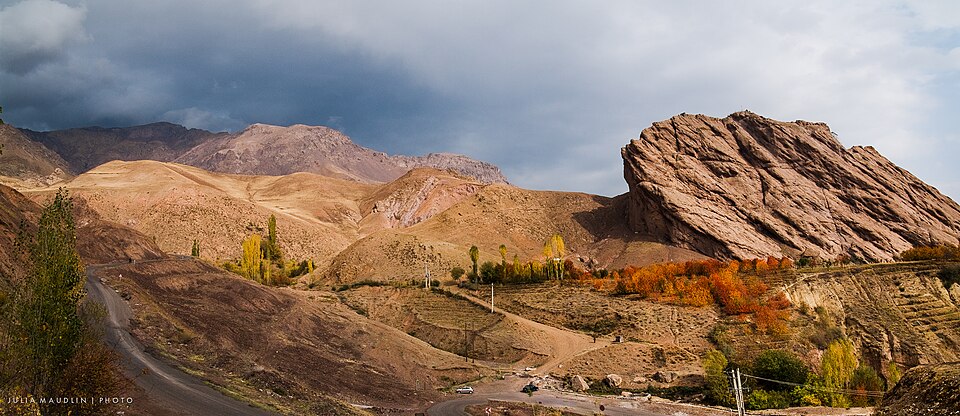
 Remains of Alamut Castle Clinging to a Crag Above the Valley of the Assassins, Iran. Photo Julia Maudlin, 22 October 2008, CCA 2.0 Generic license.
 New UNESCO World Heritage inscriptions in Lebanon, Palestine, and Iran recognize places of exceptional importance. They also expose the limits of international designation when heritage is threatened by war, disputed sovereignty, political symbolism and failures of domestic stewardship.

Roberts, David; The Ruins of Tyre, Lebanon; 1858, Sheffield Galleries and Museum Trust, public domain.
At the close of its 48th session in Busan, South Korea on July 29, 2026, UNESCO’s World Heritage Committee added sites in Lebanon, Palestine and Iran to the World Heritage List.
Lebanon’s Mount Amel Castles and Palestine’s Sebastia were inscribed under an emergency procedure and immediately placed on the List of World Heritage in Danger. The previously listed ancient city of Tyre, in Lebanon, was also moved to the Danger List. The emergency action reflected that armed conflict, development pressure, instability and limited institutional capacity are placing heritage at serious risk.
Iran’s Alamut Castle and related fortifications received a conventional World Heritage inscription and not a simultaneous danger designation despite the ongoing conflict with the U.S. and its prior specific threats to attack cultural heritage sites.
Taken together, the decisions demonstrate both the importance and ambiguity of UNESCO recognition. Listing can mobilize international attention and conservation assistance, but it can also provide governments with diplomatic prestige and symbolic claims to history without ensuring responsible stewardship.
Mt. Amel and Tyre: protection from war and neglect
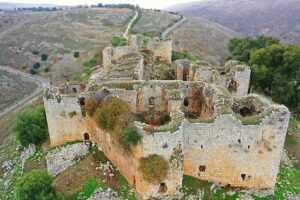
Dubieh (Doubay) Castle ruins near Chaqra, Nabatieh Governorate, Lebanon. 1 January 2020, photo Ibrahimamirnaeem, CCA-SA 4.0 International license.
The Mount Amel UNESCO designation consists of five castles in southern Lebanon: Beaufort, Toron, Dubieh, Maron and Chama’. Developed and repeatedly modified from the medieval period through the 19th century, they preserve evidence of Crusader, Ayyubid, Mamluk, and Ottoman rule.
Their significance lies in this accumulated history. They are not monuments belonging exclusively to one political or religious tradition, but parts of a landscape shaped by centuries of conflict and adaptation.
UNESCO placed the castles on the Danger List because continuing hostilities directly threaten their survival. Lebanese archaeological authorities reportedly cannot reach several of the sites, while others are close to military lines. The designation is therefore both a recognition of their historical importance and an emergency appeal.
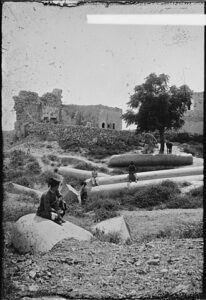
The ruins of the Crusader Cathedral, 12th century CE, where Holy Roman Emperor Frederick Barbarossa was supposedly buried, Southern Lebanese city of Tyre, Photo 1900-1920. Photo American Colony (Jerusalem) Photo Dept., public domain.
Tyre’s 380 acres World Heritage site, consisting of the Al-Bass zone, with a Roman necropolis, ancient arch and hippodrome – and its Al-Mina coastal and island zone, have been placed on UNESCO’s Danger list. Although the World Heritage site was not directly affected in a 2024 bombardment by Israel, Tyre’s visitor facilities, technical infrastructure, and administrative areas have all been impacted. The site’s ancient masonry and mosaic pavements require urgent documentation and conservation. An invitation to bid for restorative work at Ain Hiram and the DGA Seaside Complex was issued by UNESCO in January 2026.
Warfare is not the only threat to Lebanese heritage. Long before the present conflict, Lebanese archaeological sites and historic neighborhoods were being damaged by speculative construction and administrative incapacity.
In Beirut, archaeological discoveries made during postwar development have frequently disappeared into poorly documented storage, deteriorated or been bulldozed. Investigative reporting cited in an earlier Cultural Property News article found that fewer than ten of at least 120 archaeological discoveries recorded in the 1990s were accessible to the public. A major fifth-century BCE rock-cut site was destroyed for a luxury development that remained unfinished years later.
Ancient remains have also been reduced to decorative fragments within shopping centers, luxury buildings and parking facilities. Meanwhile, the Directorate General of Antiquities has operated with extremely limited staffing and resources. Archaeologists have reportedly feared professional consequences for speaking publicly about corruption and threatened sites.
See Lebanon in Chaos: Will US Sign Heritage Agreement?, Cultural Property News, September 8, 2024.
The massive 2020 Beirut port explosion of a facility containing tons of unsafely stored ammonium nitrate exposed the consequences of these institutional failures. In addition to killing at least 218 people and devastating historic districts, the blast tore down barriers around construction sites and revealed abandoned pits where archaeological remains had once stood.
Sebastia: archaeology and control of territory
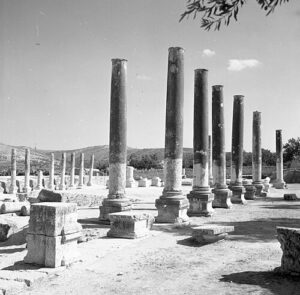
Sebastia, Photo Benno Rothenberg /Meitar Collection / National Library of Israel / The Pritzker Family National Photography Collection / CC BY 4.0
Sebastia, near Nablus in the West Bank, preserves an exceptional archaeological sequence. The site includes remains associated with ancient Samaria, followed by Hellenistic, Roman, Byzantine, Ayyubid, Mamluk and Ottoman occupation.
UNESCO identified a proposed land expropriation and the creation of an Israeli-administered national park as major threats. The project could divide the property and separate it from the surrounding Palestinian community. Palestinian officials view the inscription as protection against Israeli territorial and administrative control. Israel condemned the UNESCO decision, emphasizing Sebastia’s biblical identity and arguing that the organization was politicizing heritage and diminishing the Jewish connection to the site.
The disagreement illustrates how archaeology can become an instrument of sovereignty. Acknowledging the site’s association with ancient Israel does not invalidate its later histories or its relationship with the present Palestinian community. UNESCO’s decision cannot settle the arguments over control of the site, but it may make unilateral alteration more visible and strengthen demands that the full archaeological sequence be preserved.
Alamut: international prestige and historical complexity
Iran’s newly listed Alamūt property includes a network of mountain fortresses that served as political and intellectual centers of the Nizari Isma’ilis from the 11th through the 13th century.
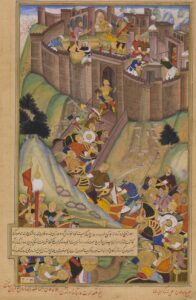
From a Chinghiz-nama Manuscript: Hulagu Khan Destroys the Fort at Alamut, artist Basawan (1560-1600), Nanda Gwaliori, circa 1596, public domain.
Alamūt occupies a powerful place in Iranian history, both as a center of political resistance and of religious independence. Established by Ḥasan Ṣabbāḥ in 1090 amid the decline of Fatimid power and the domination of the Sunni Saljuqs, it became the fortified center of the Nezārī Ismaʿili movement and sustained an autonomous Shiʿite community for 166 years. Its network of mountain strongholds showed the ability of a small, disciplined minority to resist far larger empires, while its secrecy and use of political assassinations generated fear and enduring legends of the “Hashishins” or “Order of Assassins” and the “Old Man of the Mountain.”
Yet Alamūt also had a renowned library, and notable astronomical facilities. Residence by the thirteenth century scientist, philosoper and mystic Naṣīr al-Dīn al-Ṭūsī made Alamūt a center of intellectual culture in a hostile political landscape. Its shifting doctrines also reflected the Ismaʿili effort to preserve identity through both open defiance and strategic concealment. Although the invading Mongols destroyed the state in 1256 and dispersed its population, Alamūt has remained in Iranian memory a symbol of intellectual refuge and resistance to centralized authority.
Iran’s delegation in Busan celebrated the inscription of Alamūt as a World Heritage site, made during the U.S.’ renewed military conflict. UNESCO recognition has offered the Iranian state an opportunity to project cultural continuity, scientific achievement and national resilience.
A place on the World Heritage List is an honor. Placement on the World Heritage in Danger List is a warning. In every case, designation is also a test of whether international recognition will produce genuine stewardship—or remain largely symbolic.