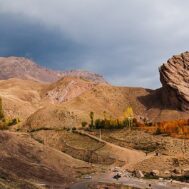
Some of Djulfa’s thousands of khachkars before their destruction, the majority of which were erected in the 16th century, © Argam Ayvazyan archives, 1970-1981, courtesy Djulfa.com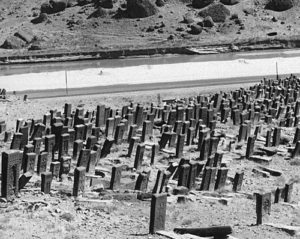
Photograph of khachkars from Djulfa, Nakhichevan, Azerbaijan by A. Ayvazyan. Before 19 December 2006. Now completely destroyed.
There is a Kafkaesque contradiction inherent in Azerbaijan’s November 10, 2025 election to UNESCO’s Intergovernmental Committee for Promoting the Return of Cultural Property to its Countries of Origin or its Restitution in Case of Illicit Appropriation (ICPRCP).
The appointment raises serious doubts about UNESCO’s credibility as a steward of impartial heritage protection. The appointment took place despite substantial evidence documenting the Government of Azerbaijan’s systematic destruction of Armenian cultural heritage in Nakhichevan and Nagorno-Karabakh territories since the late 20th century. Drawing on satellite photography and remote-sensing analysis, studies by Caucasus Heritage Watch and other observers have demonstrated how the Azerbaijani state has followed a deliberate policy of obliterating Armenian monuments.
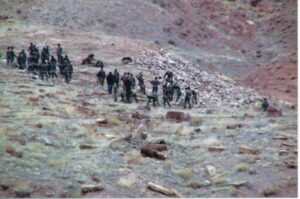
Azerbaijani soldiers destroying the Djulfa cemetery in December 2005. Courtesy Argam Ayvazyan.
Extensive scholarship and archival documentation show that in territories under Azerbaijani control, Armenian monasteries, churches, cemeteries, and carved khachkar stones, have been systematically vandalized by removing inscriptions, retooled as bogus “Albanian” churches, bulldozed, flattened and built over with mosques. A traditional culture a thousand years old has been erased.
At the same time, Azerbaijan has attempted to cultivate (though perhaps a better word is “buy”) a global reputation for cultural tolerance through strategic cultural diplomacy and financial influence within international institutions.
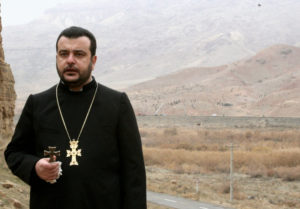
Northern Iran’s Armenian Prelate prays as Azerbaijani soldiers across the River Araxes destroy 2,000 medieval carved gravestones, khachkars. (courtesy Djulfa Virtual Memorial and Museum | Djulfa.com)
UNESCO’s willingness to accept Azerbaijan’s cultural diplomacy, and its money, is particularly shocking in light of European Parliament resolutions[1], provisional measures at the International Court of Justice[2], and Azerbaijan’s failure to fulfill the 2020 mandate to enable monitoring of endangered heritage set forth in the Declaration of the Committee for the Protection of Cultural Property in the Event of Armed Conflict of the Second Protocol to the Hague Convention of 1954.[3] UNESCO’s brazen action in appointing Azerbaijan to the ICPRCP reveals a structural vulnerability in the global heritage protection system. This vulnerability raises urgent questions about cultural erasure, soft power, and the political limits of international heritage governance.
Lost Armenian Heritage in Nakhichevan and Nagorno-Karabakh
“There are no Armenian graves in the territory of Nakhchivan. This is just an Armenian fabrication.” Azeri Parliamentarian Rafael Huseynov, 1/24/2008. [4]

Ayvazyan at the 12th-17th Century Church of St. Jacob (Hakob Hayrapet) in Paraka (Parağa),
and the location of the now-demolished church in a satellite image. Courtesy Argam Ayvazyan.
There is no question that the Armenian presence in Azerbaijan predates the modern nation-state by more than a millennium. Medieval monasteries such as St. Karapet in Abrakunis and the cemetery of Djulfa were renowned examples of Armenian ecclesiastical architecture and monumental stone carving traditions. Soviet-era ethnographic and cartographic surveys, including the field documentation of Argam Ayvazyan, recorded over one hundred Armenian religious sites in Nakhichevan alone.[5]
Nakhichevan’s Armenian population declined precipitously over the 20th century. Yet the monuments remained—until the post-Soviet period, when archival imagery and satellite analysis now demonstrate their systematic removal. Because Azerbaijan has denied foreign researchers access to heritage sites in Nakhichevan and post-2020 Karabakh, contemporary documentation relies on satellite imagery and analysis, pre-1990s photographic and architectural records, Soviet and Armenian ecclesiastical inventories, and post-war ground photography in the limited instances where it has been possible.
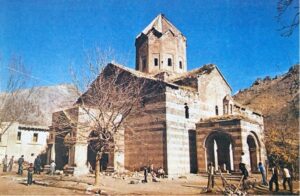
St. Thomas church, 4th-17th C., Upper Agulis (Yuxarı Əylis). Photo by Zaven Sargsyan, 1985. Courtesy Argam Ayvazyan.
Caucasus Heritage Watch’s 2022 monograph, Silent Erasure,[6] identifies 110 Armenian heritage sites in Nakhichevan from historical sources; by correlating those records with satellite data, the authors report that 108 of 110 sites had been destroyed by the late 2000s–2010s period. The two remaining undemolished locations are sites that the Azerbaijan government has determined to be Islamic/Azerbaijani. Not a single site identified by Azerbaijan as Armenian remains in Nakhichevan.
The cemetery at Djulfa, once home to thousands of intricately carved khachkars, is the most widely cited instance: incremental disappearance is visible in imagery from 1998 onward, including photographs of Azerbaijani military bulldozing the cemetery, culminating in its complete obliteration and subsequent reuse of the grounds as a firing range.

Location of St. Thomas church in Agulis indicated by a cross on a Soviet military map and a satellite image showing the new mosque built in its place. Courtesy Argam Ayvazyan.
In Nagorno-Karabakh (post-2020 war), Caucasus Heritage Watch and independent analysts reported damages and demolitions at Armenian sites, including the destruction of St. Sargis in Mokhrenes between March and July 2022, made even after the ICJ’s provisional measures.[7] While there were documented instances of Armenian forces damaging Azerbaijani homes and mosques during the conflict, the scholarly literature emphasizes the scale, directionality, and administrative character of erasure under Azerbaijani jurisdiction, which far exceeds sporadic wartime vandalism.
UNESCO has been informed of horrific destructive episodes since at least the early 2000s. Yet the organization has not enforced effective monitoring or accountability in situ. Even a direct request in 2011 by U.S. Ambassador Matthew Bryza to visit the Julfa cemetery was denied by the Azerbaijan government.
A Cozy Relationship between Azerbaijan and UNESCO

Mosque built on the site of the demolished St. Thomas monastery in 2014. Courtesy Argam Ayvazyan.
Thanks in part to a major publicity effort aimed at deflecting accusations of corruption and money-laundering by the Aliyev regime, the destruction of Armenian Christian culture in Azerbaijan has gone largely unnoticed in the UK, Europe, and the US.
In the 2010s, Azerbaijan invested in cultural diplomacy, including financial contributions to UNESCO and high-profile hosting of UNESCO events (for example, the World Heritage Committee in Baku, 2019). International reporting including a major investigation by The Guardian on the “Azerbaijani Laundromat”) has described broader lobbying campaigns in European cultural and political circles. Although individual allegations do not by themselves establish causality for UNESCO decision-making, they underscore a structural risk: when intergovernmental heritage organizations depend on member-state patronage, states can translate soft-power investments into reputational benefits, even amid documented domestic violations.
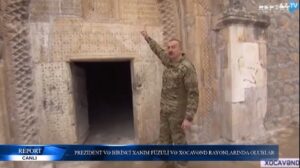
Screenshot of President of Azerbaijan, Ilham Aliev, during a visit to Nagorno-Karabakh in March 2021. He points to an Armenian inscription on a 12-17th century church in Tsakuri/Hunerli village and calls it fake. He says the church is “our ancient historical monument“ and promises to restore the “ancient Albanian temple.” The oldest inscription from this church is on a khachkar dated 1198 (ՈԽԷ in Armenian numerals). The inscription on the tympanum says “…I [Vardapet (abbot) Hakob] reconstructed the former church… in 1682.”
According to The Guardian:
“…the Azerbaijani leadership… made more than 16,000 covert payments from 2012 to 2014. Some of this money went to politicians and journalists, as part of an international lobbying operation to deflect criticism of Azerbaijan’s president, Ilham Aliyev… It arrived via a disguised route.”[9]
One recipient was Bulgarian consultant Kalin Mitrev, who received “at least €425,000 for private consulting work from a local Azeri company, Avuar Co.”[10] Mitrev said the payments were for legitimate consultancy. The Guardian article also noted that this raised questions for Mitrev’s wife, UNESCO Director-General Irina Bokova. Mitrev objected strongly to The Guardian’s report, asserting the payments were proper. A detailed overview of Azerbaijan’s lobbying efforts appears in the European Stability Initiative’s 2016 study The European Swamp.[11]
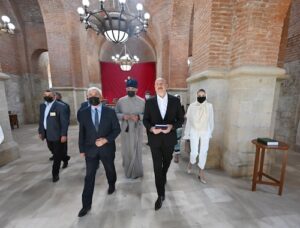
Azerbaijan President Ilham Aliyev visits ‘Albanian’ Church of Blessed Virgin Mary in Nij settlement, Gabala. Photo azertag.az.
The exhibition Azerbaijan – A Land of Tolerance,[12] opened on October 22, 2013 at UNESCO headquarters in Paris, four months after Azerbaijan donated $5 million to UNESCO, partly offsetting U.S. funding cuts. Bokova hosted the exhibition, which was organized by the Heydar Aliyev Foundation.
Bokova later facilitated Azerbaijani participation in the UNESCO Leaders Forum, where President Ilham Aliyev promoted his vision of “multiculturalism,” and she made several trips to Azerbaijan for UNESCO’s World Forum on Intercultural Dialogue.
Azerbaijan’s First Vice-President Mehriban Aliyeva, President Aliyev’s wife, met with Bokova during the 2017 Baku World Forum on Intercultural Dialogue. Earlier, in 2010, Bokova awarded Mehriban Aliyeva the UNESCO Mozart Medal.

Irina Bokova presents Alieva the UNESCO Mozart Medal.
The Aliyev government aggressively markets itself as a champion of cultural preservation, often with UNESCO’s cooperation. International support for the Aliyevs has also come from the Russian Orthodox Church and the Vatican.
(Notably, six years after major destruction of Orthodox monuments in Azerbaijan, the Heydar Aliyev Foundation funded restoration of the Roman catacombs of Saints Marcellinus and Peter in Rome.)
State Narratives and the “Caucasian Albanian” Reattribution

Azerbaijan’s First Vice-President Mehriban Aliyeva meeting with UNESCO Director General Irina Bokova on the sidelines of the Baku-hosted 4th World Forum on Intercultural Dialogue. 05 may 2017, source Office of the President of the Republic of Azerbaijan, Ilham Aliev.
Azerbaijani state historiography has advanced a reattribution scheme positing that medieval churches in these regions are not Armenian but “Caucasian Albanian” monuments later “corrupted” by Armenian inscriptions. Outside Azerbaijan, scholars view this as a politicized revision used to deny Armenian history in situ. The Azerbaijan government acknowledges removing what it calls “faked” Armenian inscriptions and presenting renovated structures as “Albanian temples.” This new narrative appears in textbooks, museum displays, and cultural programming – even in reprinted history books by U.S. and European scholars with the Azerbaijan government’s insertions of new passages legitimizing the Caucasian Albanian theory.
Conclusion
Cultural erasure of Armenian history by Azerbaijan has functioned as a strategy of territorial legitimation. In parallel, Azerbaijan has pursued soft-power cultural diplomacy, including UNESCO engagement and financial patronage, to gain legitimacy as a heritage guardian. UNESCO’s inability to secure monitoring access in 2020–2025 and its acceptance of Azerbaijan’s election to the ICPRCP highlight the structural vulnerabilities in current global heritage governance.

Argam Ayvazyan next to a 14th-century khachkar in Nors (today Nursu), near his birthplace (© Argam Ayvazyan archives, 1970-1981) (courtesy Djulfa Virtual Memorial and Museum | Djulfa.com)
The pattern of destruction documented in Nakhichevan since the 1990s and the post-2020 damage in Nagorno-Karabakh shows Azerbaijan’s sustained, policy-level approach to eliminating material traces of Armenian presence. UNESCO’s procedural neutrality and susceptibility to state diplomacy have allowed a state implicated in cultural erasure to obtain moral authority within a restitution body. This outcome undermines the public trust in UNESCO’s global heritage governance.
The destruction, appropriation, or falsification of cultural heritage is not merely a byproduct of conflict; it is often a deliberate instrument of political power. Cultural heritage marks the land, asserts collective memory, and defines belonging. For this reason, cultural monuments are especially vulnerable in contested territories. The irony of Azerbaijan’s appointment to UNESCO’s ICPRCP for the 2025–2029 term is immediately evident.
Azerbaijan’s election represents not simply a contradiction but a deep crisis in the legitimacy of UNESCO’s cultural governance. The problem is not solely one of oversight failure; it is structural. International heritage institutions cannot retain moral authority or credibility when they are susceptible to state-led cultural diplomacy and financial influence. Nor can they truly protect cultural property.
Related Reading
Argam Ayvazyan: Spy–Researcher For Nakhichevan Armenian Culture
Caucasus Heritage Watch: Azerbaijan is Destroying Armenian Heritage

Khachkars in the Djulfa cemetery, before 19 December 2006. Francis Rawdon Chesney, The Expedition for the Survey of the Rivers Euphrates and Tigris, 1850 [543], Wikimedia Commons.
Notes
[1] Recent European Parliament resolutions condemn human rights violations in Azerbaijan, call for the immediate release of political prisoners and Armenian detainees, and urge for an end to repression against the media and civil society. They also call for conditional future EU-Azerbaijan partnerships based on human rights improvements and a peace deal with Armenia, and support sanctions against Azerbaijani officials responsible for violations. Recent resolutions have also requested an investigation into the forced displacement of Armenians from Nagorno-Karabakh by the International Criminal Court. See: Human rights breaches in Thailand, Sudan and Azerbaijan. https://www.europarl.europa.eu/news/en/press-room/20250310IPR27234/human-rights-breaches-in-thailand-sudan-and-azerbaijan. See also: European Parliament, Resolution of 10 March 2022 on the destruction of cultural heritage in Nagorno-Karabakh (2022/2582(RSP)).
[2] Azerbaijan has been involved in cases at the International Court of Justice (ICJ) against Armenia since September 2021, both initiating its own case and being sued by Armenia. These cases, which both sides brought under the International Convention on the Elimination of All Forms of Racial Discrimination (CERD), allege systemic racial discrimination against each other’s ethnic groups. On November 12, 2024, the ICJ ruled that both cases can proceed, dismissing many preliminary objections raised by both parties. International Court of Justice, Summary of the Judgment of 12, November 2024, https://www.icj-cij.org/node/204327.
[3] Declaration of the Committee for the Protection of Cultural Property in the Event of Armed Conflict of the Second Protocol to The Hague Convention of 1954 for the Protection of Cultural Property in the Event of Armed Conflict – ensuring cultural property protection in and around Nagorno-Karabakh and setting-up an independent technical mission, Committee for the Protection of Cultural Property in the Event of Armed Conflict, 15th, Paris, 2020, https://unesdoc.unesco.org/ark:/48223/pf0000380348.
[4] Azerbaijani Parliamentarian Gives Convincing Response to Armenian MP’s Groundless Accusations, Azerbaijan State News Agency, 1/24/2008.
[5] Andran Abramian, (Interview with) Argam Ayvayan: Spy-Researcher for Nakhichevan Armenian Culture, Cultural Property News, March 27, 2021. https://culturalpropertynews.org/argam-ayvazyan-spy-researcher-for-nakhichevan-armenian-culture/
[6] Lori Khatchadourian, Adam T. Smith, et al., Silent Erasure: A Satellite Investigation of the Destruction of Armenian Cultural Heritage in Nakhchivan, Azerbaijan (Caucasus Heritage Watch, 2022).
[7] Caucasus Heritage Watch, Nagorno-Karabakh Monitoring Reports (2021–2022), including documentation of St. Sargis (Mokhrenes) destruction between March–July 2022.
[8] Luke Harding, Caelainn Barr and Dina Nagapetyants, “UK at centre of secret $3bn Azerbaijani money laundering and lobbying scheme” The Guardian, 4 September 2017, https://www.theguardian.com/world/2017/sep/04/uk-at-centre-of-secret-3bn-azerbaijani-money-laundering-and-lobbying-scheme
[9] Id.
[10] Id.
[11] European Stability Initiative, The European Swamp – Caviar Diplomacy, Part 2, Prosecutors, corruption and the Council of Europe, 17 December 2016, https://www.esiweb.org/pdf/ESI%20-%20The%20Swamp%20-%20Caviar%20Diplomacy%20Part%20two%20-%2017%20December%202016.pdf
[12] Photo exhibition “Azerbaijan – A Land of Tolerance” at UNESCO, Heydar Aliev Foundation, https://heydar-aliyev-foundation.org/en/content/view/139/2938/Photo-exhibition-%E2%80%9CAzerbaijan-%E2%80%93-A-Land-of-Tolerance%E2%80%9D-at-UNESCO.