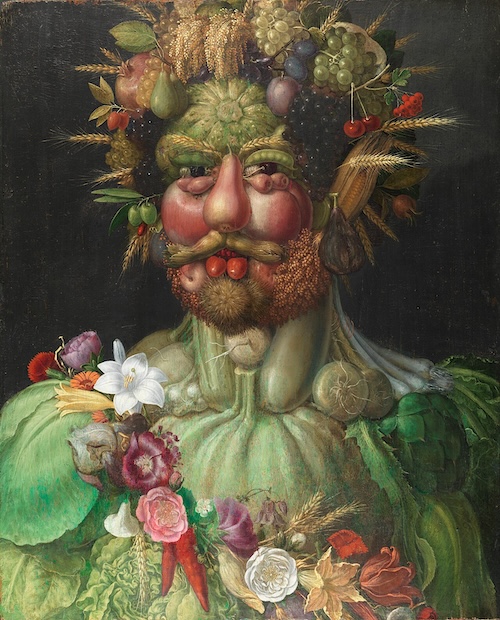
 Giuseppe Arcimboldo, Rudolf II of Habsburg as Vertumnus, Roman god of the seasons, growth, plants and fruit, 1590, public domain.
 Italy’s push for “food sovereignty” under Giorgia Meloni’s government turns cuisine into a strategic tool involving identity, economics, and geopolitics, while clashing with the messy reality that Italian food has always been hybrid and today is dependent on migrant labor. With UNESCO recognition elevating Italian cuisine as global intangible heritage, the politics of “authenticity” expose how easily culture-war purity collides with history… and life as we know it.
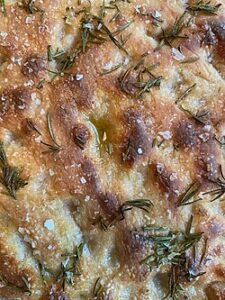
Rosemary, sea salt and olive oil on top of the crust of sourdough focaccia, 6 September 2020, photo Fred Berenson, CCA-SA 4.0 International license.
When Italy’s right wing government renamed the agriculture ministry to include “sovranità alimentare,” it wasn’t just a bureaucratic press ploy. It signaled that food would be treated as a strategic domain: cultural, economic, even geopolitical.
The idea is that a nation should be able to choose its own food-production system: privileging quality, local production, “natural” sustainability and the Mediterranean diet, while resisting global standardization and novel industrial foods such as lab-grown meat or insect-based flours. (If you aren’t familiar with mealworm and cricket-flour, look them up!)
But Italy’s most exportable image – its fabulous cooking – was never the product of purity. Italian cuisine has a long history of borrowing and remixing. Even as the state elevates food as a marker of identity, much of the farming sector relies on migrant labor at the very moment that national politics is often defined by hostility to immigration. And the language of “food sovereignty,” originally associated with farmers’ movements, ends up linking Italy’s right-wing government to some of its most radical critics, who also argue that food cannot be separated from land, ecosystems, and community control. Even the “purists” are stuck when industrial demand exceeds domestic supply, as with certain wheat used for pasta.
UNESCO world heritage status for Italian cuisine.

Food in Mercato Centrale, Florence, 12 May 2010, photo Brian & Jaclyn Drum, CCA 2.0 Generic license.
The stakes for “food sovereignty” rose sharply once UNESCO recognition entered the picture. France set an important precedent when the “gastronomic meal of the French” was placed on UNESCO’s list of intangible cultural heritage in 2010. The listing of a “festive meal bringing people together” was one of the first times food was treated globally as heritage rather than mere consumption. The French artisanal baguette followed in 2023.
The December 2025 inclusion of the whole of Italian cuisine as an ‘intangible heritage of humanity’ was a first. Listed by UNESCO, Italian cuisine is redefined as a global cultural asset: not just a collection of recipes, but a “biocultural diversity” of raw materials, artisanal techniques, local knowledge and intergenerational practice.
That kind of recognition carries obvious potential upsides, like tourism, branding, and prestige. Yet it also invites politics to the table. If cuisine becomes heritage, the state is tempted to act like a curator drawing borders between authentic and fake, tradition and contamination, legitimate variation and “culinary crime.” UNESCO’s language may emphasize living culture, but domestic political incentives often push toward fixed rules, symbolic enforcement and dramatic culture-war signaling, like the outrage of Italy’s government when the UNESCO gift shop itself sold jars of carbonara pre-made with atypical ingredients – in Belgium.
Since the 1990s, a rise in national-identity politics surrounding food.

Shop window of an Italian delicatessen in Rome, showcasing a wide variety of prepared foods and traditional Italian products. 12 February 2024, photo Wilfredor, CC0 1.0 Universal Public Domain Dedication.
In the mid-1990s, national- identity politics became a key arena for “who we are,” because it’s emotional (like Mom and apple pie in the USA) and easily mobilized. When McDonald’s arrived in Italy in the 1980s, there were protests when an outlet opened near the Spanish Steps. American fast food threatened Italian tradition; Italians resisted; tradition was saved.
In Italy, these protests matured into what political scientists call gastronationalism: the use of food and its production to fuel an identity narrative. On Italy’s right, it revolves around two claims: Italian food must be protected from foreign contamination and “Italian” recipes should be treated as sacred, unchangeable texts. Cream in carbonara or pineapple on pizza are practically criminal, so that culinary choices become proxy battles over belonging and national dignity. But there are inherent contradictions: Italy’s culinary reputation was built on regional differences and constant reinvention.
In fact, much Italian food traveled to the U.S. with immigrants and returned to Italy transformed and invigorated.

Malai Paneer Pizza from India, 3 June 2015, photo Barthateslisa, CCA-SA 4.0 International license.
One of the most destabilizing facts for gastronationalists is also one of the most historically plausible: Italian cuisine was not only exported by the diaspora; it was partly produced by the diaspora. Migrants carried regional traditions to the United States, adapted them to new ingredients, new tastes and new forms of commercial life, and then those adaptations circulated back. A similar process in which recipes spread via the Internet rather than immigrants, can now be seen in foods like Indian Malai Paneer Pizza.
Originally, pizza’s global rise was inseparable from Little Italy in New York City, the commercial slice, the toppings, and pizza’s subsequent influence on Italian pizzaioli. Carbonara’s contested origin story similarly reveals how quickly “tradition” can harden even when documentary history is messy. Foreign influence is not a pollutant; it’s one of the engines that made Italian cuisine globally beloved in the first place.
Food as “soft power” to build national prestige
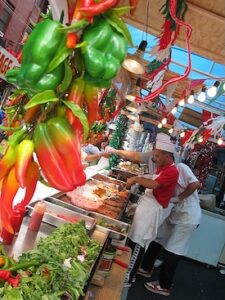
Street vendors at the annual Feast of San Gennaro in Little Italy, New York City. Sept 8 2004, photo Dschwen. CCA -SA 3.0 Unported license.
Italy’s cuisine is powerful enough to function as a global language: pleasure and prestige rolled into one. Food, like art, is an ambassador. That is why it’s tempting for governments to turn it into a political instrument. But the more food is used as a badge of purity, the more its real, hybrid history pushes back. And the more loudly “authenticity” is demanded, the more urgent it is to consider its ethical components: truth in labeling, transparency in sourcing, acknowledgement for workers, and an honest assessment that what makes Italian food “Italian” is its living capacity to change.
FURTHER READING:
Carlo, Andrea, How the Italian right is weaponizing food, Politico, January 6, 2026.