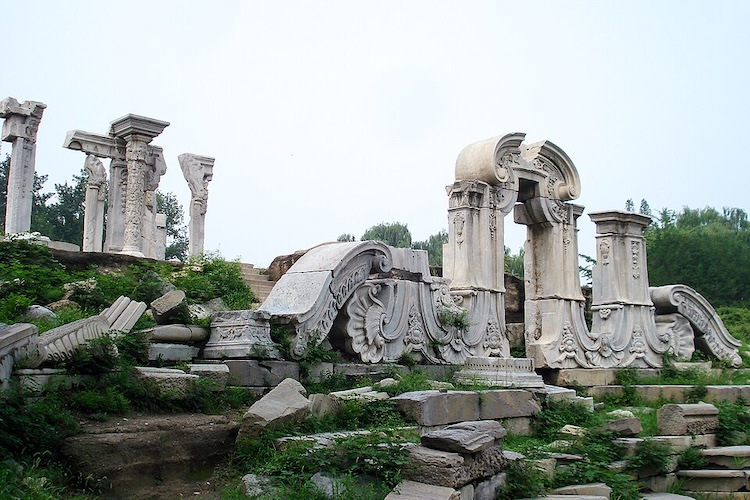
 Remains of the Old Summer Palace, photo Windmemories, 31 July 2009, CCA-SA 4.0 International license.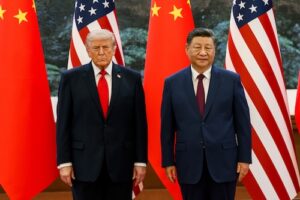
US President Donald Trump meets with PRC President and CCP General Secretary Xi Jinping in Beijing. 13 May 2026. White House photo.
President Donald Trump’s recent visit to China was supposed to be focused on trade relations – a subject tied closely to Chinese President Xi Jinping’s framing of Communist Party rule as the force that “ended national humiliation.” Whether President Trump knew it or not, trade relations in China aren’t ever just about current manufacturing or tariffs but include far older resentments going back to the Opium Wars with Britain.
Much of Xi Jinping’s “Chinese Dream” propaganda mixes awareness of past ‘colonial’ wrongs with a heavy dose of rejuvenation – celebrating advanced technology, aggressive foreign policy, a dominant Han cultural heritage and heightened nationalism.
Under Xi Jinping, reminders of the “Century of Humiliation,” the long narrative through which the Chinese Communist Party frames Western interaction with China, have been focused on unequal treaties, foreign incursions, and times of great tension with Western powers. For the Chinese people, this theme is a key part of patriotic education from grade school on. In the operation of government, it impacts foreign policy, technical competition, and importantly, cultural restitution claims.
Nanjing Museum scandal prompts inventory of National Museums
In recent news, a December 2025 scandal at the Nanjing Museum sharply undercuts the simplistic characterization of China’s reiterated claims about “stolen” cultural heritage abroad. At precisely the moment Beijing is intensifying nationalist claims for the return of allegedly looted relics from Western museums, one of China’s own premier state museums stands accused of internally laundering, mislabeling, and selling national treasures through domestic channels.
According to former museum employee Guo Lidian, authentic works may have been deliberately reclassified as fakes by the museum’s former director, transferred to provincial relic stores, and then resold privately inside China and overseas. He further alleged that sealed wartime Palace Museum caches containing more than 100,000 treasures were improperly opened and exploited. If true, this would represent not foreign imperial plunder but systematic internal corruption within institutions specifically charged with preserving Chinese art and culture.
The case fits a pattern already visible in earlier scandals involving library manuscripts (both inside China and a U.S. theft destined for sale in China), of insider thefts and illicit domestic sales. The Art Newspaper earlier documented how stolen manuscripts and antiquities repeatedly surfaced within Chinese auction houses despite formal due diligence systems. One notorious case involved manuscripts stolen from the Sichuan Provincial Library that circulated through the domestic Chinese market for years under false identities before discovery.
One result of the Nanjing scandal is that in April 2026, Beijing ordered a national inventory of state museum collections.
‘Stolen’ Chinese cultural property

General Chiang Kai Shek, President of Nationalist China and party visit USS Wasp (CVA 18). Vice Admiral A.M. Pride, USN, General Shek, and Ambassador to China, Karl L. Rankin, converse as they watch operations. Wasp is off Formosa, January 9, 1954. National Museum of the U.S. Navy.
At a time when U.S. promised protections for Taiwan appear increasingly flimsy, it is worth noting that cultural heritage claims are also being used in anti-Taiwan propaganda today. In the official view of Peoples Republic of China, Taiwan is seen as holding Chinese national treasures hostage as the core of its National Palace Museum.
The 1930s split between the People’s Republic of China (PRC) and the Republic of China (ROC) in Taiwan also divided the vast imperial art collection of the Qing emperors kept in Beijing’s Forbidden City.
In 1925, the Nationalist government led by Chiang Kai-shek turned the Forbidden City into the National Palace Museum. Soon afterward, China was plunged into war, first against Japan and then in a civil war between the Nationalists and the Communists. To protect the imperial treasures from being captured or destroyed, officials repeatedly moved them across China over a period of about fifteen years.
The collection was taken to Nanjing, the Nationalist capital, and then moved farther inland as Japanese forces advanced. After World War II, many treasures were returned to Beijing and Nanjing. But by 1948-49, Communist forces under Mao Zedong were close to defeating the Nationalists. Fearing the collection would fall into Communist hands, the Nationalist government decided to send many of the most valuable objects to Taiwan.
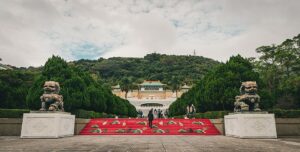
Taiwan’s National Palace Museum, 7 January 2023, photo Ji Soo Song, CCA 2.0 Generic license.
Only three of five planned shipments actually reached Taiwan – about one fifth of the collection was moved out of Beijing – but they included many of the finest artworks and imperial treasures. As a result, today there are effectively two major “Palace Museums”: the National Palace Museum in Taipei and the Palace Museum in Beijing’s Forbidden City.
This narrative meshes with the PRC’s claim that Taiwan itself is ‘stolen’ Chinese property. The story forms an important part of Chinese education today, including in Hong Kong, where the Guardian reported in 2024 that mandatory curriculum changes centered on Xi Jinping Thought and patriotic education.
Summer Palace Looting Redux
Revelations of internal corruption are definitely not found in museum narratives at sites such as the Yuanming Yuan or Old Summer Palace ruins, the National Museum of China, and “patriotic education” campaigns. Among the most emotionally powerful symbols in modern China’s historical narrative is the destruction of the Emperor’s Summer Palace, the Yuanming Yuan, by Anglo-French troops in 1860. Yet the modern political use of that event rests on deliberate omissions from its history.
The selective retelling of the story today has lost none of the emotional impact for many people in China. For years Chinese state media and sympathetic commentators have claimed that millions of “stolen” Chinese artifacts from the Summer Palace remain in foreign museums and private collections, often implying that entire institutional holdings were looted outright by imperial armies. The numbers vary wildly. One oft-repeated figure asserted that 1.64 million stolen Chinese antiquities reside in 200 museums in 47 countries. Later claims expanded the supposed total to ten million overseas objects. Writing in the South China Morning Post, Peter Neville-Hadley noted that these statistics were frequently attributed to a nonexistent UNESCO study and that the British Museum – accused in Chinese media of holding 230,000 looted Summer Palace items — estimated that perhaps fifteen objects in its collection might plausibly derive from the Yuanming Yuan.
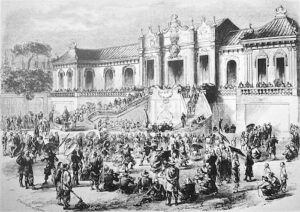
Godefroy Durand, Looting of the Yuan Ming Yuan by Anglo French forces in 1860, L’Illustration, 22 December 1860, public domain.
Also missing from official Chinese narratives is the immediate cause of the destruction itself. The looting and burning of the Summer Palace was not a riot of vandalism detached from military events. It followed the capture, torture, and murder of British and French emissaries and journalists who had entered negotiations with Chinese rulers under a flag of truce. Henry Loch, secretary to Lord Elgin, who led the British forces, survived imprisonment and torture; eighteen members of the diplomatic party did not. Their mutilated bodies were later recovered, causing outrage among the allied French and British. However, even Chinese accounts that dwell extensively on the looting routinely omit these killings altogether. The destruction of the Summer Palace was ordered as a reprisal directed not at ordinary Chinese citizens but at the Qing imperial court.
Nor was the looting itself exclusively Western. Eyewitnesses described extensive participation by Chinese laborers, local opportunists, merchants, and intermediaries. Loot moved rapidly into Chinese commercial channels. French troops (who got there first) sold clocks and decorative objects to British soldiers; palace items and non-palace items were immediately mixed together in Beijing, Canton, and Hong Kong markets. Chinese traders willingly bought objects from departing French soldiers. The French packed select items for Napoleon III, but enormous quantities of material were dispersed through ordinary market mechanisms inside China itself.
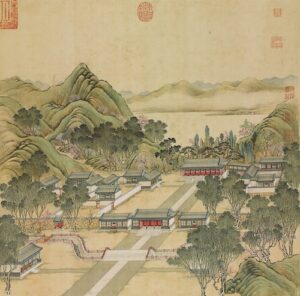
Hall of Rectitude and Honor, Zhengda Guangming, The Main Audience Hall, built to receive high officials or foreign guests, courtesy Shen Yuan, Tangdai, Wang Youdun, added 20 December 2011, CCA-SA 3.0 unported license.
This distinction matters because modern Chinese rhetoric often collapses every Chinese artwork abroad into a category of imperial plunder. Yet many art objects left China through legal sale, export commerce, missionary collecting, scholarly exchange, or ordinary antiquarian trade over centuries. Even objects now identified as having Summer Palace provenance were often purchased legally from Chinese sellers decades later. The Museum of Fine Arts in Boston, for example, acquired a painting associated with the Summer Palace from a Chinese seller in 1913 within China itself.
The emotional power of the Yuanming Yuan narrative also obscures a deeper social reality: the Summer Palace was an elite imperial enclave almost wholly disconnected from ordinary Chinese life. The treasures housed there belonged to the Qing court, not to the peasantry. Rural Chinese who later suffered famine, rebellion, Japanese invasion, and Maoist collectivization had little material relationship to imperial bronzes, cloisonné, or jade fountains. At the time, the looted objects appear to have been regarded primarily as sources of monetary value rather than civilizational patrimony. The modern nationalist reframing of Qing imperial possessions as collectively owned “national treasures” is a twentieth-century political construction.
Destruction of the four ‘Olds’ during the Cultural Revolution:
That reconstruction accelerated under the Communist Party, which simultaneously positioned itself as guardian of Chinese civilization while overseeing destruction in the twentieth centuryon a scale far exceeding colonial foreign depredations.
During the Cultural Revolution, Red Guards confiscated more than 600,000 antiques and jade objects in Beijing in a single month. Over seventy percent of officially designated cultural sites in the capital were damaged or destroyed. Temples, ancestral halls, manuscripts, sculpture, paintings, and religious objects vanished across the country. Even the remains of the Summer Palace itself suffered further destruction. According to Chinese cultural authorities, nearly 31,000 historic sites catalogued in 1982 had disappeared by 2009.[1]
Wholesale destruction in Tibet and Eastern Turkestan
Nor has the large-scale destruction of cultural heritage ended with the Cultural Revolution. In recent years, Chinese government policies in Xinjiang have resulted in the demolition of thousands of mosques, shrines, cemeteries, and traditional Uyghur neighborhoods under campaigns framed as modernization, security, and “Sinicization.” Independent researchers, satellite analyses, and human rights groups have accessed Chinese government data showing that more than 15,000 mosques and religious sites in Xinjiang have been damaged or destroyed since 2017.

Tibetan monks arrested after protest. Students for a Free Tibet. Wikimedia Commons.
Simultaneously, in Xizang – known in the West as Tibet – authorities have continued campaigns restricting Tibetan-language education, regulating monasteries, removing religious imagery, resettling nomadic populations, and subordinating traditional artistic and spiritual life to Communist Party rules.
The cumulative effect has been the erosion not merely of physical monuments but of living cultural systems: language, ritual practice, sacred geography, artistic traditions, and historical memory itself. In this context, Beijing’s highly publicized demands for the return of nineteenth-century imperial artifacts from Western museums sit uneasily with continuing erasure of minority cultures and heritage sites within China’s own borders.
Performative repatriation of a fountain made by a Milanese Jesuit
Everyone has heard of China’s efforts to reclaim the famous animal-head water clock created during the reign of the Qianlong Emperor in the 18th century at the Old Summer Palace/Yuanming Yuan near Beijing. It was primarily designed by the Italian Jesuit artist and court painter Giuseppe Castiglione, who worked for the Qing emperors. The hydraulic engineering that made the zodiac animal heads spray water to mark the hours was designed by another Jesuit missionary, Michel Benoist.
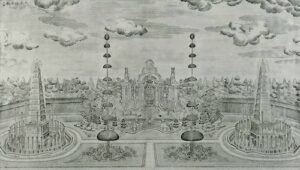
After Yi Lantai, “Dashuifa zhengmian (The Great Fountain main façade)” from “Xiyang shuifa tu (Pictures of the Western-style Buildings and Waterworks),” Plate 15 of 20, ca. 1783-86, copperplate engraving printed on paper.
Activist artist Ai Weiwei, who created artworks based on the zodiac heads, mocked the state’s selective attachment to cultural heritage, arguing that Communist authorities “never really care about culture” and describing the famous zodiac heads as symbols of political mythmaking rather than authentic artistic understanding.
Yet the Chinese state simultaneously encourages patriotic collecting and repatriation campaigns. Chinese billionaires entered the global art market not simply as collectors but as participants in a state-encouraged project of symbolic restoration. Auction houses linked to politically connected elites helped transform “bringing Chinese art home” into a nationalist act.
The modern politics of repatriation have increasingly merged with commercial leverage. Few examples illustrate this better than the actions of François Pinault. After Chinese outrage erupted over the 2009 Christie’s sale of two bronze zodiac heads from the Yves Saint Laurent–Pierre Bergé collection, Chinese bidder Cai Mingchao publicly refused to pay after winning the auction, transforming the event into a nationalist spectacle. Chinese authorities reportedly imposed pressure on Christie’s operations in China. In 2013, Pinault, whose luxury conglomerate Kering and holding company Groupe Artemis had extensive Chinese business interests, donated the zodiac heads to China as a goodwill gesture. Shortly afterward Christie’s became the first foreign auction house licensed to operate independently in China.
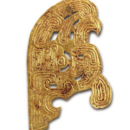
Gold plaque, now in Gansu Provincial Museum, Lanzhou, China. Formerly collection Musée Guimet, Paris.
A variant on this pattern appeared in a lesser-known 2015 controversy involving the Musée Guimet in Paris. A collection of ancient gold plaques and harness ornaments originally donated to the museum by dealer Christian Deydier and Pinault was effectively extracted from the French national collection after Chinese officials asserted the works had been pillaged from archaeological sites in Gansu. Until a 2026 change in French law, France ordinarily treated public collections as inalienable. Rather than risk offending Beijing through a lengthy parliamentary process to authorize restitution, French authorities facilitated a retroactive nullification of the donation so the objects could be “returned” to China. Deydier bitterly accused the French government of having “dropped its trousers” to curry favor with Beijing.
The irony was considerable. The same reports acknowledged that the objects were connected to widespread looting of Gansu archaeological sites during the 1990s – looting in which the Chinese military was alleged to have played a role. Yet this aspect was carefully avoided in official discussion. The result was a clear demonstration of geopolitical pressure shaping museum policy.
Stealing it back
Meanwhile, another uncomfortable subject has received little official attention in China: the theft of Chinese objects from European museums by criminal gangs apparently supplying Chinese buyers. Museums in Britain, France, Norway, and Sweden were repeatedly targeted between 2010 and 2015. The Rathekeale Rovers gang stole jade, lapis, and rhinoceros-horn objects from British museums, many specifically associated with the Summer Palace. Authorities believed some of the unrecovered objects were trafficked into China, where wealthy collectors viewed the acquisitions as patriotic recoveries rather than criminal contraband.
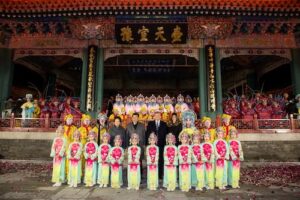
Donald and Melania Trump – Xi Jinping and Peng LiYuan, 8 November 2017, U.S. G0vernment photo.
In this sense the modern politics of the Summer Palace are less about restitution than about nationalism and symbolic grievance. The Communist Party has elevated the Yuanming Yuan into a foundational myth of Western humiliation while minimizing the complexities of the original event: the torture and murder of diplomats; the role of Chinese intermediaries and markets in dispersing the loot; the distinction between imperial court property and popular patrimony; the catastrophic destruction of Chinese heritage by Maoist campaigns; and the present-day use of cultural claims to secure diplomatic or commercial concessions.
The tragedy of the Summer Palace was real. So too was the violence of imperial intervention in nineteenth-century China. But the contemporary transformation of every Chinese artwork abroad into evidence of historical theft is less about history and more about political theater – a theater useful both to the Chinese state and to Western corporations eager to preserve access to the Chinese market.
[1] Roderick MacFarquhar & Michael Schoenhals, Mao’s Last Revolution (Harvard/Belknap), cited in Peter Neville-Hadley, China’s ‘stolen’ cultural relics: why the numbers just don’t add up, South China Morning Post, 9 June 2017.
Additional Reading
- French Government Reverses Donation to Guimet of Chinese Gold Ornaments, Cultural Property News, July 27, 2015.
- Fact Check: Yuanming Yuan – The 1860 Looting of the Summer Palace, Cultural Property News, March 8, 2018
- Chinese Art Heists: Purloined Treasures, Cultural Property News, September 22, 2018
- SPECIAL REPORT: 2023 CHINA MOU – Building China’s Art Monopoly and Destroying Minority Culture and Identity, Committee for Cultural Policy and Global Heritage Alliance – May 26, 2023
- Jean-Michaël Maugüé, Art in Exile at Home: The National Palace Museum, Taiwanese Identity, and China’s Imperial Collection, Jun 22, 2021, Cambridge Journal of Law, Politics and Art.
[1] Roderick MacFarquhar & Michael Schoenhals, Mao’s Last Revolution (Harvard/Belknap), cited in Peter Neville-Hadley, China’s ‘stolen’ cultural relics: why the numbers just don’t add up, South China Morning Post, 9 June 2017.