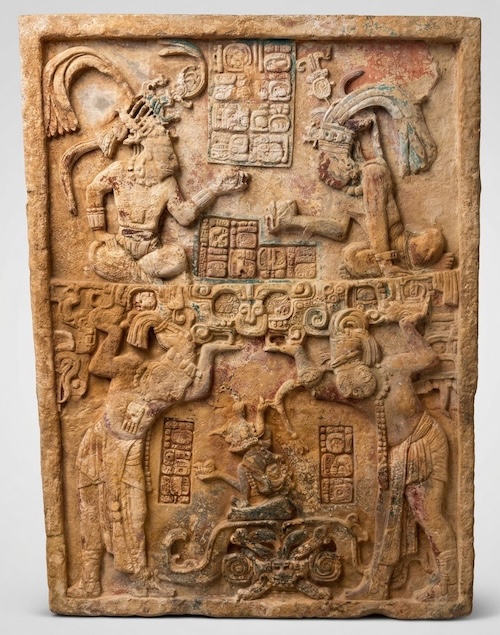
 Late Classic Mayan lintel delivered to Consulate of Mexico by NY District Attorney's Antiquities Trafficking Unit (ATU), showing the Sun God Raised in the Sky (773 A.D.) Possibly linked to the sculptor known as Mayuy, potentially from the Usumacinta River corridor, Petén frontier region, Guatemala.
 A New York repatriation of a carved Maya lintel to Mexico may have sent a masterpiece to the wrong country, as current scholarship increasingly points to Guatemala as its likely origin. The Laxtunich case exposes how political spectacle and rushed cultural-property enforcement can outrun evidence, turning restitution into misdelivery.
Antiquities returns follow a familiar ritual. Flashbulbs. Flags. A mishmash of ancient objects arrayed on tables. Smiling prosecutors standing beside smiling diplomats. Another triumph of cultural justice, another headline declaring that looted heritage has “gone home.” But what if ‘home’ is the wrong country?
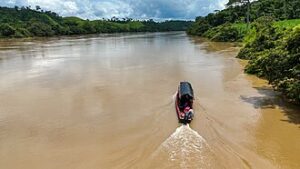
A motorboat navigates the Rio Usumacita, on the border between Chiapas in Mexico and Guatemala. Photo ProtoplasmaKid, 29 September 2024. CC by SA 4.0 license.
That question hangs over the recent return of a carved Maya lintel by the Manhattan District Attorney’s Office under the leadership of prosecutor Matthew Bogdanos, an event publicly celebrated as a return of an inalienable national treasure to Mexico. Yet a number of scholars are dubious – their work suggests that the monument long associated with the elusive site called Laxtunich didn’t come from Mexico at all, but from neighboring Guatemala.
When repatriation advocates insist that cultural heritage is bound up with irradicable identity and nationhood, sending a monument to the wrong claimant state is not a technical error. It is closer to mixing up babies in a maternity ward. This ceremony wasn’t a restoration of patrimony – it was a geopolitical misdelivery.
The deeper story isn’t only about one lintel. It is about the hazards of moral theater when scholarship is still evolving, and bureaucratic expedience outruns evidence.
The Jungle Mystery Called Laxtunich

Quest for the 1955 Lost City film based on the adventures of Dana and Ginger Lamb.
Laxtunich is one of the strangest names in Maya archaeology. It doesn’t refer to an excavated site with mapped plazas and published architecture, but to a place half-preserved in photographs, notebooks, and the unreliable adventures of a California couple, Dana and Ginger Lamb. In 1950, Dana Lamb claimed to have reached a “lost city” in the jungle frontier between southern Mexico and northern Guatemala. There he photographed extraordinary carved stone lintels still set within a ruined vaulted structure. Later he transformed the trip into romantic explorer literature—snakes, danger, hidden temples, heroic endurance.
Serious scholars have long treated these narratives skeptically and dismissed portions of Lamb’s account as fanciful. But Lamb’s photographs were real and invaluable. They preserved the earliest visual record of monuments that were later looted, cut down, thinned for transport, trafficked abroad, and dispersed into collections. Thus, Dana Lamb occupies an odd place in the story, as an unreliable but still essential witness.
The modern understanding of Laxtunich owes much more to patient scholarship. Important contributors include Stephen Houston, Charles Golden, Andrew Scherer, James Doyle, and foundational figures such as Ian Graham of Harvard’s Peabody Museum. Their work has combined epigraphy, topography, stylistic analysis, and ancient political history.

Dana and Ginger Lamb, 11 August 1933, Los Angeles Time Photographic Collection at UCLA Library, American travel writers, CC-BY-4.0 license.
These researchers showed that the lintels belong to the Late Classic Maya world of the eighth century, closely tied to the powerful kingdom of Yaxchilan, whose rulers projected authority across a contested frontier zone. They also questioned the old assumption that Laxtunich lay in Mexico.
For decades, dealers, museums, catalogs, and other publications incorrectly described Laxtunich as being in Chiapas, in Mexico. That label then hardened into market convention.
But recent scholarship reconstructing Lamb’s travel route suggests a different geography. By comparing Lamb’s travel route as outlined in his letters, distances, travel times, terrain descriptions, references to water scarcity, and likely access paths from the Usumacinta corridor, researchers concluded that the site most plausibly lay in the Sierra del Lacandón / Petén frontier region—today in Guatemala. Specific candidates include sites near La Pasadita, Tixan, and especially El Túnel, which matches multiple clues from Lamb’s notes: defensive walls, a dry cenote, a collapsed vaulted building, and a matching trail approach. After all, ancient political affiliation almost never conforms to modern state borders. A site subordinate to Yaxchilan (in Mexico) in antiquity could quite logically lie inside modern Guatemala today.
The Latunich Lintels
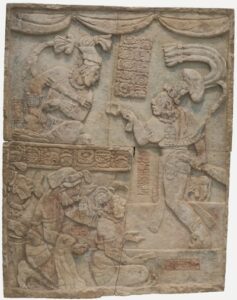
A comparable stone lintel showing presentation of captives to a maya ruler, A.D. 785, from the Kimbell Art Museum, Ft. Worth, Texas USA, courtesy Kimbell Art Museum.
The Laxtunich lintels are not minor fragments. They are among the finest surviving examples of Late Classic Maya court sculpture from the western lowlands: richly carved elite figures, hieroglyphic texts, dynastic references, ritual scenes, traces of original pigments, and probable signatures linked to the sculptor known as Mayuy. They illuminate royal patronage, ritual performance, and artistic mobility in the Maya world.
One related monument entered the Kimbell Art Museum. Others circulated privately, sometimes hidden in Swiss storage, sometimes only briefly available to scholars. Some had been brutally altered for transport from the jungle.
These are not generic antiquities. They are masterpieces. And yet when one was returned in New York, the public was not given a rigorous scholarly dossier identifying exactly which lintel it was, its excavation history, the basis for assigning it to Mexico rather than Guatemala, or how competing provenance hypotheses were evaluated.
Repatriation by Press Conference
The Manhattan DA’s antiquities program has frequently been celebrated in the press for recovering objects and returning them abroad, and criticized in museum and collecting circles for upholding foreign interests over U.S. access to art, treating long-ago legally imported objects as stolen – and threatening museum and art collectors with criminal prosecution if they fail to immediately relinquish artworks to source country claimants. Critics have long argued that the DA’s Antiquities Trafficking Unit often prefers publicity-friendly mass returns, dramatic aggregate value claims, and compressed narratives over research and serious analysis. The DA routinely ascribes million dollar values to returned objects – supplying only a fuzzy photo or none at all for hundreds of objects – making it impossible to corroborate or criticize its claims.
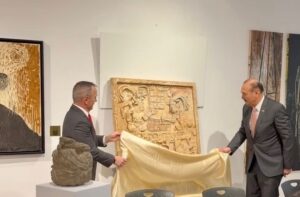
Assistant District Attorney Matthew Bogdanos reveals the returned lintel at the offices of the Consulate of Mexico in New York City.
Allegations like these have followed the DA’s Antiquities Trafficking Unit from its beginning, when Bogdanos’ first major seizure of South Asian works from Subash Kapoor were wildly overvalued (and even Indian diplomats to which they were returned stated that they had taken the real objects home and left the fakes behind). In another case, purportedly ancient mosaics that were returned to Lebanon were revealed by a French art historian to be modern copies of well-known originals in museums, and Tibetan religious works were returned to the the Chinese government despite its policy of deliberate destruction of Tibetan culture. Roman coins and artifacts found across the Mediterranean and from England to Afghanistan have been claimed as ‘Italian.’ In a few cases, well-known academics have been cited in court documents, authenticating fakes.
Criticisms of Bogdanos’ modus operandi share a common theme: the state-to-state repatriation model can flatten questionable returns into moralizing and simplistic ‘solutions’ and turn pure puffery into serious criminal accusations.
One collector summarized the concerns over the lintel bluntly: “The government is so aggressive in taking anything it can from collectors that they are actually giving it to the wrong country.”
That quote captures the stakes. If enforcement is just a race for symbolic wins, accuracy can become collateral damage.
Writers associated with regional Maya heritage have stressed that border-zone sites cannot be understood through modern national labels alone. The ancient Usumacinta river region was a networked landscape of river corridors, satellite courts, military outposts, marriage alliances, and contested loyalties. To assign ownership today requires careful attention to actual findspot, not broad civilizational branding. A “Maya lintel tied to Yaxchilan” does not automatically equal “Mexican.” That leap confuses political influence in 780 CE with international boundaries in 2026.
Why This Case Is Different
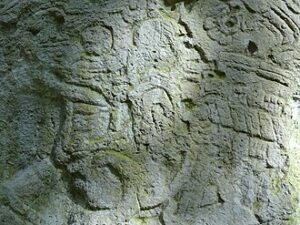
Detail of Mayan figure on stele, Yaxha, Peter, Guatemala. 25 November 2014. Photo by Adam Jones from Kelowna, BC, Canada. CCA-SA 2.0 license.
No serious person disputes that looted monuments should be studied ethically, trafficked objects scrutinized, and illicit excavation condemned. But the Laxtunich case presents a hard question: when scholarship indicates the source country is unresolved, how is a rapid handover justified?
If the object likely came from Guatemala, then Mexico’s receipt of it is not a moral correction to the ills of trafficking. It is an administrative convenience. That may satisfy diplomats but it shouldn’t satisfy archaeologists.
The real heroes of this story are not prosecutors or adventurers. They are scholars who reconstructed routes through old letters; who compared inscriptions line by line and traced pigments invisible to casual eyes; who study stylistic hands and frontier politics; who ask the unglamorous but decisive question: where did this monument actually stand? In the case of this lintel, that diligent research encompasses a degree of uncertainty but points strongly to Guatemala.
Some will argue that Mexico and Guatemala share intertwined Maya heritage, so the distinction is secondary. But that argument collapses against the legal bases used to justify repatriation in the first place. If national patrimony matters, then national precision matters. If heritage is identity, then identity cannot be reassigned for convenience.
What Should Have Happened

Rio Usumacinta, also called Rio Chixoy in Guatemala, photo Fernandoreyespalencia, 20 August 2009, CCA 3.0 Unported license.
A defensible process should have included:
- Publication of the exact lintel identification.
- Release of dimensions, inscriptions, and prior ownership history.
- Independent scholarly review of source-country claims.
- Consultation with Guatemalan authorities if evidence supported that origin.
- Conditional custodianship pending provenance resolution.
The Laxtunich lintel may yet prove to be Mexican. It may prove to be Guatemalan. It may remain permanently uncertain because looters destroyed the archaeological context decades ago. But uncertainty should lead to caution, not haste. Repatriation is not a sacrament. It is a factual claim wrapped in legal process. When facts are contested, the process should slow down in order to make the correct determination. Otherwise, justice becomes just a show and masterpieces don’t go home, but somewhere else.
Additional Reading

Quest for the Lost City, Dana and Ginger Lamb, book cover. The book received mixed reviews.
Houston, Stephen (ed.). Stephen Houston, ed. A Maya Universe in Stone Los Angeles: Getty Publications, 2021
Reviewed by Donna Yates November 30, 2022, Copyright © 2023 College Art Association. Printed in Trafficking Culture, https://traffickingculture.org/app/uploads/2023/01/A-Maya-Universe-in-Stone.pdf. Licensed under Creative Commons Attribution-NoDerivatives 4.0 International License.
Andrew K. Scherer et al., Yaxchilan from the Perspective of Guatemala: New Data on Settlement, Fortifications, and Sculptural Monuments, The PARI Journal, Vol. XX, No. 2, 2019 (contributors Andrew K. Scherer, Charles Golden, Omar Alcover Firpi, Whittaker Schroder, Mónica Urquizú, Edwin Román). https://www.precolumbia.org/pari/journal/archive/PARI2002.pdf#