 "The Political Sodom and Gomorrah are Doomed to Destruction"
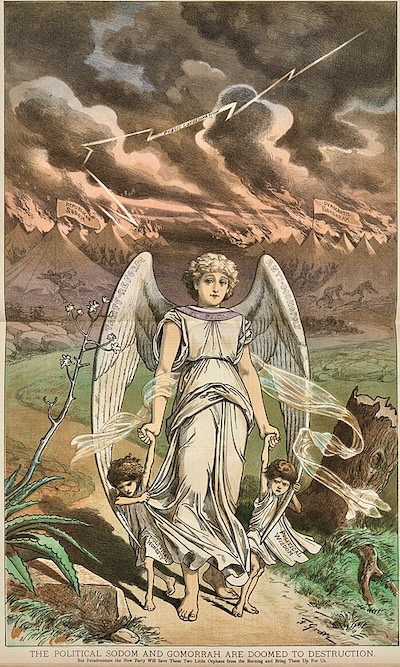
1882 cartoon by Friedrich Grätz, from U.S. "Puck" magazine, May 1882.
Summary from Library of Congress:
Print shows an angel labeled "New Party" with wings labeled "Tariff-Reform" and "Anti-Monopoly" leading two small orphan children labeled "Political Honesty" and "Political Wisdom" to safety, away from the fires, ignited by lightning labeled "Public Condemnation", that are consuming "Republican Sodom" and "Democratic Gomorrah". Public domain.
"The Political Sodom and Gomorrah are Doomed to Destruction"
1882 cartoon by Friedrich Grätz, from U.S. "Puck" magazine, May 1882.
Summary from Library of Congress:
Print shows an angel labeled "New Party" with wings labeled "Tariff-Reform" and "Anti-Monopoly" leading two small orphan children labeled "Political Honesty" and "Political Wisdom" to safety, away from the fires, ignited by lightning labeled "Public Condemnation", that are consuming "Republican Sodom" and "Democratic Gomorrah". Public domain. Recent U.S. court rulings and fresh tariff measures have created a volatile trade environment for collectors, dealers, auction houses, and museums. Although cultural goods have long been treated differently from industrial imports, shifting legal interpretations may disrupt cross-border trade, raise costs, and weaken the United States’ dominant position in the international art market.
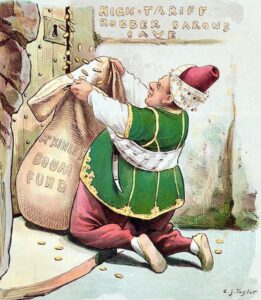
The open sesame, by author C.J. Taylor, depicting William McKinley as Ali Baba kneeling before a slightly opened door in the “High-Tariff Robber Barons Cave”, holding a bag labeled “McKinley Boom Fund”, which is being filled with coins issuing from the opening in the doorway. Source Library of Congress. Public domain.
The art market has long been accustomed to operating within a relatively stable framework of tariff exemptions and cultural carve-outs. Today, it finds itself navigating a period of acute legal and commercial volatility. The recent sequence of events in Washington D.C. – beginning with the Supreme Court’s striking down of President Donald Trump’s unilateral tariffs and followed almost immediately by the imposition of new levies under alternative statutory authority – has produced precisely the opposite of what market participants had hoped for: even greater uncertainty.
For collectors, dealers, auction houses, and museum professionals, the implications are immediate, operational, and, in many cases, extremely challenging.
The Supreme Court’s February 20 decision was, at first glance, a decisive constitutional correction. By ruling that tariffs imposed under Presidential emergency powers were unlawful, on the basis that the authority to levy taxes and duties resides with Congress, the Supreme Court appeared to reset the legal structure of U.S. trade policy back where it long belonged, in the hands of Congress. The Court’s judgment offered a momentary sense of relief.
By the end of the same day, the administration had introduced a new justification for tariffs, invoking Section 122 of the Trade Act of 1974 to impose tariffs, initially at 10%, quickly escalating to 15%, on imports from virtually all countries. These measures, while legally distinct from the prior tariff mechanism, reproduced many of the same imposts or duties, although they are limited – possibly temporarily – to a 150-day statutory window. Simultaneously, the administration initiated a broad set of Section 301 ‘investigations’ aimed at establishing longer-term tariffs. The ‘investigations’ are to determine if continued tariffs are justified on imports whose overproduction would cause harm to U.S. industrial manufacturing.
You may be asking yourself – what on earth does overproduction have to do with art or antiques? The answer is a definitive, “Nothing whatsoever.”
The Committee for Cultural Policy’s written submission to the United States Trade Representative Jamieson Greer is linked below. To quote a key paragraph:
“The application of Section 301 remedies to goods classified under HTS Chapter 97—artworks, antiques, manuscripts, rare books, and collectors’ items – is fundamentally misplaced. These objects are unique, non-fungible, and finite; many were created decades or centuries ago and cannot be reproduced or scaled. As such, they cannot be subject to “structural excess capacity” or overproduction. Neither the European Union nor any other country identified in this investigation can be said to generate surplus cultural goods in the manner contemplated by trade remedies designed for industrial manufacturing sectors. The conceptual basis of the investigation does not apply to cultural property.”
Despite what appear to be obvious reasons for not including handmade artworks and antiques under tariffs designed to protect industrial manufacturing, today’s trade policies are likely to remain characterized by contested legal interpretations and continuing potential for escalation. The result is a genuinely unstable structure.
Art markets that rely on long planning cycles – consignment negotiations, exhibition scheduling, private treaty sales, and the like are ill-suited to policy regimes that shift within a single trading day.
The Supreme Court ruling briefly suggested a return to normal operations, enabling dealers to contemplate restocking and cross-border acquisitions. Yet the rapid imposition of new tariffs immediately reintroduced cost uncertainty.
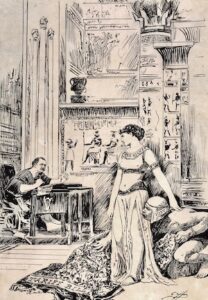
1896 cartoon satirizing current US politics in form based on well known historical painting by Jean-Leon-Gerome. US President Grover Cleveland as Caesar, presented with Cleopatra labeled “Free Silver” in a carpet labeled “Tariff Bill”; servant at right who brought in the carpet is US Senator George Graham Vest. 7 February 1896. Source Library of Congress. Public domain.
Some U.S.-based dealers are already shifting to sourcing exclusively within the United States. This means that their stock is not exposed to tariffs and disrupted shipping but creates its own limitations. The domestic supply of fresh, high-quality, historically significant material is finite. Some foreign dealers are withholding inventory from the U.S. market altogether, opting to sell in countries with more predictable trade environments. Others are absorbing tariff costs in the short term, but are passing the costs on to buyers, thereby inflating prices. Others have adopted a cautious “wait-and-see” approach, temporarily limiting or even suspending exports to the U.S. until the rules are better defined.
The longer-term consequences of these strategies may split the global art market into self-supporting geographic fragments instead of what has been a truly international system.
Museums are mandated to provide public access and education, and depend very much on the free circulation of cultural goods that will later be donated. The Association of Art Museum Directors has stated a clear position regarding the Section 301 Investigation: works of art are categorically distinct from industrial goods and should remain outside the scope of trade remedies designed for manufacturing sectors.
Their position is based on very longstanding U.S. policy. Since the Tariff Act of 1930, and reinforced through international agreements such as the Florence Agreement, the United States has treated cultural goods as “informational materials” deserving of duty-free movement. The rationale is both cultural and strategic: the free exchange of art supports intellectual discourse, diplomatic engagement, and soft power.
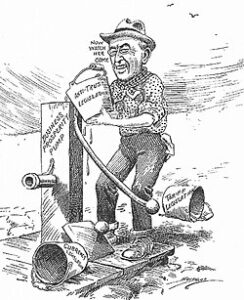
1914 US cartoon showing Woodrow Wilson priming the pump, representing prosperity, with buckets representing legislation.
26 June 1914, Cartoon by Clifford Berryman. Source Library of Congress. Public domain.
The current tariff regime jeopardizes that longstanding framework. While fine art generally retains its exemption status as “informational materials,” the boundaries between fine art and decorative art and antiques are not always clear. Decorative arts including furniture, objects d’art, and other hybrid categories frequently fall outside the fine art exemption, subjecting them to the full weight of tariffs. This creates distortions within collecting categories, privileging certain forms that remain duty-free over others that are not.
The administration’s Section 301 investigations, targeting sixteen major trading partners across a different industrial sectors, are explicitly designed to justify a longer lasting tariff framework. While the stated focus is on “structural excess capacity” in manufacturing, the scope of potential remedies is expansive.
Crucially, the investigations operate under discretionary authority, allowing for tariffs without the same temporal or rate limitations as Section 122. The timeline for extending the current tariffs – a target date of July 24, 2026 – suggests that there may be a rapid transition from temporary to potentially permanent measures.
For the art market, the risk lies not in immediate inclusion within these tariffs, but in regulatory spillover. Industry groups, including CINOA and other international federations, have been unequivocal in their submissions: cultural goods are non-fungible, finite, and outside the logic of overproduction. There is no “excess capacity” in Old Master paintings or ancient artifacts. Tariffs cannot incentivize domestic substitution because no substitute exists.
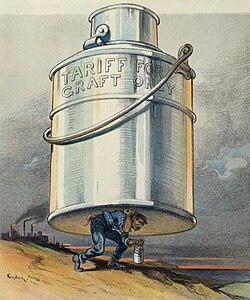
The fullest dinner pail by cartoonist Keppler, 1908. Cartoon shows a man labeled “Workingman” bent over under the weight of an enormous dinner pail labeled “Tariff for Graft Only”. Satire of election slogan “Full Dinner Pail”, meant to suggest prosperity and working people having enough to eat. Source Library of Congress. Public domain.
Moreover, the imposition of tariffs on such goods would produce an outcome the opposite of what the administration seeks. Rather than protecting domestic industry, it would penalize domestic dealers, collectors, and institutions who rely on international circulation.
The United States, which currently accounts for approximately 44% of global art market value, would risk ceding its leadership position. If the cost of importing works into the U.S. rises, consignors will simply choose to sell elsewhere. The downstream effects will be reduced auction volumes, less gallery activity, and a contraction in all the businesses that provide ancillary services to the art market.
A relatively low tariff – like the 15% proposed – can be integrated into pricing models if it is stable and predictable but the prospect of volatile tariff rates is alarming in itself. Businesses need predictability in order to operate!
Lawsuits from states facing serious industrial impacts from the proposed tariffs may result in retroactive adjustments. However, there is no clear repayment mechanism for now-voided tariffs. The federal ruling that companies are now entitled to refunds for previously paid tariffs adds another layer of administrative uncertainty.
Ultimately, the art market is facing a period of adjustment driven by shifts in trade policy. The Supreme Court’s intervention has clarified certain constitutional boundaries, but it has not resolved the underlying tensions or halted the administration’s drive for tariff revenue.
As the Trump administration advances its tariff agenda through new legal mechanisms, the market remains watchful but uncertain, hoping above all for the stability required to function effectively across borders.
See the Committee for Cultural Policy’s submission to the Office of the United States Trade Representative:
2026-04-15 Committee for Cultural Policy Comments on Section 301 Investigation