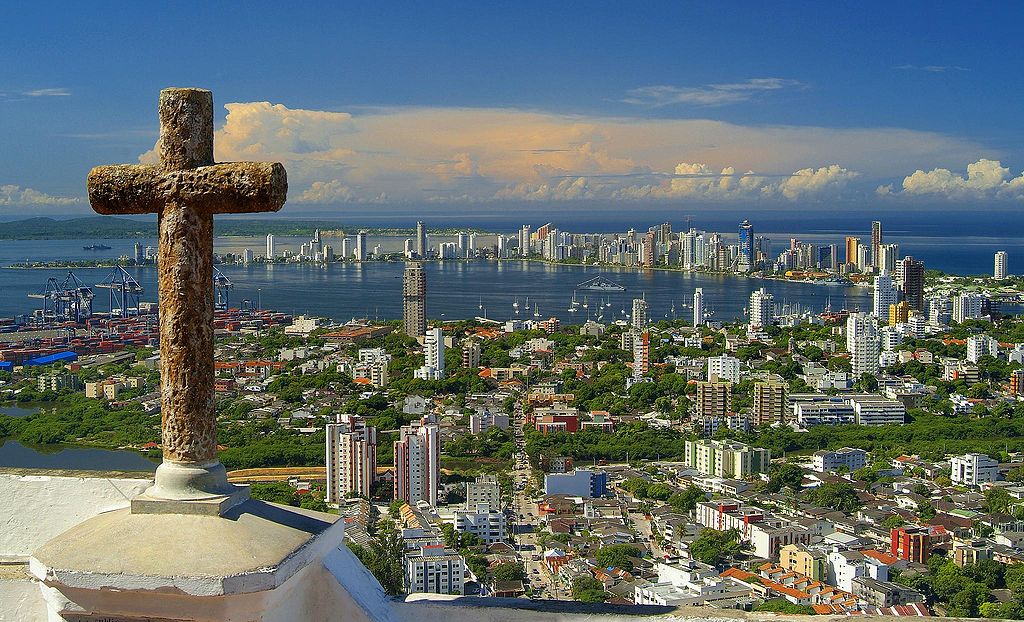
 View of the Santa Cruz de Manga Islands, Boca Grande and Castillo Grande and Tierra Bomba seen from Cerro de la Popa photo by Norma Gòmez, Cartagena de Indias, Colombia. 1 February 2008, Creative Commons Attribution 2.0 Generic license.

Mask used in folk ritual of Chaquiras indigenous people of Colombia. Used in spiritual rituals related to abundance and sexuality and in medicinal rituals in which the ayahuasca tea is used. Altino Arantes Museum., photo by Wilfredo Rafael Rodriguez Hernandez, 23 December 2019, CCA-SA 4.0 International.
Committee for Cultural Policy, Inc. and Global Heritage Alliance Testimony submitted to Cultural Property Advisory Committee Regarding the Renewal of the Memorandum of Understanding (MOU) between the Government of the Republic of Colombia and the United States Submitted September 8, 2025 to the U.S. Department of State
PRECIS
The Committee for Cultural Policy (CCP) and the Global Heritage Alliance (GHA) strongly oppose the automatic renewal of the U.S.–Colombia cultural property agreement, now entering its twentieth year. Congress enacted the Cultural Property Implementation Act (CPIA) to allow temporary, narrowly tailored measures—not permanent embargoes. Yet Colombia’s MOU has become just that: an indefinite blockade covering objects far beyond the law’s scope, including Catholic religious art and mass-produced colonial items never intended for restriction.
There is no evidence that U.S. demand fuels looting in Colombia today. American museums require rigorous provenance, collectors are not buying undocumented works, and only a handful of Colombian artifacts have even appeared on the market in recent years. Meanwhile, Colombia’s archaeologists remain starved of resources. A single $300,000 U.S. grant in 2025 exceeded Colombia’s entire annual cultural heritage budget. CCP and GHA urge CPAC to deny renewal or condition it on strict reforms: narrowing the Designated List, requiring real funding for site protection, and ensuring reciprocal long-term museum loans.
I. Introduction
The Committee for Cultural Policy (CCP)[1] and Global Heritage Alliance (GHA)[2] respectfully submit this testimony regarding the proposed renewal of the Memorandum of Understanding (MOU) between Colombia and the United States. This testimony outlines the ongoing challenges the Cultural Property Advisory Committee faces in following the law it is appointed to uphold. These include ensuring both the protection of Colombian archaeological sites from looting and the American public’s legal right to access for public education, for scholarship, for legitimate collecting, and to support U.S. cultural institutions’ mandate to hold and display Colombia’s ancient and ethnological art.

Parque Arqueológico de San Agustín. San Agustín. Huila. Colombia. Photo Paul M.R. Maeyaert. PMRMaeyaert@gmail.com.
In Colombia’s case, as in at least two dozen other equally flawed but endlessly-renewed cultural property agreements, it is imperative for the CPAC committee to scrutinize repeated requests in the light of actual facts. If the law and the facts don’t match, it is time to limit the scope of agreements – to stop issuing sweeping Designated Lists of import restrictions on objects going back a million years and up to 1947. In many cases, such as Turkey, China and India, where the source country’s cultural policy is unquestionably destroying minority heritage and using U.S. agreements to sustain authoritarian regimes, the only law-abiding, American thing to do is to back off from those agreements entirely.
We submit this testimony in opposition to an unqualified renewal of the Memorandum of Understanding (MOU) between the United States and Colombia under the Convention on Cultural Property Implementation Act (CPIA), 19 U.S.C. §§ 2601 et seq.
The U.S.–Colombia MOU was first entered in 2006 to protect designated categories of pre-Colombian archaeological objects and ecclesiastical/ethnological material from the Colonial period. It has now been in force, through successive renewals, for nearly twenty years.
Congress, when enacting the CPIA in 1983, did not envision such MOUs as permanent embargoes.[3] Instead, import restrictions were designed as temporary emergency measures to provide source countries with “breathing room” to implement self-help protections, inventory systems, and site protections. Today, after two decades, it is essential to ask:
- Has Colombia met the four statutory criteria under the CPIA?
- Do circumstances still justify renewal?
- Or has the MOU drifted into what we have repeatedly warned against in the case of repeated renewal requests —a permanent fixture of U.S. customs law, unsupported by evidence of ongoing pillage?
After reviewing the evidence, we conclude that Colombia’s renewal fails to meet the statutory requirements of the CPIA. CPAC should either recommend termination of the MOU or condition any renewal on strict benchmarks for Colombian compliance, limitation of the designated list, and reciprocal measures such as long-term loans.
II. The Statutory Framework

Archaeology Museum, Sogamoso, Boyacá, Colombia. Museo Arqueológico Eliécer Silva Célis, 11 February 2024, photo Ridiculopathy, CC0 1.0 Universal Public Domain Dedication.
The Cultural Property Implementation Act (“CPIA”), 19 U.S.C. §§ 2601 et seq. sets significant limitations on the executive authority to impose import restrictions on archaeological and ethnological objects. The Cultural Property Advisory Committee (“CPAC”) is to provide the executive with useful advice about this process. (Id. § 2605.)
Under 19 U.S.C. § 2602(a)(1), the President may enter or renew agreements only if four determinations are made:
- The requesting nation’s cultural patrimony is currently “in jeopardy” from pillage.
- The requesting nation has taken “measures consistent with the Convention” to protect its patrimony.
- U.S. import restrictions, applied in concert with other market nations, will substantially deter pillage and less drastic remedies are not available.
- Restrictions are consistent with the international interest in the exchange of cultural property for scientific, cultural, and educational purposes.
The definitions of archaeological and ethnological objects limit the scope of any restrictions. “Regular” restrictions may only be applied to archaeological artifacts of “cultural significance” “first discovered within” and “subject to the export control” of a specific UNESCO State Party. (19 U.S.C § 2601).
The legislative history underscores the fact that “ethnological material” is to be defined narrowly.[4] According to the Senate Report, Ethnological material:

Footed Bowl Depicting a Pair of Monkeys, Colombia, Nariño, 750-1250, The Muñoz Kramer Collection, gift of Camilla Chandler Frost and Stephen and Claudia Muñoz-Kramer, photo by Los Angeles County Museum of Art.
“[I]ncludes any object that is the product of a tribal or similar society, and is important to the cultural heritage of a people because of its distinctive characteristics, its comparative rarity, or its contribution to the knowledge of their origins, development or history. While these materials do not lend themselves to arbitrary age thresholds, the committee intends this definition, to encompass only what is sometimes termed “primitive” or “tribal” art, such as masks, idols, or totem poles, produced by tribal societies in Africa and South America. Such objects must be important to a cultural heritage by possessing characteristics which distinguish them from other objects in the same category providing particular insights into the origins and history of a people. The committee does not intend the definition of ethnological materials under this title to apply to trinkets and other objects that are common or repetitive or essentially alike in material design, color, or other outstanding characteristics with other objects of the same type, or which have relatively little value for understanding the origins or history of a particular people or society.” [5]
Further, there is no indication in the publication of the proposed extension in the Federal Register that the Government of Colombia actually requested the extension of the previous agreement.[6] If there was a request, publication of the fact that it was made is required under the law.[7] If Colombia’s government did not make a request – then who at the State Department decided it was in the United States’ best interest to perpetuate a blockade of already twenty years duration that harms U.S. collectors, businesses, and museums?
III. Looking Back to Colombia’s First 2010 Renewal Request – and Its Failure to Meet the 2006 MOU’s Terms

Gold pendant, Colombia, Chiriqui, A.D. 500-1550, William Randolph Hearst Collection, Los Angeles County Museum of Art, public domain.
Twenty years after the U.S. – Colombia MOU came into force, we cannot do better than to reiterate the concerns of the Association of Art Museum Directors (AAMD) when Colombia applied for renewal of U.S. restrictions in 2010. The AAMD had supported legitimate protection efforts under Colombia’s initial 2006 application but cautioned that:
- Import restrictions must not become permanent.
- Colombia had obligations under Article II to protect sites, compensate chance finds, and provide access through long-term loans.
- U.S. museums and the American public deserve reciprocal benefits if the U.S. market is closed.[8]
These recommendations were never meaningfully implemented by Colombia. Five years later, in 2010, the AAMD called for amendments requiring:
- Long-term loans of Colombian material, not just short-term exhibition loans which are extremely financially burdensome for U.S. museums.
- Rigorous site protection within Colombia rather than shifting enforcement abroad.
- Compensation programs for chance finds to prevent destruction of objects for bullion value.[9]
Again, and again Colombia has come back to the table. Now, twenty years later, it claims that the same conditions under the Four Determinations exist despite its best efforts to protect sites and ecclesiastical collections and despite the passage of decades of a complete blockade to U.S. entry of Colombian art and artifacts. This is not even plausible.

Colombian gold jewelry, 26 November 2013, photo by Sailko, Vatican Apostolic Library, CCA-SA 3.0 license.
The Committee for Cultural Policy (CCP) and Global Heritage Alliance (GHA) emphasize that under the statute:
- CPIA restrictions must address current looting, not looting decades past. No public evidence has been provided by Colombia or the State Department that Colombian cultural property is currently in jeopardy.
- Colombia must demonstrate self-help measures, including adequate funding for site protection, inventories, and law enforcement.
- The designated list has been expanded beyond the statutory definitions of “archaeological” and “ethnological” material. For example, Colonial coins and other objects of mass production should not be included. Catholic religious art and artifacts cannot begin to meet the definition of ‘primitive’ ethnographic art under the CPIA.
- Any restrictions must be prospective only — applied to items illicitly exported after the effective date of the regulations, not retroactively.
- If Colombia, after all its claimed efforts is still struggling with looting, it should explore alternatives, such as a portable antiquities scheme modeled on the United Kingdom, allowing reporting and retention of common finds, thereby discouraging black-market destruction.
IV. Analysis of Colombia’s 2025 Request
- Is Cultural Patrimony in Jeopardy?

Colombia 8 reales 1770 NR anverso, 20 May 2021, photo Pollito Alpistei, CCA-SA 4.0 International.
The CPIA requires proof that Colombian patrimony is currently in danger from pillage. In the 1990’s there was significant looting in Colombia, particularly materials from the Malagana region in 1992-3. In 2006, when the first import restrictions were imposed, there was still some evidence of looting. But in 2025, no new evidence has been presented. Only a few types of Colombian artifacts – notably its ancient gold jewelry – have a popular international market. Those from the Malagana discoveries have circulated globally for close to thirty years – or more. There are still many hundreds of ancient objects in worldwide circulation from Colombia, yet only three Colombian artifacts priced at more than $30,000 have sold in global auctions from 2023-2024.
The Colombian Institute of Anthropology and History (ICANH) Archaeology and Heritage publishes information on its lines of institutional research, policy, and actions. These emphasize preventive archaeology, inventories, and management of World Heritage Sites (San Agustín, Tierradentro, Ciudad Perdida).[10] These are commendable goals, but they underscore that Colombia already has laws and programs in place.
Neither the activities of ICANH nor any other data are available to show that a U.S. market is driving looting or that Colombia has problems with the illicit export of ancient artifacts or ethnological materials to the United States today. Instead, the MOU functions as a permanent embargo on virtually all Colombian artifacts, a symbol of a problem more than twenty years ago. U.S. art dealers are not selling freshly looted objects and collectors are not buying them. U.S. museums are not even accepting donations of pre-Columbian art without documented proof of entry prior to 1970. U.S. law does not provide for the extension of a cultural property agreement long after the rationale for such an agreement has expired.
- Has Colombia Taken Adequate Self-Help Measures?
Colombia’s Instituto Colombiano de Antropología e Historia (ICANH) has developed programs in preventive archaeology, inventories, and site management. Notable achievements include:
- Creation of archaeological reference collections and laboratories.
- Management of World Heritage Sites such as San Agustín and Tierradentro.
- Preventive archaeology requirements for construction projects (under Laws 397/1997 and 1185/2008).
- Site looting remains a problem only where law enforcement is weak.
- Compensation for chance finds has not been implemented; finders still melt gold objects rather than trying to sell them illegally.
- Long-term loans remain prohibited by Colombian law.
- Many sites lack year-round security, despite the availability of low-cost technology.
Twenty years of import restrictions have not produced the intended progress. Instead, Colombia has come to rely on U.S. enforcement without fulfilling its reciprocal obligations.

Ancient Americas Gallery, Michael C. Carlos Museum, Atlanta, Georgia, USA, photo by Gary Todd, 1 July 2009, CC0 1.0 Universal Public Domain Dedication.
Funding for ICANH and site protection remains wholly inadequate and enforcement of heritage laws against destruction by development lacks proportionality, so that fines and sanctions have no deterrent effect. For example, the El Quimbo hydroelectric project (Huila) incurred ICANH sanctions for heritage damage. The fines imposed were hundreds of millions of pesos – but a hundred million Colombian pesos equals less than $25,000! Compared to the USD $837 million project cost and the serious harm to heritage, this was a pittance.
Despite press releases touting sector budgets (≈ $1.09 billion Colombian pesos ≈ U.S. $275,000) for cultural, educational, and environmental development through the Ministry of Culture (down ≈18% year on year), independent reporting depicts a chronic museum funding crisis, precarious staffing, and stalled reforms— undermining long-term conservation and access obligations.[11]
Colombia continues to rely on foreign funding – in fact, the U.S. State Department’s U.S. Ambassadors Fund for Cultural Preservation (AFCP) awarded $300,000 on August 1, 2025 to support Teyuna–Ciudad Perdida Archaeological Park conservation. This was a very valuable contribution – more than the whole budget published by the MinCulturas but indicative that core site preservation still relies primarily on external grants.[12]
Safeguards are needed for salvage archaeology from road building and other infrastructure and urban expansion projects given repeated, large-scale salvage contexts and documented damage in major projects.[13]
- Are Restrictions Part of a Concerted International Response?

Pre-Columbian jewellery from Colombia in the Metropolitan Museum of Art, 23 January 2014, photo by Sailko, CCA-SA 3.0 license.
The CPIA requires that restrictions work “in concert” with major market countries. There is no indication that the U.S. has been a destination for looted Colombian antiquities for decades. The market for undocumented objects has simply shifted elsewhere, including to Asia and the Gulf states. While EU nations now limit imports, only the U.S. bears the burden of a comprehensive blockade. Restrictions should be prospective only, applying only to items illicitly exported after the effective date of the regulations. U.S. Customs and Border Protection, however, frequently fails to adhere to the definition of “satisfactory evidence” in the statute, demanding more documentation than the CPIA law requires when objects have been outside of the source country for at least ten years.[14]
- Are Restrictions Consistent with International Exchange?
By cutting off U.S. museums and collectors, the MOU undermines the interchange of cultural property. Long-term loans remain unavailable. Colombian law severely limits the circulation of its patrimony abroad. The American public is deprived of the ability to study or display Colombian heritage except through rare temporary exhibitions.
The central role of American art museums is to present humanity’s artistic achievements through their permanent collections. While loan exhibitions enrich public access to great works, they cannot replace the sustained engagement offered by long-term display. Only permanent collections allow audiences to revisit objects, learn their histories, and experience curatorial dialogues among them. They also make possible the sustained research, conservation, and restoration that require ongoing care under the museum’s stewardship. Yet Colombian law does not permit long term foreign loans.
V. The Problem of the Designated List
The designated list for Colombia has been far beyond the CPIA’s statutory limits since the first agreement with Colombia in 2006. For example:
- Colonial ecclesiastical material is not “tribal or nonindustrial” art and does not fall within the Senate’s definition of ethnological material.
- Mass produced items should not be included in a Designated List. Coins, for example, are not yet included and should not be added; they are mass-produced and circulated widely and cannot be presumed to be “first discovered within” Colombia.
- The list includes other common objects of utility that have no special status or function. These restrictions risk sweeping in objects that are neither archaeological nor ethnological under the statute.
This overbreadth exceeds CPAC’s authority and converts the MOU into a blanket embargo.
VI. The Policy Problem: Twenty Years of Restrictions

Colombian Burial Urn, 750-1250 AD, Ancient Americas Gallery, Michael C. Carlos Museum, Atlanta, Georgia, USA, photo by Gary Todd, CC0 1.0 Universal Public Domain Dedication.
The CPIA was not intended to create perpetual embargoes. Congress required review every five years to ensure continued justification. Yet the Colombia MOU has simply rolled over, without serious evaluation of benchmarks.
As the AAMD noted in 2010, “import restrictions for any specific country under the Act were never intended to be a permanent fixture of the customs laws.”
Colombia has had nearly twenty years of protection under the U.S. embargo. The Cultural Property Advisory Committee should consider whether the import restrictions have been effective in deterring looting or have simply impeded the ability of American museums, art dealers, and collectors to bring legally obtained antiquities into the United States without any discernible benefits to the United States or to the Republic of Colombia. For these reasons, Colombia’s 2025 request is not consistent with the CPIA. CPAC should recommend against renewal unless strict benchmarks are imposed to ensure compliance, reciprocity, and adherence to the law.
NOTES

1891 map of Colombia depicts the main physical features and administrative divisions of the country.
[1] The Committee for Cultural Policy, Inc (CCP) is an educational and policy research organization that supports the preservation and public appreciation of art of ancient and indigenous cultures. CCP supports policies that enable the lawful collection, exhibition, and global circulation of artworks and preserve artifacts and archaeological sites through funding for site protection. We deplore the destruction of archaeological sites and monuments and encourage policies enabling safe harbor in international museums for at-risk objects from countries in crisis. We defend uncensored academic research and urge funding for museum development around the world. We believe that communication through artistic exchange is beneficial for international understanding and that the protection and preservation of art from all cultures is the responsibility and duty of all humankind. The Committee for Cultural Policy, POB 4881, Santa Fe, NM 87502. www.culturalpropertynews.org, info@culturalpropertynews.org.
[2] Global Heritage Alliance (GHA) advocates for policies that will restore balance in U.S. government policy in order to foster appreciation of ancient and indigenous cultures and the preservation of archaeological and ethnographic artifacts for the education and enjoyment of the American public. GHA supports policies that facilitate lawful trade in cultural artifacts and promotes responsible collecting and stewardship of archaeological and ethnological objects. The Global Heritage Alliance. 1015 18lh Street. N.W. Suite 204, Washington, D.C. 20036. http://global-heritage.org/
[3] U.S. SENATE REPORT NO. 97-564, at 4–5 (1982) (emphasizing that restrictions are intended as temporary emergency measures).
[4] 19 U.S.C. § 2601(2)
[5] U.S. SENATE REPORT NO. 97-564, at 5 (defining ethnological material narrowly as products of tribal or nonindustrial societies). See Committee for Cultural Policy & Global Heritage Alliance, Comments on Proposed Renewal of U.S.–Colombia MOU (2020), available at https://culturalpropertynews.org.
[6] Proposal to Extend the Cultural Property Agreement Between the United States and Colombia, Federal Register, 90 FR 38195, 08/07/2025, https://www.federalregister.gov/documents/2025/08/07/2025-15020/proposal-to-extend-the-cultural-property-agreement-between-the-united-states-and-colombia
[7] 19 USC § 2602(e-f)
[8] Association of Art Museum Directors, Comments on Proposed MOU with Colombia (Mar. 2006), on file with CPAC.
[9] Association of Art Museum Directors, Statement of the Association of Art Museum Directors, Meeting of the Cultural Property Advisory Committee to Review the Proposal to Extend the Memorandum of Understanding Between the Government of the United States of America and The Government of the Republic of Colombia Concerning the Imposition of Import Restrictions on Archaeological Materials from the Pre-Columbian Cultures and Certain Ecclesiastical Material from the Colonial Period of Colombia. (2010), on file with CPAC.
[10] ICANH, https://www.icanh.gov.co/
[11] MinCulturas, El sector cultural tendrá el segundo presupuesto más alto de su historia, pese al hundimiento de la Ley de Financiamiento, https://www.mincultura.gov.co/noticias/Paginas/el-sector-cultural-tendra-el-segundo-presupuesto-mas-alto-de-su-historia-pese-al-hundimiento-de-la-ley-de-financiamiento.aspx.
[12] U.S. Embassy, Bogota, United States Supports the Conservation of the Teyuna Archaeological Park Lost City with a Grant of $300,000, August 1, 2025. https://co.usembassy.gov/es/estados-unidos-apoya-la-conservacion-del-parque-arqueologico-teyuna-ciudad-perdida-con-una-subvencion-de-300-000-dolares/.
[13] ANI, Nearly Two and a Half Million Archaeological Pieces Have Been Discovered in 4G Projects, January 9, 2022, https://www.ani.gov.co/cerca-de-dos-millones-y-medio-de-piezas-arqueologicas-han-sido-descubiertas-en-los-proyectos-4g.
[14] 19 U.S.C. § 2606(b)