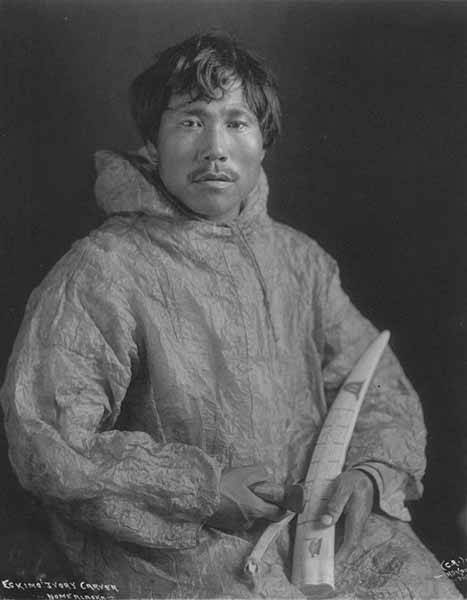
 Eskimo Ivory Carver. Nome, Alaska. Photo by H. G. Kaiser, circa 1912, University of Washington Special Collections.
 A new law, the Alaska’s Right to Ivory Sales and Tradition Act or the ARTIST Act, co-sponsored by Senators Dan Sullivan and Lisa Murkowski of Alaska, makes significant changes to the legal landscape regulating marine mammal ivories in the United States. Federal amendments to the Marine Mammal Protection Act on June 12, 2026 will enable Native Alaskan walrus carvings to be sold in all states.
For decades, federal law has recognized that Alaska Native communities may harvest marine mammals, primarily walrus and whale, for food and to utilize walrus and cetacean teeth or tusks, marine-mammal ivory, bone and baleen to make traditional clothing and handicrafts – for their own use and to sell these to the public.

Herd of walruses in water, Bristol Bay, Walrus Islands, Round Island. 9 July 2001, USF&WS, public domain.
Congress enacted the Marine Mammal Protection Act of 1972, or MMPA, to establish a general moratorium on the taking and importation of marine mammals and marine-mammal products. From the beginning, however, MMPA contained an exemption recognizing the subsistence and cultural practices of Alaska Native coastal communities. Only authentic Native articles could be sold in interstate commerce.
Thus, walrus ivory has long occupied a fundamentally different legal category from African elephant ivory. Walrus is a living marine-mammal species governed primarily by the MMPA. By contrast, fossilized mammoth and mastodon ivory comes from extinct species and is not regulated under the MMPA.
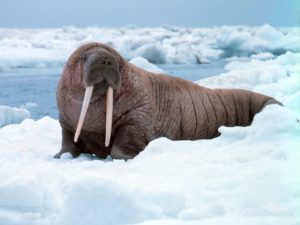
Large walrus on the ice – Odobenus rosmarus divergens – contemplating the photographer – Alaska, Bering Sea, Captain Budd Christman, NOAA Corps.
However, in 2016, in order to protect elephant populations globally from poaching to obtain their ivory tusks, the U.S. Fish and Wildlife Service adopted a near-total federal restriction on commercial trade in African elephant ivory. The regulation, formally titled the “Revision of the Section 4(d) Rule for the African Elephant,” contained only limited exceptions for qualifying antiques, musical instruments and certain manufactured items.
Importantly, the new federal rule was limited to African elephant ivory. The Fish and Wildlife Service specifically stated that it did not regulate ivory derived from walrus, whales or mammoths. Nevertheless, the public message was that “ivory is illegal” and moreover, “buying ivory is immoral.” Tourists, collectors, online marketplaces and retailers became reluctant to purchase or list any ivory product, regardless of species or legal origin.
State laws enacted after elephant ivory ban
Soon after, a wave of state ivory bans were enacted. Unlike the federal rule, a number of state laws defined “ivory” broadly enough to include walrus, whale, narwhal, mammoth and mastodon material. For example, California defines ivory to include a tooth or tusk from an elephant, hippopotamus, mammoth, mastodon, walrus, warthog, whale or narwhal.

African bush elephant (Loxodonta africana), Amboseli National Park, Kenya, Diego Delso, delso.photo, 22 May 2024, License CC BY-SA
New Jersey’s 2014 law similarly defined ivory to include material from virtually all sources and prohibited its importation, sale or possession with intent to sell.
California, Hawaii, New Jersey, New York, Oregon, Washington and the District of Columbia all failed to protect marine-mammal ivory items lawfully produced by Alaska Natives. The resulting patchwork created both legal obstacles and a damaging perception that Alaska Native marine-mammal art was illegal.
Native artisans harmed by overbroad restrictions

Kingikmiut Eskimos paddling an umiak, a boat made of animal skins, during a whale hunt, Bering Strait, Cape Prince of Wales, Alaska, between 1901 and 1906, Silver gelatin print, Photo by Susan R. Bernardi, University of Washington Special Collections.
The economic consequences were in some cases catastrophic for Alaska Native carvers and artists, especially from remote communities where economic opportunities were limited. One St. Lawrence Island carver estimated that his income had fallen by approximately 40 percent, while a craft fair organized for cruise-ship passengers in Nome that provide income to many Alaska Native artists reportedly produced no sales after visitors learned that the artwork contained ivory. This sort of market confusion – as well as common sense objections to the state laws’ rationale raised by dealer and collector organizations such as ATADA, the Authentic Tribal Art Dealers Association – drove the legislative campaign to amend the Marine Mammal Protection Act. ATADA has worked tirelessly to educate policymakers and the public on these issues.
William Hughes, President of ATADA, responded to the bill’s passage:
“ATADA welcomes the protections to Alaska Native carvers offered by the ARTIST Act, although such remedial action is long overdue. The income loss to Alaska Native artisans due to consumer confusion and market stigma caused by the MMPA and subsequent State laws was completely foreseeable. We anticipate that Native American artisans will suffer similar income loss as a result of consumer confusion and market stigma caused by the Safeguard Tribal Objects of Patrimony Act unless this well intentioned law is also amended or clarified through implementing regulations.”
A nine year legislative process is completed

King Island Eskimos Carving Ivory Near Nome, 1 September 1949, By Haddon, E.P. (U.S. Fish and Wildlife Service url) [Public domain], via Wikimedia Commons; Handbook to the ethnographical collections, British Museum. Dept. of British and Mediaeval Antiquities and Ethnography, 1910, By Internet Archive Book Images [No restrictions], via Wikimedia Commons
The first Congressional proposals to address this were broader than the 2026 amendment. Some proposals included mammoth and mastodon ivory. The Congressional committee reviewing earlier proposals were concerned that elephant ivory could be falsely represented as legal mammoth or walrus ivory, particularly when buyers or officers enforcing the law could not readily distinguish among the materials.
The first bill bearing the ARTIST Act title was introduced by Alaska’s Senator Don Sullivan in September 2024, the Alaska’s Right to Ivory Sales and Tradition Act. Rather than attempting to protect every category of ivory associated with Alaska commerce, the proposal concentrated on authentic Alaska Native articles made from marine-mammal materials. However, the act failed to pass during that Congressional session.
Senator Sullivan, with Senator Murkowski as a cosponsor, reintroduced the measure in 2025. The full Senate passed the amended bill by unanimous consent on October 8, 2025. Representative Nick Begich introduced a similar bill that month. The House Natural Resources Subcommittee on Water, Wildlife and Fisheries held a hearing on March 26, 2026 and approved an amended version. Eventually, the House took up the earlier Senate bill and passed that version. The bill was presented to the president on June 8. He approved it on June 12, making it Public Law 119-99.
What the ARTIST Act actually does

Ivory amulet from Alaska, Tlingit, 1820-50, Metropolitan Museum of Art, photo Wmpearl, CC0 1.0 Universal Public Domain Dedication.
The ARTIST Act does considerably more than add a one-sentence exemption to state ivory laws. It defines “marine mammal ivory” as including a tooth or tusk from a walrus or a species of cetacean.
It rewrites the earlier Alaska Native exemption in the MMPA. The act now defines an “authentic Alaska Native article of handicrafts and clothing” as composed wholly, or in some significant respect, of natural materials. Traditional Alaska Native handicrafts are defined to include “weaving, carving, stitching, sewing, lacing, beading, drawing and painting.”
Items must be produced, decorated or fashioned through traditional Alaska Native handicrafts by an Alaska Native who resides in Alaska and dwells on the coast of the North Pacific or Arctic Ocean. The work may not be produced through a pantograph (used in engraving to carve exact copies in different sizes), multiple carvers or another mass-copying device.
The law expressly preempts state prohibitions. A state may not prohibit the interstate commerce, importation, sale, trade, barter, possession or possession with intent to sell or barter marine-mammal ivory, marine-mammal bone or baleen that has been incorporated by an Alaska Native into an authentic Alaska Native article of handicrafts or clothing.

Engraved walrus tusk by Angokwazhuk (Happy Jack), c. 1900-1904, walrus ivory and graphite, Fenimore Art Museum, Photo by WmPearl, 2019, CC0 1.0 Universal Public Domain Dedication.
It preserves federal conservation authority. If a marine-mammal species or stock subject to Alaska Native taking is determined to be depleted, the responsible secretary can impose restrictions based on the species or the area or time when the marine mammal is taken.
The act also adds an evidentiary requirement that received less attention in public announcements but which reflects deference to Native traditional knowledge in recent amendments to NAGPRA. In making depletion determinations and findings of adverse impacts affecting covered Alaska Native communities, the secretary must state in writing that “in consideration of the whole record, including Indigenous knowledge, such regulation, assessment, determination, or finding is supported by substantial evidence.” Finally, the act contains a rule of legal construction stating that it does not diminish existing tribal rights or undermine government-to-government consultation.
What the law does not do

Eskimo ivory carver, 1912, Library of Congress, digital ID cph.3c01243.
Raw tusks or unworked materials are not protected – only finished handicrafts meeting the specific criteria under the law. The law does not authorize non-Natives to harvest walruses or produce qualifying authentic Alaska Native articles from newly harvested walrus ivory.
Unfortunately, the law does not protect objects made from fossilized mammoth or mastodon ivory from state bans, a step which has been urged as a rational accompaniment to the provisions of the current act, but which cannot be accomplished by amending the MMPA, which only applies to marine mammals.
The act also does not eliminate federal import, export, Endangered Species Act, CITES or other wildlife-law requirements that may apply to particular species or transactions. It does not displace other federal conservation and international-trade rules.

Eskimo family at work carving ivory and sewing fur clothing, St. Michael, Cantwell, J. C. (1904) Report of the Operations of the U. S. Revenue Steamer Ninivak on the Yukon River Station, Alaska, 1899-1901, Washington, D.C.: Government Printing Office University of Washington, Freshwater and Marine Image Bank, public domain.
There is no new federal certification, tagging or marketplace-registration program. Its protection depends on whether the article actually satisfies the statutory definition of an authentic Alaska Native article. Artists, dealers and purchasers therefore have a strong interest in preserving reliable information about the artist, materials and origin of a work.
The ARTIST Act represents the culmination of nearly nine years of hearings, correspondence, committee action and repeated bill introductions. It also reflects an evolution in legislative strategy. The enacted law protects only authentic Alaska Native marine-mammal art while leaving fossil ivory and broader elephant-ivory regulatory structures outside its scope. This leaves federal and state laws with unfortunate, too broad provisions that have resulted in the seizure and destruction of authentic antique objects made of ivory, often by pulverizing them in “ivory crush” actions, rather than more targeted procedures against smuggling or illicit import that would actually preserve living species.
For Alaska Native artists and rural communities, the law provides something that previous federal policy did not: an explicit national rule stating that qualifying traditional handicrafts cannot be outlawed by individual states.
Statement of support by World Wildlife Fund
On June 3, 2026, the World Wildlife Fund issued the following statement from Steve MacLean, Managing Director, US Arctic Program:
“The ARTIST Act reaffirms the rights of Alaska Native artists to create and sell authentic artworks and traditional handicrafts in the US that are made from sustainably sourced marine mammal products, including walrus ivory. This longstanding cultural tradition is a vital source of economic opportunity and income for many Alaska Native communities, and walrus remain a critical component of Indigenous food security and cultural expression. Alaska’s congressional delegation, working with the Eskimo Walrus Commission, has shown dedication and leadership in advancing this bill, which helps to restore opportunities for Alaska Native Artists to share their artwork and provide for their families.”