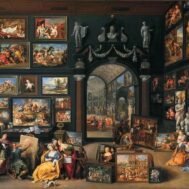
Norman Rockwell’s “So You Want to See The President!” Photo: Bruce M. White. Courtesy of the White House Historical Association.
Norman Rockwell, So You Want to See The President! (1943). Photo courtesy of Heritage Auctions.
So You Want to See the President!, a series of drawings originally published by the Saturday Evening Post in 1943, was recently purchased by the privately funded, nonpartisan White House Historical Association. It paid $7.25 million for Rockwell’s four interconnected panels at a November 2025 auction and put them on public view at the People’s House exhibition center in June 2026.
The association describes the work as showing “democracy in action.” That is true, but it is more complicated than the phrase implies.
The work was commissioned by Franklin Roosevelt’s press secretary, Stephen Early. Rockwell spent a week hanging out in the Oval Office waiting area and watching the people who waited and passed in. Across the four panels, journalists talk and smoke; Miss America sits beside her publicity man; senators converse; military officers lean together; White House employees carry messages. Roosevelt appears only at the end, barely seen through an opened door.
The White House becomes a somewhat grander version of a doctor’s waiting room, populated by recognizable American “types.”

“Ours to Fight For — Freedom of Speech, Freedom of Worship, Freedom from Want, Freedom from Fear.” Author Office of War Information, Poster illustrated by four paintings by Norman Rockwell for The Saturday Evening Post, United States Government Printing Office 1943, University of North Texas Digital Library, public domain.
But the scene also reveals the boundaries of Rockwell’s America at this time. The people depicted are all the sort who get access to power. They all belong to some accepted institution and they all accept each other. They are not workers or farmers and they are all White. The panels are not discredited by these limitations– after all, they are based on what Rockwell saw. While there is an intentional nostalgia, a “this is America!” good feeling, they also show that “the people’s house” has always required permission to access it; we just can’t see who is excluded.
Rockwell faced similar constraint in other situations. He later recalled being instructed to remove a Black person from a group scene because the Post permitted Black figures only in service occupations. But he also benefitted by allowing his work to be censored. Rockwell was not a powerless employee; he was the Post’s most popular artist and profited by iterating its preferred conception of America.
In the same year, 1943, Rockwell also created his famous Four Freedoms panels, which attempt to render Roosevelt’s global democratic principles in intimate scenes of local life. They were extraordinarily effective wartime propaganda, but they also conveyed an almost all-White domestic experience.
It is fair to say that Rockwell saw his own later career as a redemption story – and left evidence of self-indictment. In 1962 he said: “I was born a White Protestant with some prejudices that I am continuously trying to eradicate.” He added that he was angry at unjust prejudice “in other people and in myself.”
When he resigned from the Post, he wrote that “the work I now want to do no longer fits into the Post scheme.” At Look magazine Rockwell acquired room to address poverty, segregation, racial violence and international human rights. His work gained a reportorial severity.
The first great result was The Problem We All Live With, which depicts six-year-old Ruby Bridges walking to the recently desegregated William Frantz Elementary School in New Orleans in January 1964. Four federal marshals surround her, but Rockwell crops their heads from the frame. On the wall behind the child are racist graffiti, the initials of the Ku Klux Klan and the remains of a tomato thrown by protesters.
The response included hostile letters accusing the artist and Look magazine of propaganda. The criticism did not stop him. Ruby Bridges later praised Rockwell for having the courage to make such a statement after a career associated with conventional family imagery.

Photo of a study for “Murder in Mississippi (Southern Justice)” copyright Norman Rockwell. Wikimedia Commons {{Non-free 2D art}} Fair Use for subject of article.
One year later, Rockwell went further. On June 21, 1964, civil-rights workers James Chaney, Andrew Goodman and Michael Schwerner disappeared near Philadelphia, Mississippi. They had been investigating the burning of Mount Zion Methodist Church and assisting Black residents with voter registration. After the men were released from local custody, Deputy Sheriff Cecil Price and members of the Ku Klux Klan intercepted and murdered them, burying their bodies in an earthen dam. Rockwell was commissioned to illustrate a Look article about the killings, published under the title “Southern Justice” on June 29, 1965.
For Murder in Mississippi, Rockwell initially conceived a wider horizontal scene: the three workers on one side, Price and the armed posse closing in from the other. As the design developed, he removed the identifiable killers. In the published study, their presence survives as long, threatening shadows entering the illuminated space around the victims.

African American and white Mississippi Freedom Democratic Party supporters demonstrating outside the 1964 Democratic National Convention, Atlantic City, New Jersey; some hold signs with portraits of slain civil rights workers James Earl Chaney, Andrew Goodman, and Michael Schwerner. Photo Warren K. Leffler 24 August 1964, Library of Congress Prints and Photographs Division Washington, D.C.
Rockwell pursued the assignment with extraordinary intensity. He collected press photographs and newspaper accounts, studied details of the crime and posed models under harsh studio lights. The finished scene is not a literal reconstruction but a pietà. Schwerner stands wounded, supporting Chaney, while Goodman lies on the ground. The interracial embrace at the center is both physical and political. Two men remain upright only by holding one another. Their murderers appear only as shadows. Although Rockwell worked on a finished painting for much longer, Look’s editor chose and published the sketch. Rockwell acknowledged why: by the time he completed the final, “all the anger that was in the sketch had gone out of it.”
The bravery of Rockwell’s civil-rights work operated at several levels. He risked the goodwill of an enormous middle-class audience that associated his name with reassurance. It was social – he publicly opposed segregation at a time when many readers responded by calling his work dishonest propaganda and treating racial integration itself as a crime. It was aesthetic – his later work does not deliver comfort but a direct challenge to the viewer.
The second co-option

Screenshot of Department of Homeland Security post using Norman Rockwell painting without permission. Painting courtesy of the Norman Rockwell Family Agency.
Rockwell’s works’ vulnerability to political appropriation did not end with his death. In 2025, without seeking permission, the Department of Homeland Security placed reproductions of paintings including Salute the Flag and Working on the Statue of Liberty in social-media messages about protecting the American way of life and recruiting “homeland defenders.” Rockwell’s descendants were appalled and objected that the works were being used to support anti-immigrant politics incompatible with the artist’s beliefs.
Rockwell’s family argued that his work had been “marshalled for the cause of persecution toward immigrant communities and people of color.” They pointed to The Problem We All Live With, Murder in Mississippi and New Kids in the Neighborhood as evidence of a legacy grounded in compassion and a desire for justice.
By purchasing So You Want to See the President!, the White House Historical Association has preserved an important work and made it accessible. That is a genuine public benefit. It is hoped that the work will be displayed to show how democracy was imagined in 1943: both patriotic and hierarchical.

President Barack Obama, Ruby Bridges, and representatives of the Norman Rockwell Museum view Rockwell’s “The Problem We All Live With”, hanging in a West Wing hallway near the Oval Office, July 15, 2011. Ruby Bridges is the girl in the painting. (Official White House Photo by Pete Souza), public domain.
The most responsible step for the association to do would be to place So You Want to See the President together with later Rockwell works. The 1943 panels ask who is permitted to wait outside the president’s office. The Problem We All Live With asks why a Black child requires federal officers to enter a public school. Murder in Mississippi asks what happens when local government joins the mob.
In 2011, at Ruby Bridges’s suggestion, President Barack Obama borrowed The Problem We All Live With and put it up outside the Oval Office – essentially in the same place where people waited to see the President. Viewing it with Bridges, Obama said that without the actions of people like her, he might not be standing there as president. Here, the painting did not merely decorate the place of power. It reminded power of its debt to the past.