Twenty years after the Taliban blew up two famous Buddha statues, Afghans commemorated their loss at a ceremony in the central Bamiyan Valley on March 9. As part of the commemorations, a lantern-lit procession of Hazara families from the Bamiyan Valley led to the base of the sandstone cliff where the statues once stood. The $120,000 projector used for the installation was donated by a Chinese couple, Janson Yu and Liyan Hu. Yu and Hu were saddened by the destruction of the statues in 2001. Wanting to pay tribute, they requested permission from UNESCO and the Afghan government to do the project. A few months later, the Taliban would retake Kabul and Hazaras would again face severe repression. Screenshot from Radio Free Europe-Radio Liberty.
 PRECIS
This article is based upon testimony submitted September 8, 2025 to the Cultural Property Advisory Committee at the U.S. Department of State in opposition to the renewal of an emergency cultural property agreement that imposed import restrictions on art and artifacts from Afghanistan. Months before the CPAC committee heard and took testimony on the original request, in 2021, there was no longer a “Government of Afghanistan” – the Taliban were in charge instead. Nonetheless, the U.S. issued regulations in 2022 banning import based upon a “request” from a “former government of Afghanistan” that had no legal existence. Among the many concerns raised by this action is that the law that restricts imports also requires that seized artifacts be given back to the State Party, in this case, the Taliban.
Today, Afghanistan’s heritage continues to suffer devastating losses under Taliban rule. Since retaking power, the Taliban have presided over the industrial-scale destruction of archaeological sites, the neglect of fragile monuments, and the outright sacrifice of world-renowned Buddhist and Islamic sites for short-term profit. The most dramatic example is Mes Aynak, a vast Buddhist monastic complex layered over one of the world’s richest copper deposits. In August 2025, Interior Minister Sirajuddin Haqqani—a U.S.-designated terrorist—met with Chinese representatives in Kabul. It appears that China will soon commence open-pit mining that will erase the site entirely. This reflects a broader pattern in which revenue and patronage take precedence over preservation.

Screenshot of Hazara families from Bamiyan coming to see the statue recreated in light.
Elsewhere, satellite imagery and field reports document systematic bulldozing in Balkh, flattening Bronze Age and Iron Age settlements. The Qosh Tepe Canal has cut directly through the archaeological heartland of northern Afghanistan, obliterating dozens of lesser-known sites. Bamiyan, already scarred by the Taliban’s destruction of the great Buddhas in 2001, remains unstable, with caves collapsing and commerce encroaching into buffer zones. Even Islamic monuments are at risk: Herat’s Musalla complex and the Minaret of Jam teeter on the edge of collapse, saved only by emergency stabilization funded and implemented by international NGOs.
The Taliban’s repression compounds these losses. Women and girls are barred from education, scholars are silenced, and minority communities—especially the Hazara—face persecution amounting to cultural erasure. Claims of heritage protection are contradicted by neglect, outright destruction, and the commodification of sites. Afghanistan’s past is being dismantled by those who rule its present.
I. Introduction

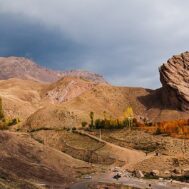
Sunrise over Bamiyan Valley, photo by Afghanistan Matters from Brunssum, Netherlands. CCA 2.0 Generic license.
The Committee for Cultural Property (CCP[1]) and the Global Heritage Alliance (GHA[2])jointly submit this testimony in response to the State Department’s proposal to extend emergency restrictions on imports of Afghan archaeological and ethnological materials first imposed in 2022.[3] We oppose the proposed five-year extension of these restrictions under 19 U.S.C. § 2603. The emergency measures, unilaterally enacted in February 2022, were accompanied by an extraordinarily broad Designated List spanning from “approximately 50,000 B.C. to A.D. 1920” and covering sweeping categories of objects.[4] The current proposal would prolong for another five years what was intended as a temporary emergency measure, transforming it into a de facto long-term blockade.
Why an emergency extension fails the CPIA’s legal tests
This extension should be denied for four core reasons:
- Procedural and legal defects. The CPIA requires precise statutory predicates that are not met here: the emergency standard of § 2603 is designed for narrowly tailored, time-limited action and cannot lawfully be converted into an all-purpose, multi-year blockade across tens of millennia of material. The statute’s text, structure, and implementing regulations require targeted, evidentiary showings, not a sweeping, open-ended import prohibition. (§ 2603)
- Incompatible counterpart and repatriation destination. By law, U.S. seizures must be “first offered for return to the State Party.” [5] In today’s circumstances, that means return to the Taliban authorities—whose Interior Minister for years has been Sirajuddin Haqqani, long the subject of a U.S. wanted listing and widely reported as a designated terrorist. That is not a tenable human-rights or cultural-rights situation, nor is giving art and artifacts to the Taliban in conformance with preservation, with the goals of the 1970 UNESCO Convention or consistent with U.S. policy interests.
- Failure to target the actual drivers of loss. The most acute threats to Afghanistan’s heritage today are state-sanctioned or militia-enabled extractives (not a U.S. art-market demand): illegal and uncontrolled mining[6] (including colossal copper development at Mes Aynak) and industrial-scale bulldozing of sites in Balkh and elsewhere.[7] Broad U.S. import restrictions do not reduce those harms; they risk pushing refugees’ lawful possessions into forfeiture while doing nothing to disincentivize destruction inside Afghanistan.
- Diaspora equity and cultural-rights concerns. Thousands of Afghans who assisted the United States have fled into the diaspora; many preserved books, family heirlooms, or devotional objects as anchors of identity. A sweeping Designated List puts those very items at risk of seizure and return to the Taliban. If the U.S. is serious about protecting Afghan heritage and the communities who cherish it, it should create safe-haven pathways and lawful custodial frameworks—not expand a legal machinery that reflexively repatriates to a regime responsible for the destruction of Bamiyan’s Buddhas and the evisceration of civil and cultural rights.[8]
The 2022 ‘emergency’ action laid down a Designated List that purported to encompass a vast range of periods and categories—from 50,000 B.C. through A.D. 1920—ensnaring multi-civilizational material and cross-border cultures that spanned what is now Afghanistan, Iran, Turkmenistan, Uzbekistan, Tajikistan, and Pakistan. Renewing that sprawl, without a careful pruning to CPIA-compliant categories, risks:
- Overbreadth that captures lawful, long-circulating objects with no Afghan site-specific origin;
- Conflicts with diaspora cultural rights and refugee property; and
- Requires a return-seized-objects-to-Taliban pipeline under the CPIA’s § 2609.[9]
If CPAC chooses not to reject the extension outright, it should at minimum insist that any action be tightly re-scoped, time-boxed, prospective, and tethered to specific, evidenced emergency categories – not a list that extends to the early twentieth century.
II. The facts support neither an emergency nor a bilateral agreement
The “emergency” standard has been stretched beyond recognition

Conservator Sherazuddin Saifi works on pieces of a small statue damaged by the Taliban because they were judged to be against Islam, at the National Museum of Afghanistan, in Kabul, Afghanistan, prior to return of Taliban, Aug. 17, 2019. Voice of America photo.
The CPIA framework is clear. [10] Congress set a high bar for § 2603: under emergency restrictions, materials must be newly discovered and in jeopardy or tied to a particular site of high significance facing crisis-level threats, or constitute a particular culture’s record in crisis—and the U.S. restriction must be likely to reduce the incentive for pillage. Emergency tools are not a blank check. Extending them yet again—without tethering to specific, evidenced emergency categories and without a viable, rights-respecting return destination—strays beyond the statute. A catch-all list running from the Paleolithic through the early 20th century, renewed in a five-year cycle, is not what § 2603 authorizes.
Moreover, a global market-deterrence rationale rings hollow in this case. The best current evidence shows that the principal drivers of site destruction are inside Afghanistan—bulldozer-level looting and state-sanctioned or militia-mediated extractives—not a U.S. buyer pulling looted material through American ports. Satellite analysis by the University of Chicago and field reports from the French Archaeological Delegation in Afghanistan (DAFA) documented industrial-scale bulldozing of at least 162 ancient settlements between 2018–2021 and continuing destruction at 37 sites after the Taliban takeover. No plausible showing has been made that U.S. import controls reduce the incentive to run heavy machinery across Bronze Age sites.
The “return to State Party” rule points to the Taliban
The CPIA’s return rule cannot be wished away: designated material forfeited to the U.S. “shall – (1) first be offered for return to the State Party.” [11] That is black-letter law, mirrored in the Customs regulations. Practically, that means heritage seized from refugees or the lawful market is routed back to the Taliban.
Nor is there an easy “safe harbor” workaround. Some have cited defense-authorization provisions out of context, but there is no blanket statutory authority to seize under the CPIA and then warehouse Afghan cultural property in U.S. museums indefinitely; the mandatory first step is return to the State Party.
The four § 2602 determinations (if this were treated as bilateral) cannot be satisfied
Should CPAC or the Department attempt to convert this emergency into a long-term bilateral in substance, the four determinations impose hurdles that are not satisfied here:
- Jeopardy from pillage. Yes, heritage is under threat; but the types of harm (state-aligned mining, bulldozing, and infrastructure development) Afghanistan’s pillage and destruction is primarily state-sponsored or state-tolerated and will not be deterred by U.S. import controls.
- Self-help. The Taliban’s governance on culture is a patchwork of ad hoc gestures (often funded and executed by non-Taliban entities such as ALIPH and the Aga Khan Trust for Culture) coupled with systemic repression and unpredictability. That is not “measures consistent with the Convention.”[12]
- Concerted international response / least-drastic measures. UNESCO and bilateral donors (for example, Italy at Bamiyan/Shar-i-Gholghola) are funding targeted stabilizations; those are the right tools. A U.S. import blockade will not increase foreign aid or NGO assistance; it risks collateral harms without changing incentives on the ground.
- International interchange. The Taliban government is not even recognized by the United States. The Taliban do not engage in cultural relations. As of August 2025, only one country, Russia, has formally recognized the Taliban government of Afghanistan. Many other countries, including China and the UAE, have established diplomatic ties and exchanged high-level visits with the Taliban but have not extended formal recognition. On the contrary, sweeping Designated lists of blocked objects over 50,000 years of culture and up to A.D. 1920 undercut legitimate research, exhibition, and cultural life for Afghans forced into a diaspora, especially when the return destination is a regime that criminalizes images and constricts scholarship and access.
III. Razing Afghanistan’s Past Under the Taliban
The CPIA presumes that the State Party is committed to Convention-consistent self-help. That presumption fails here. Since the destruction of the Bamiyan Buddhas in 2001 – the most potent global memory of Taliban cultural policy – and the destruction with sledgehammers of the collections of the National Museum in Kabul the United States has ample reason to distrust the Taliban’s cultural policies.
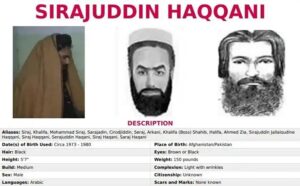
FBI Wanted Poster for Sirajuddin Haqqani, Miniter of Interior (which controls the Culture Ministry) in Taliban government of Afghanistan.
The Interior Minister, Sirajuddin Haqqani, who has for years been listed as a wanted terrorist by U.S. authorities, holds the ‘culture’ portfolio for Afghanistan. The lack of true concern over the preservation of heritage can be seen in the August 20, 2025 meetings between China’s foreign minister Wang Yi and Haqqani in Kabul. These meeting focused on agreements over mining and security cooperation: specifically, a mining agreement that will open Mes Aynak to copper and cobalt extraction starting now[13] – and the Taliban’s promise to cooperate with China in refoulement of Muslim refugees escaping China’s concentration camp province of Xinjiang, despite such forced returns being a violation of international human rights norms.
Taliban spokesmen declare that they have assigned hundreds of men to protect heritage sites and provincial officials stage photo-ops beside scaffolds and sandbags. However, the most visible conservation projects in Afghanistan today are not Taliban initiatives; they are limited to fragile, foreign-funded triage.
The Taliban say they are now guardians of culture. They tell visiting journalists that they will protect Afghanistan’s antiquities, that looting is a relic of the chaos and war that they themselves have banished. Yet the ground tells another story, written in the gouges of bulldozer blades and the scatter of crushed brick where citadels once stood. In the years since the Taliban’s return, the destruction of the archaeological record has not ended, it has been professionalized at the service of other state goals.

Bronze Age site of Dilberjin in northern Afghanistan, excavated by archaeologist Victor Sarianidi in 1970s, showing destruction by heavy machinery in 2021. Google Earth.
What used to be furtive pits dug with shovels is now broad-daylight earthmoving directed by men with access to machines, fuel, and crews. In a country where the Taliban hold decisive power, heavy machinery does not roam without permission. The result is a slow, mechanical catastrophe: whole Bronze Age and Iron Age settlements scraped flat. With the Taliban regime’s grip on provincial authority, it is officials and commanders who decide where backhoes operate and when they look the other way.
Satellite analysis has made the scale of loss impossible to deny. Researchers at the University of Chicago, working with French and Afghan archaeologists and colleagues on the ground, compared high-resolution imagery over time across the north. The pattern is chillingly consistent. At site after site—especially in the region of Balkh, the core of the ancient lapis route—one sees initial scars where bulldozers shaved the crowns of mounds, followed by dense constellations of pits as smaller crews comb the debris.
Professor Gil Stein, who leads the University of Chicago’s Center for Cultural Heritage Preservation, notes that more than 29,000 archaeological locales have been documented across Afghanistan; between 2018 and 2021 alone, at least 162 were devastated, roughly one per week. But since 2021, the mechanized method has persisted and spread under Taliban control, with at least thirty-seven additional sites torn open—often in districts that changed hands first as the movement advanced on Kabul.[14]
Philippe Marquis, who directs the French Archaeological Delegation in Afghanistan (DAFA), has mapped the economy that powers this erasure, from villagers, to local landowners, goldsmiths, and moneylenders to mid-tier traders who can clean, mend, and price objects, and who maintain routes toward the Gulf and other regional buyers.[15] Today, the U.S. and European markets – more sensitive to provenance and law, no longer play an important role.
DASHLI
Dashli was excavated in the 1970s by Russian archaeologist Victor Sarianidi, who discovered many Bronze Age centers in Afghanistan and Turkmenistan. The site stood relatively intact into the twenty-first century. By 2021, nearly every architectural feature had been obliterated by bulldozers. A defining site of the Central Asian Bronze Age is gone.
BAMIYAN VALLEY AND SHAR I GHOLGHOLA

The Hunter King from Kakrak, a valley next to Bamiyan. Wall paintings from the 7th-8th century, Kabul Museum, Afghanistan.
In Bamiyan, twenty-four years after explosives ripped the Buddhas out of the cliff, cracks widen, caves crumble, and ad hoc commerce creeps into buffer zones, only receding when outside pressure forces a pause. The landscape around Bamiyan tells a harder story, one in which NGO persistence collides with the scale of damage and the inertia of local power. After the Buddhas fell, a generation of “master plans” accumulated—each aiming to balance cliff stability, mural conservation, development controls, and the needs of the Hazara communities who live in the valley. Because the Taliban refuse to protect the area close to the site, makeshift commerce inches into the buffer zone, coal depots appear and disappear under pressure, and every freeze-thaw cycle pries the cliff wider.[16] The significance of the Italian government’s renewed funding in 2023, channeled through universities and development agencies, is less a promise to restore what cannot be restored than a commitment to defend what is left: safer paths for visitors, genuine risk mapping, and the steady labor of consolidating surfaces so the painted caves do not slough away. That an official in the Taliban’s local directorate could say aloud that Shahr-i Gholghola might collapse within a year if nothing were done shows both the fragility of the moment and the paradox that makes NGO work possible: cooperation is granted when urgency serves everyone’s interest and withdrawn when other priorities intrude.[17]
MES AYNAK
“Mes Aynak is the most important discovery of the century. Destroying Mes Aynak would be like destroying Atlantis.”
U.S. Archaeologist Mark Kenoyer, speaking in the 2014 documentary film, Saving Mes Aynak, directed by Brent E. Huffman[18]
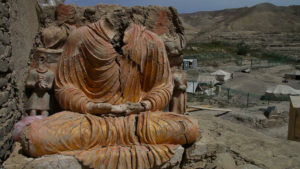
Mes Aynak, Seated Buddha. Photo Brent Huffman, “Saving Mes Aynak.” Archeologists have uncovered countless priceless artifacts at an ancient Buddhist settlement south of Kabul: an ancient copper mine, a series of monasteries, homes and workshops.
Nowhere is that tension more acute than at Mes Aynak, the staggering Buddhist complex layered above one of the world’s largest copper deposits. Mes Aynak is arguably Afghanistan’s most concentrated cultural-and-economic collision: one of the world’s largest unworked copper deposits directly beneath a vast, fragile Buddhist complex. Temporary shelters and emergency consolidations – funded by ALIPH and executed by the Aga Khan Trust – aimed to buy time to remove what can be moved.
Public claims by the Taliban that Mes Aynak could be mined by under-site tunneling without harming the surface were not matched with engineering plans. Chinese operators have indicated that a pit mine is the only profitable way to exploit the ore body at scale—an approach that would wipe out the site. In August 2025, a meeting between Interior Minister Haqqani and Chinese officials rendered an agreement to move forward without hesitation – now. The logic of the state is clear: copper is revenue; heritage is negotiable. Again, U.S. border controls can neither change those economics nor save Mes Aynak.[19]
BALKH
Balkh, the “Mother of Cities,” lies at the center of a web of trade that once carried lapis lazuli, copper, and tin to the edges of the known world. From the air, rings of ancient walled settlements once puckered the steppe. In Balkh’s plains, ring-forts that once held metallurgists and merchants are now leveled pads, easier for tractors to cross. Up close, they are now flattened shelves of compacted earth.
TEPE ZARGARAN
At Tepe Zargaran, looting in the 1990s began as a grim form of rural income under the overview of local commanders. Villagers pried carved blocks from Kushan-period buildings, likely an associated Buddhist stupa, and carried them away by hand. By 1995, farmers had set heavy stones from the monument into irrigation channels—practical masonry where sanctuaries once stood. When archaeologists returned after 2006, they found fragments of Hellenistic column drums and capitals re-used in canal walls and embankments.[20]
QOSH TEPE CANAL
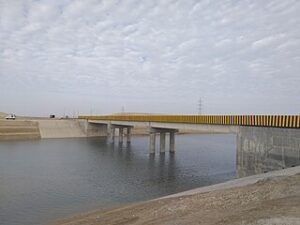
Qoshtepa canal,
Photo by Bek1998, 13 December 2023, CCA-SA 4.0 International license.
Even where mining is not the immediate driver, state development under Taliban authority has become a blunt instrument of loss. The Qosh Tepe Canal, begun in 2021–2022, is the most dramatic example. Its projected 250-kilometer course slices across the Balkh oasis, a palimpsest of ancient settlements. By the time more than one hundred kilometers had been dug, aerial imagery showed the canal’s raw trench passing close to or directly through sensitive zones. After protests by archaeologists and appeals from abroad, the route was reportedly nudged to spare one well-known site. That modest adjustment came far too late for dozens of lesser mounds, and it does nothing to blunt the secondary impacts: new roads, staging areas, spoil piles, and the steady rumble of trucks. Far to the south, in Sistan, a separate canal has already demonstrated how “development” can chew through heritage even without direct contact, as the construction footprint spreads, contractors take shortcuts, and local officials grant favors.
According to the Eurasia Daily Monitor,
“The canal could divert up to 20 percent of the Amu Darya’s flow, significantly reducing water supply to Uzbekistan and Turkmenistan as well as raising concerns over agricultural sustainability and potential regional conflicts due to worsening water shortages. Afghanistan is not part of existing Central Asian water-sharing agreements, increasing tensions with neighboring countries…[which] could escalate into broader regional instability.”[21]
BALA HISSAR IN KABUL
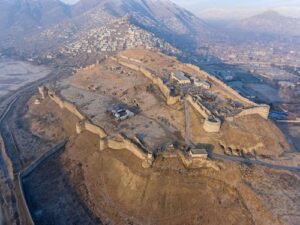
Bala Hissar, aerial view. Courtesy Aga Khan Trust for Culture.
On the heights above Kabul, the interrupted transformation of Bala Hissar into an archaeological park sits at the mercy of politics and budgets. The citadel has watched over Kabul for millennia, an acropolis repeatedly battered by coups, invasions, and civil wars. In late 2020, a plan took shape to turn the scarred hill into a full archaeological park. The partners were ALIPH, the Aga Khan Trust for Culture, DAFA, and the Afghan government—augmented by a pledge from India. The vision was expansive: excavation seasons, visitor paths, interpretation galleries, and training pipelines for Afghan conservators. Then events intervened. India’s pledge evaporated with the fall of Kabul; foreign ministries reassessed risk; permits and promises dissolved. The Aga Khan Trust for Culture’s on-the-ground capacity and ALIPH’s willingness to backstop essential work has allowed some progress. DAFA’s archaeologists exposed parts of Kushan and early Islamic layers and, crucially, keep Afghan field teams intact so expertise did not disperse.
SHEWAKI STUPA

Workers at the restoration of the Shewaki Buddhist stupa near Kabul. Courtesy International Alliance for the Protection of Heritage in Conflict Areas (ALIPH).
The work at Shewaki set an early template for what such cooperation can look like when it functions well. The Buddhist stupa east of Kabul—first noted by Charles Masson nearly two centuries ago—had long been known, but only in 2016 did a sustained, Afghan-led campaign begin to lift it from ruin. The Afghan Cultural Heritage Consulting Organisation assembled a local team that excavated the massive drum and recovered the geometry of the ceremonial stairways. By 2019, with the Ministry of Information and Culture and the Afghan Institute of Archaeology (still partners of record), the structure’s lower fabric was stabilized and its profile re-emerged against the hills. When the war’s political tide turned, the intervention did not vanish; it was fortified. ALIPH stepped in with more than $800,000 to finish the most urgent phases, keeping Afghan workers on payroll and ensuring the monument crossed the threshold from endangered relic to legible, communal landmark. However, reality of limited funds means the team has had to defer research since 2023.[22]
STABILIZATION OF THE MUSALLA COMPLEX’S 5TH MINARET, HERAT 2023-2024

Gawhar Shad Mausoleum in 1928. Herat, Afghanistan. Photograph Frédéric Gadmer.
Herat’s Musalla complex, once a marvel of Timurid ambition, has demanded a different, more surgical approach. With the ensemble largely gone, the survival of a single leaning minaret became the test of whether a city still had the means to honor the beauty it inherited. Here, too, the pattern repeats: international money and method paired with Afghan hands. The Aga Khan Cultural Services – Afghanistan undertook emergency works to arrest the tilt and consolidate the minaret’s fractured core, a mix of structural engineering and patient craft in fired brick and lime. Floods, seismic jolts, and the slow grind of erosion had pushed the tower past a safe angle; stabilization bought time. In April 2024, the Herat Department of Information and Culture said that the work on the second phase of restoration and stabilization of the Fifth Minaret has been started by the Aga Khan Foundation.[23]
MINARET OF JAM
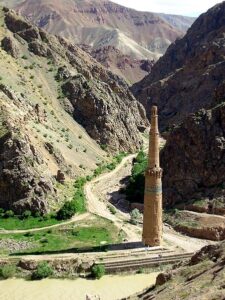
Minaret of Jam, Harirud, Afghanistan, Photo by David Adamec, 2006, public domain.
The Minaret of Jam, a World Heritage Monument of “outstanding Universal Value” and extraordinary epigraphic skill and beauty, was built by the Ghorid Sultan Ghiyas-ud-din in 1194. The minaret is 65 meters tall and made of fired bricks, many with remaining colored tilework decoration. It lies in an otherwise desolate, steep walled river-cut defile in west-central Afghanistan: it might have been a summer retreat for the Sultan’s court. Its remote location, far from any town on the banks of the Hari-Rud has played some part in its relatively high state of preservation. It has never been extensively restored – only the most basic work has been done to protect its foundations from erosion. Inscribed stones that appear to mark a Jewish cemetery of the same date are found near the minaret as are fragmentary remains of other Ghorid period buildings. In 2022, UNESCO, which was working with local contractors in Jam, was seeking cooperation with the Afghan Ministry of Culture to do more to protect the site of the minaret by setting out a buffer zone and adding to basic erosion prevention and stabilization. UNESCO now states only that measures for protection are under review and an approved program” is likely to be undertaken in the long term.” [24]
THE YU AW SYNAGOGUE IN HERAT
The “target” for conservation in Afghanistan is puzzling in this case. This project, to restore the late 19th– early 20th C Yu Aw synagogue in Herat to turn it into a community museum (though its Wikipedia page states it serves as a child care center) and the neighboring Jewish bathhouse as a local hammam may be useful to the present Herati community, but not to its former Jewish community, since there is not a single Afghan Jew remaining in Afghanistan. Afghanistan’s Jews , who had lived their for millennia, departed as refugees after the Soviet invasion and the civil war that followed, abandoning the property. Zalmay Safa, who served as historic preservation officer both for the Ghani government and the Taliban has said, “This is a cultural and historic site, which is not used as a place of worship, and the local government will support its preservation.” His intent, he said, was to be tolerant and respectful of others’ places in Afghanistan’s history. He may not be aware of the sensitivities of the Jewish community in the diaspora to the repurposing of synagogues for non-Jewish purposes.[25]
WASHINGTON D.C.’S MUSEUM OF THE BIBLE AND THE AFGHAN LITURGICAL QUIRE

Jewish prayer book, siddur, from Afghanistan, the oldest Hebrew religious writing after the Dead Sea Scrolls. Courtesy Museum of the Bible.
It is in this register—where preservation meets a displaced community, that Washington, DC’s Museum of the Bible’s work with the Afghan Liturgical Quire takes on special weight. The quire is a small book with an outsized story: Hebrew liturgical texts in a compact codex, its leaves written in Hebrew, Aramaic, and Judeo-Persian, its devotions still familiar to congregations today. For years it was misidentified and then a paper trail and photographs tied it back to Afghanistan, specifically to Bamiyan, and to a Hazara family who had safeguarded it through perilous times. Scientific analysis anchored the manuscript’s date in the eighth century, inscribed before the age of most surviving Hebrew codices. The museum did not simply acquire a rare object; it recognized that the quire was a fragment of a shattered community’s cultural life, and that its ethical care required active partnership.
The museum consulted Afghan Jewish diaspora organizations, sought scholarly review, and engaged with officials of the former Afghan government while it still functioned. The American Sephardi Federation’s public praise—unusual in a field wary of the politics of acquisition—turned on that diligence. The museum’s stated position today is that it holds the quire as custodian, and that its job is to preserve, research, exhibit, and connect—so that Afghans in exile can see a piece of their country’s Jewish past and so that the manuscript itself has a safe future. In a climate where repatriation can mean handing objects to authorities who neither represent nor protect the communities that produced them, this model offers one way forward.[26]
Flexible policies that place preservation first can offer lifelines—some to monuments, some to manuscripts, all of them to people. In an era when Afghanistan’s rulers often treat heritage as either a diplomatic prop or an obstacle to extraction, the NGOs and museums that work there are restoring a different kind of meaning: that the past belongs first to the communities who carry it and that saving a single stupa, tower, or prayerbook is not a consolation prize but a principled refusal to let history be ground under the tracks of a machine.
IV. The Taliban’s Attack on Afghanistan’s Diverse, Multi-Ethnic Living Culture
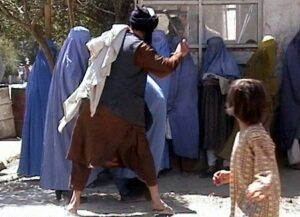
Video screengrab recorded by RAWA in Kabul showing Taliban from department of Amr bil Ma-roof (Promotion of Virtue and Prevention of Vice, Taliban religious police) beating a woman in public because she removed her chador in public. 26 August 2001, RAWA.
Despising secular education, burning books and denying the value and importance of history is even more damaging than the destruction of physical heritage. When the Taliban describe their achievements, it is often to celebrate a return to a ‘pure’ Islam. However, Taliban ‘values’ are often contrary to Islamic tradition – they are more aligned with poorly understood Sharia (the Taliban refuse to listen to Muslim scholars) and a butchered version of Pashtunwali, Pashtun customary law.[27] In fact, the Taliban have deliberately replaced community-based decision making (including the Pashtun tradition of the jirga) with top-down rule by an infallible Taliban leader. They do not follow many Pashtun codes of honor and sanctuary, but they are not traditional Salafists either. The Taliban are an essentially messianic movement that differs substantially from traditional Islam. This is a cultural transformation achieved as many young Pashtun men were sent away from their communities to train to become fighters in Pakistan territory, where they attended fundamentalist religious schools. One belief firmly retained was that women were untrustworthy and that to retain their honor, men should control all aspects of women’s lives.
What the West associates most with the Taliban is its horrific treatment of women.[28] With half the world women – and mothers – one of the most shocking policies of the Taliban is to deny the personhood of women and girls. The Taliban have made it illegal for women to make decisions for themselves, to associate even with other women publicly, and to express themselves – women are not even supposed to speak aloud in the street. The limits placed on women’s agency include denial of access to education, to work, to obtain medical care, and to leave their homes or travel unaccompanied. Rights to cultural expression in dress and adornment have been supplanted by requirements to wear chador (the full body veiling). Traditional dancing, singing and making music are forbidden, as are traditional wedding and funeral ceremonies. Such restrictions were never imposed on women before in Afghanistan, not even in strict Pashtun households, and they are antithetical to the traditional social behaviors in urban society even among most Pashtun and certainly among virtually all Farsiwan (Persian-speaking) peoples and other urbanites. They were never practiced among rural Persian speakers (aka Tajiks), Turkoman, Uzbek, Hazara, and other ethnic minorities in Afghanistan. This is a veritable crushing of a living women’s culture.
Genocide Against Afghanistan’s Hazara Shi’a Minority

Hazara family, woman and children on donkey back, Band-i-Amir, photo by Françoise Foliot, 1974-1975, Creative Commons Attribution-Share Alike 4.0 International license
There is also belief among most Taliban that Shi’a Muslims are heretics and not really Muslims at all. While no one lives in security today in Afghanistan except members of the Taliban, the Hazara community is the most threatened and oppressed community of all. In the case of the Hazara Shi’a religious minority, the Taliban have perpetuated what many observers consider a genocide – an attempt to eliminate an entire ethnic and religious group. Afghan governments have many times used the tools of severe repression, forced resettlement and Pashtun colonization to repress the Hazara minority but the Taliban have been worse even than the brutal Amir Abdur al Rahman Khan. In August 1998, the Taliban went house-to-house to massacre thousands of Hazara men in the city of Mazar-i-Sharif.[29] Since coming back to power in 2021, the Taliban have isolated and repressed the Hazara community as a whole. Hazaras have always been discriminated against in Afghanistan, but not since the late 19th century have Afghan rulers used such repression against a single ethnicity – land confiscation, deliberate starvation through burning of crops, cutting down trees, seizing livestock and committing countless horrendous acts of cruelty against the Hazara population.[30] Mass killings of Hazaras, including women and children, have occurred multiple times both in the 1990s and since the Taliban takeover and murder is commonplace – the Taliban claim the Hazaras are not really human, but devils.[31] Hundreds of thousands of Hazaras who fled to Iran or to Pakistan have been forced back into Afghanistan in recent months.[32]
V. Countering Taliban policies
The Taliban’s rejoinders to criticism have become predictable. When confronted with photos of destroyed sites, cultural officials blame mischief-makers or say that they are foreign inventions. They point to occasional seizures of supposed “antiquities,” sometimes including theatrical items, supposed “mummies” or gaudy crowns of dubious authenticity, paraded for state television. They claim the West seeks to tarnish them.
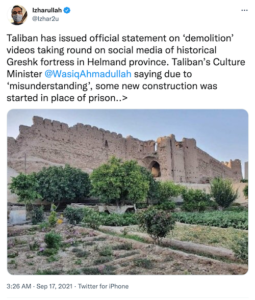
Taliban’s Twitter response to video of bulldozer knocking over wall at ancient fortress, Greshk, Afghanistan
What they leave out is telling: there are no transparent investigations into site destruction; no sanctions against local commanders who allow machines to operate; no published inventories of objects taken into “state” custody; no credible, independent oversight of major infrastructure works; and no legal or administrative framework that would allow Afghan archaeologists to work without fear and to say no when projects endanger the past.
For archaeologists who have devoted their lives to Afghanistan, the most effective brake on looting has never been the criminal law. It has been employment. When villagers can earn a solid wage working on controlled excavations and conservation—when they can point to a stabilized stupa or a repaired minaret as a source of local pride—pits dry up and bulldozers stay idle. That was the case at Shewaki; it has been the case at dozens of smaller sites, from Kabul to Bamiyan.
Where international funds pay local crews, a virtuous cycle can form: knowledge grows, household income rises, and the calculus that drives looting shifts. But such projects depend on permission and predictability. Researchers cannot promise years of employment when a provincial commander can change the rules overnight, and donors cannot justify grants when the ground they save one month might be rezoned for a road the next.
It is tempting to believe that the antiquities market is the main engine of this damage, and that tighter interdictions at faraway borders will starve the trade. But the evidence seen from the ground and the air points elsewhere. The destruction today is from a local industry of mechanized ransacking and state-sanctioned “development.” The profits lie as much in land cleared, favors dispensed, and rents collected as in any statue smuggled abroad. That is why the Taliban’s protestations ring so hollow.
The truth is simple and bleak. Afghanistan’s past is being dismantled by those who rule its present. Where foreign organizations bring money, training, and global attention, precious fragments can still be saved and communities can still be paid to guard what is theirs. But without a political will that values history as a public good and without laws that restrain officials and commanders as well as villagers, civilizations that once crossed this land will continue to be turned into fill dirt and canal lining.
In the vacuum left by collapsing institutions and the rise of a hardline state, Afghanistan’s most meaningful cultural rescue has come from a loose constellation of NGOs, foundations, and museum partners. Their projects vary in scope and philosophy from emergency shoring and micro-grants that keep a crew working for another winter, to multi-year conservation campaigns that retrain artisans and re-equip laboratories, but together they amount to a practical ethics: save what can be saved, hire Afghans to do it, document everything, and keep options open for the day when the country’s past can again be studied without fear.
VI. Heritage and the Afghan diaspora: centering human rights and lived culture

Haji Muhammad Yusuf with a Hazara orphan, displaying a new carpet woven in antique design. Kabul Afghanistan, early 1980s.
The United States assisted, evacuated, and admitted tens of thousands of Afghans who supported U.S. missions or fled persecution. Many brought (or hope to reunite with) books, manuscripts, textiles, devotional items, family heirlooms, and other cultural anchors. Under the CPIA, those items—if they fall within a padded Designated List and lack impossible provenance proofs—are at risk of seizure and statutory return to the Taliban.
That is an outcome at odds with our refugee-protection obligations, with cultural-rights norms, and with the UNESCO Convention’s spirit of fostering interchange for scientific, cultural, and educational purposes—not shutting diaspora communities out of their own heritage.
A rights-respecting heritage policy for Afghanistan must include:
- A diaspora safe-haven carve-out: lawful entry for personal/family cultural property of Afghans admitted to, paroled into, or legally resident in the U.S., subject to reasonable declarations and (where appropriate) custodial agreements with recognized institutions.
- Custodial trusteeship options: voluntary deposit programs with U.S. museums, libraries, and archives to protect and study Afghan cultural objects until such time as a legitimate, rights-respecting Afghan government can credibly provide for their safety and public access.
- A scholarship & access framework: facilitate digitization, open-access research, and diaspora co-curation—the opposite of an interdiction regime that consigns culture to opacity.
- Pressing for responsible mining standards for heritage: use diplomatic channels with China and regional governments to insist that any Mes Aynak development adhere to independent, published cultural-impact assessments and preserve the Buddhist complex in situ (or fund and execute full relocation if engineering says otherwise). Require transparent, monitorable plans.
- Focus enforcement where it matters: strengthen DHS/CBP targeting for specific, documented thefts from the Kabul Museum or site storerooms—with photo registries and case-files—rather than treating whole cultural eras as presumptively excluded from U.S. import.
These steps are consistent with international interchange and offer a better policy pathway than seizure-and-return to a regime that still constrains image-making, scholarship, and women’s participation in cultural life.
VII. Conclusion
We cannot recommend any extension of the ineffective, illegal emergency restrictions. However, if CPAC recommends any continuation, it should be surgically narrow and incorporate, at minimum, these conditions:
- Tight tailoring to § 2603. Identify specific emergency categories (by site or well-defined class), demonstrate with evidence that U.S. restrictions would reduce incentives, and impose a short, non-renewable term unless new, site-level evidence is submitted.
- Prospective application only. No retroactive effect beyond the effective date of the renewed notice; do not ensnare diaspora lawful property or long-circulating material without a link to a specific Afghan site. (This aligns with CPIA prudence and avoids due-process pitfalls.)
- Diaspora safe-haven carve-out as set forth above, together with a museum custodianship pathway, reasonable timeframes instead of blanket coverage of more than 50,000 years, and most importantly, transparency and periodic review of Afghanistan’s unstable heritage situation.

Postage stamp, Afghanistan, featuring Shahr e Zohak, the Bamiyan valley and Band i Amir., 1965.
The CPIA is not a morality play; it is a carefully drafted statute that conditions U.S. import controls on precise findings and international cooperation that will actually reduce pillage -and that channels forfeited material back to a bona fide State Party stewarding its patrimony. None of that matches Afghanistan’s reality today. Extending a blanket, emergency-style blockade for five more years would be unlawful in design, ineffective in practice, and ethically fraught in outcome.
For all of these reasons, we urge CPAC and the U.S. Department of State to recommend against extending the current emergency restrictions as proposed, and to adopt a program that protects people and patrimony together—in Afghanistan, and across the Afghan world.
NOTES
[1] The Committee for Cultural Policy (CCP) is an educational and policy research organization that supports the preservation and public appreciation of the art of ancient and indigenous cultures. CCP supports policies that enable the lawful collection, exhibition, and global circulation of artworks and preserve artifacts and archaeological sites through funding for site protection. CCP deplores the destruction of archaeological sites and monuments and encourage policies enabling safe harbor in international museums for at-risk objects from countries in crisis. CCP defends uncensored academic research and urges funding for museum development around the world. CCP believes that communication through artistic exchange is beneficial for international understanding and that the protection and preservation of art is the responsibility and duty of all humankind. The Committee for Cultural Policy, POB 4881, Santa Fe, NM 87502. www.culturalpropertynews.org, info@culturalpropertynews.org.
[2] Global Heritage Alliance (GHA) advocates for policies that will restore balance in U.S. government policy in order to foster appreciation of ancient and indigenous cultures and the preservation of their artifacts for the education and enjoyment of the American public. GHA supports policies that facilitate lawful trade in cultural artifacts and promotes responsible collecting and stewardship of archaeological and ethnological objects. The Global Heritage Alliance, 5335 Wisconsin Ave., NW Ste 440, Washington, DC 20015. http://global-heritage.org/
[3] Proposal to Extend Emergency Import Restrictions Imposed on Archaeological and Ethnological Material from Afghanistan, Federal Register, 90 FR 38196, 08/07/2025, https://www.federalregister.gov/documents/2025/08/07/2025-15019/proposal-to-extend-emergency-import-restrictions-imposed-on-archaeological-and-ethnological-material/
[4] Emergency Import Restrictions Imposed on Archaeological and Ethnological Material from Afghanistan, Federal Register, 87 FR 9439, https://www.federalregister.gov/documents/2022/02/22/2022-03663/emergency-import-restrictions-imposed-on-archaeological-and-ethnological-material-of-afghanistan. The Designated List covers 7 pages in the Federal Register and includes archaeological and ethnological material ranging in date from the Paleolithic (50,000 B.C.) through the beginning of the Durrani Dynasty (A.D. 1747). Ethnological material includes architectural objects and wooden objects associated with Afghanistan’s diverse history, from the 9th century A.D. through A.D. 1920. In clear violation of the statute, it states that “the Designated List set forth is representative only. Any dates and dimensions are approximate. The list is inclusive of yet-to-be-discovered styles and types.”
[5] 19 CFR § 12.104e, see also https://statecodesfiles.justia.com/us/2021/title-19/chapter-14/sec-2609/sec-2609.pdf.
[6] United Nations Development Programme Afghanistan, “Afghanistan Human Development Report 2020, Pitfalls and Promises: Minerals Extraction in Afghanistan,” https://hdr.undp.org/system/files/documents/2020pressreleaseafghanistannhdr.pdf. Although dated, abusive mining practices continue at even greater scale under the Taliban, which earned the bulk of its income from illegal mining, not drugs, even prior to its takeover of Afghanistan in 2021.
[7] “Afghanistan, Archaeological sites ‘bulldozed for looting”, BBC 22 February 2024, https://www.afghanistan-analysts.org/en/recommended-reading/afghanistan-archaeological-sites-bulldozed-for-looting/
[8] Kate Fitz Gibbon, “Bamiyan: What Lasted for 1500 Years Will Be Gone in Ten,” Cultural Property News, March 11, 2022, https://culturalpropertynews.org/bamiyan-what-lasted-for-1500-years-will-be-gone-in-ten/. Also Sarvy Geranpayeh, “New concerns for the Bamiyan Valley’s future in Taliban hands surface on anniversary on monumental Buddhas’ destruction,” 11 March 2022, https://www.theartnewspaper.com/2022/03/11/bamiyan-buddhas-taliban-preservation-looting-development.
[9] 19 U.S. Code § 2609
[10] 19 U.S. Code §§ 2601 et seq.
[11] 19 U.S. Code § 2609(b)(1)
[12] Sarvey Geranpayeh, “Isolation is thwarting archaeological discoveries of Afghanistan’s rich heritage,” Art Newspaper, 25 April 2023, https://www.theartnewspaper.com/2023/04/25/isolation-is-thwarting-archaeological-discoveries-of-afghanistans-rich-heritage.
[13] Cliff D. Taylor, Stephen G. Peters, and David M. Sutphin, “Summaries of Important Areas for Mineral Investment and Production Opportunities for Nonfuel Minerals in Afghanistan,” U.S. Geological Survey, https://pubs.usgs.gov/of/2011/1204/pdf/02A.pdf. The study noted that, “the world-class Aynak copper-cobalt deposit… is currently estimated to contain 240 million metric tons of ore at 2.3 percent copper.”
[14] Shweta Sharma, “Afghanistan archaeological sites going back to 1000 BC plundered under Taliban rule, “Independent, 22 February 2024, https://www.independent.co.uk/asia/south-asia/afghanista-taliban-archaeological-historical-sites-b2500425.html
[15] Kate Fitz Gibbon, “Afghanistan Sites Demolished by Bulldozers,” Cultural Property News, March 30, 2024, https://culturalpropertynews.org/afghanistan-sites-demolished-by-bulldozers/.
[16] Kate Fitz Gibbon, “Bamiyan: What Lasted for 1500 Years Will Be Gone in Ten,” Cultural Property News, March 11, 2022, https://culturalpropertynews.org/bamiyan-what-lasted-for-1500-years-will-be-gone-in-ten/
[17] Sarvy Geranpayeh, “Italy throws Afghanistan a lifeline for restoration in the Bamiyan area,” Art Newspaper, 4/21/2023, https://www.theartnewspaper.com/2023/04/21/italy-throws-afghanistan-a-lifeline-for-restoration-in-the-bamiyan-area?utm_source=chatgpt.com
[18] “Saving Mes Aynak,” Wikipedia, https://en.wikipedia.org/wiki/Saving_Mes_Aynak
[19] Kate Fitz Gibbon, “Mes Aynak: Corruption, Copper and a Nation’s Heritage,” Cultural Property News, August 23, 2018, https://culturalpropertynews.org/mes-aynak-corruption-copper-and-a-nations-heritage/, and Mes Aynak, Dark Days for Afghanistan’s Buddhist Heritage, Cultural Property News, April 4, 2022, https://culturalpropertynews.org/dark-days-for-afghanistans-buddhist-heritage/.
[20] Julio Bendezu-Sarmiento, Philippe Marquis, Johanna Lhuillier, and Hervé Monchot, “A Sepulchral pit from Late Iron Age in Balkh. The site of Tepe Zargaran (Afghanistan)”, 2018, https://shs.hal.science/halshs-01958035v1.
[21] Syed Fazl-e-Haider, “Central Asia faces Potential Water Shortage as Afghanistan’s Canal Project Nears Completion,” Eurasia Daily Monitor, Vol 22, Issue 16, February 10, 2025. https://jamestown.org/program/central-asia-faces-potential-water-shortage-as-afghanistans-canal-project-nears-completion/
[22] Kate Fitz Gibbon, “Can Taliban be Trusted to Preserve Afghan Heritage?”, Cultural Property News, April 21, 2023, https://culturalpropertynews.org/can-taliban-be-trusted-to-preserve-afghan-heritage/
[23] “Herat’s Fifth Minaret Undergoes Second Phase of Restoration,” TOLO News, 18 April 2024, https://tolonews.com/arts-culture-188369.
[24] UNESCO, “Minaret and Archaeological Remains of Jam,” https://whc.unesco.org/en/list/211/.
[25] Sarvy Geranpayeh, “Taliban Government approves conservation work on historic synagogue in Afghanistan,” Art Newspaper, 10/26/2022, https://www.theartnewspaper.com/2022/10/26/taliban-government-approve-conservation-work-on-historic-synagogue-in-afghanistan.
[26] “Afghanistan Liturgical Quire,” Museum of the Bible, https://collections.museumofthebible.org/artifacts/25290-afghanistan-liturgical-quire.
[27] Kate Fitz Gibbon, “Pashtunwali: Pashtun Traditional Tribal Law in Afghanistan, Cultural Property News, August 28, 2021, https://culturalpropertynews.org/pashtunwali-pashtun-traditional-tribal-law-in-afghanistan/.
[28] Although this is an oversimplification, Pashtunwali tradition holds the public role of women to be highly circumscribed despite their internal role as non-public decision makers within their families. The social constraints of Pashtunwali involve complete separation of women from all but the closest male relatives, very limited social contacts with women outside their extended families, adherence to all the friendships and feuds of their marital family, punishment of barrenness by divorce, punishment of adultery by death, marriage partners chosen by their elders, and even forced marriages, including to their husband’s brother should the husband die.
[29] Mehdi J. Hakimi, “Relentless Atrocities: the Persecution of Hazaras,” 44 MICH. J. INT’L L. 157 (2023), https://repository.law.umich.edu/mjil/vol44/iss2/2 and Human Rights Watch, “Afghanistan: The Massacre in Mazar-I-Sharif”, Vol 10, No. 7 (November 1998), https://www.hrw.org/legacy/reports98/afghan/Afrepor0-01.htm#P81_13959 .
[30] Kabul Now, “Taliban orders Hazaras to pay penalty to Kuchis for lost livestock” (September 2, 2023), https://kabulnow.com/2023/09/taliban-orders-hazaras-to-pay-penalty-to-kuchis-for-lost-livestock/ and Kabul Now, “Taliban orders Hazaras to pay penalty to Kuchis for lost livestock” (September 2, 2023), https://kabulnow.com/2023/09/taliban-orders-hazaras-to-pay-penalty-to-kuchis-for-lost-livestock/ and Taliban evicts entire Hazara village in Bamiyan After Ruling in favor of Nomadic Kuchis, Kabul Now, July 29, 2025, https://kabulnow.com/2025/07/taliban-evicts-entire-hazara-village-in-central-afghanistan-after-ruling-in-favor-of-nomadic-kuchis/.
[31] There is a Taliban saying, “Uzbeks to Uzbekistan, Tajiks to Tajikistan, Hazaras to ‘Ghoristan’ (the graveyard).
[32] Human Rights Watch, “We are the Walking Dead”, (June 29, 2014), https://www.hrw.org/report/2014/06/29/we-are-walking-dead/killings-shia-hazara-balochistan-pakistan