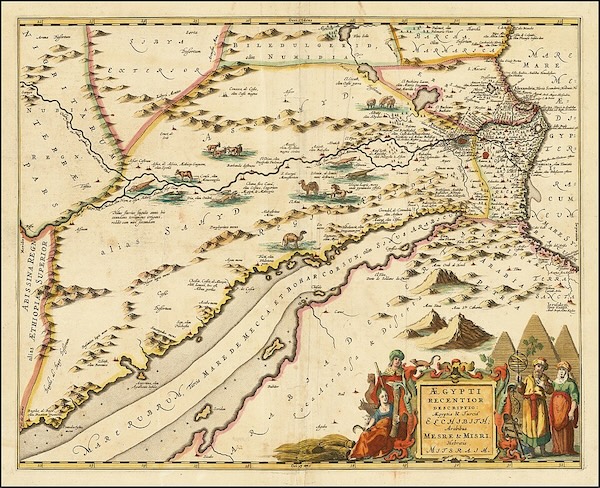
 Aegypti Recentior Descriptio: Aegyptis & Turcis Elchibith; Arabibus Mesre & Misri, Hebraeis Mitsraim, Jan Janssonius (1588–1664), circa 1650, Public domain.
 Egypt has failed to meet the requirements for extending U.S. import restrictions under the CPIA, The current agreement functions less as targeted anti-looting policy than as a sweeping embargo on nearly all Egyptian cultural material. Egypt has not demonstrated the required “self-help.” It has neglected archaeological sites, poorly managed storerooms, censored scholarship, and spent a billion dollars on prestige projects like the Grand Egyptian Museum while minority heritage and conservation needs are ignored. The United States should refuse to renew the agreement—or, at minimum, drastically narrow it—because the current regime enables state control over heritage, restricts scholarship and cultural exchange, and penalizes lawful circulation of art.
As published in the Federal Register.
To the Members of the Cultural Property Advisory Committee:
The Committee for Cultural Policy, Inc. (“CCP”)[1] respectfully submits this formal objection to the proposed five-year extension of the Memorandum of Understanding (“MOU” or “Agreement”) between the United States and the Arab Republic of Egypt (Egypt) [2] under the Convention on Cultural Property Implementation Act (“CPIA”).[3] This request is scheduled for CPAC’s consideration at its March 3–5, 2026 meeting, with public comments submitted through Regulations.gov.[4]
Introduction
The Committee for Cultural Policy, Inc. (“CCP”)[1] respectfully submits this formal objection to the proposed five-year extension of the Memorandum of Understanding (“MOU” or “Agreement”) between the United States and the Arab Republic of Egypt (Egypt) [2] under the Convention on Cultural Property Implementation Act (“CPIA”).[3] This request is scheduled for CPAC’s consideration at its March 3–5, 2026 meeting, with public comments submitted through Regulations.gov.[4]
In CCP’s view, Egypt has not met the requirements for a five-year extension under the CPIA. Egypt’s request does not satisfy the statute’s four determinations. Its government has spent a billion dollars to build a museum glorifying Pharaonic Egypt while it neglected deteriorating archeological sites and artifacts, destroyed large parts of protected Islamic period sites, and seized and denied access to Christian and Jewish heritage. Egypt’s current designated list is exceptionally broad—exceeding statutory limits by sweeping in categories such as coinage and “Ottoman” objects that do not align with the CPIA’s stated scope (“archaeological material of cultural significance” and “ethnological material of a nonindustrial society”).[5] A designated list of this breadth cannot be administered efficiently, fairly or consistently.
Our objection to renewal is grounded in the CPIA’s requirements for extending import restrictions and the public-interest determinations on which CPAC must advise. In summary, Egypt has not shown that the conditions justifying the existing restrictions continue to pertain in a manner that satisfies the CPIA, and the United States should not extend a regime of import restrictions that is: (1) overbroad in scope; (2) unworkable in practice given historic lawful export patterns and persistent documentation gaps; (3) unsupported by transparent evidence of “self-help” and effective site or collection stewardship; (4) inconsistent with the international interchange of cultural property for scientific, cultural, and educational purposes; and (5) likely to reinforce state appropriation of minority religious heritage while Egypt undertakes state-led development projects that UNESCO has repeatedly warned are incompatible with World Heritage obligations.
This objection draws on the public record and on reporting and analysis by the Committee for Cultural Policy regarding Egypt’s performance (and nonperformance) during the current and prior Egypt–U.S. MOUs, including Egypt’s treatment of minority cultural patrimony; site management, storerooms, and conservation practices; policies affecting foreign archaeological work and publication; and the sweeping scope of the designated list the United States is being asked to enforce.
For these reasons, we respectfully request that CPAC recommend against extension. In the alternative, if any extension is contemplated, it should be narrowly tailored; exclude ethnological categories that sweep in minority religious patrimony and property of minorities driven from the country; and be conditioned on measurable, publicly verifiable benchmarks (including inventorying, access, actual enforcement data, and compliance with UNESCO World Heritage requirements).
Fundamental Statutory Constraints
The CPIA is not a general mechanism for another government’s cultural policy, or endorsement of foreign national ownership laws – and it is not meant to produce permanent or near-permanent embargoes on everything old from a requesting nation. Congress required that CPAC and the Department make specific determinations, including that
- the cultural patrimony is in jeopardy from pillage,
- the requesting nation has taken measures consistent with self-help,
- import restrictions would be of substantial benefit,
- less drastic remedies are unavailable, and
- restrictions are consistent with the general interest of the international community in the interchange of cultural property for scientific, cultural, and educational purposes.
The March 2021 testimony submitted by the Committee for Cultural Policy on Egypt’s renewal request emphasized Egypt’s failure to meet these statutory constraints. We also noted the practical problems U.S. Customs and law enforcement face when a designated list encompasses virtually every object ever made over a vast timeline and territory touched by many civilizations.[6] We provided documentation showing that Egypt historically issued export documentation that was incomplete or non-itemized,[7] yet its government now asserts that virtually all objects outside the country are “stolen.”[8]
Overbroad Designated Lists.
The current restrictions are exceptionally broad, and the government has not justified renewing them under CPIA standards. As reflected in CBP’s implementing rule for the current agreement, the U.S. restrictions cover Egyptian archaeological material dating from approximately 300,000 B.C. to A.D. 1750, and ethnological material from A.D. 1517 to 1914. They are currently effective through November 30, 2026.[9]
This is not a targeted response to discrete categories demonstrably at risk from current pillage driven by demand in the United States. Functionally, it operates as an embargo across most material-culture categories—stone, metal, ceramic, wood, glass, bone/ivory, leather, paper, textiles, writing, and human and animal remains—supplemented by an expansive ethnological component.
The problem is compounded by the breadth of the designated list the United States is asked to enforce. As CCP has previously explained, designated lists in this area can span enormous time ranges and encompass sweeping categories, including religious and ethnological items. Here, the Egypt designated list extends from prehistoric periods through the Ottoman era for archaeological material and into the modern period for ethnological material. It also reaches into religious cultural property, including Islamic and minority Coptic, and other Christian ritual materials. It would also include personal objects of heritage from Egypt’s dispersed Jewish community (though specifically excluding Jewish ceremonial or ritual objects) that are not only culturally significant but closely tied to the identity and rights of communities that have faced persecution and expulsion.
What is required for an extension.
An extension under the CPIA requires more than generalized assertions. The statute requires a specific, evidence-based showing that the factual conditions that justified the original agreement still pertain; that the requesting country has taken meaningful “self-help” measures to protect its cultural patrimony; that continued U.S. import restrictions would be of substantial benefit in deterring pillage; that less drastic remedies are not available; and that the restrictions remain consistent with the general interest of the international community in the interchange of cultural property for scientific, cultural, and educational purposes.[10]
The public record supporting this extension request does not provide that necessary, specific, and verifiable showing, particularly given that Egypt’s recent cultural governance appears to undermine, rather than advance, the heritage-protection rationale the CPIA is intended to serve.
Failure to meet the core “self-help” requirements under the CPIA.
Egypt cannot credibly satisfy the CPIA’s “self-help” expectations where it has prioritized prestige megaprojects and political spectacle while allowing storerooms, documentation, site security, and non-Pharaonic collections to languish. Under the agreement, Egypt committed to use its best efforts to preserve its heritage and to inventory museum and storeroom collections consistent with established international professional standards.
The public record, however, reflects systemic shortcomings: excavation areas reportedly converted into dumping grounds; illegal construction on active or adjacent excavation sites; chronic storage deficiencies and missing or inadequate documentation; and a continuing lack of meaningful, publicly available data on arrests, convictions, seizures, and the chain of custody for recovered objects.
Archaeological sites neglected.
A particularly vivid example is the Heliopolis excavation area, where a German expedition returned to find portions of its site covered by a garbage dump and to confront illegal construction at the location where a temple excavation had begun.[11] That is not “self-help.” It reflects negligence and misgovernance at a site of recognized importance.
The storeroom and inventory conditions described in the same reporting similarly undercut any claim that Egypt has undertaken the hard, unglamorous work that import restrictions are meant to supplement. Egypt maintains numerous archaeological warehouses, yet only a small fraction have been regularly inspected, and none has been fully inventoried. In many facilities, conditions reportedly expose delicate objects to water, heat, insects, and other hazards—so that deterioration may pose as serious a threat as theft. When baseline documentation and storage controls remain inadequate a decade into an MOU, it is not reasonable to characterize Egypt’s efforts as due diligence.
Funding dedicated to showplaces while other sites crumble.
At the same time, Egypt has repeatedly devoted vast public resources to headline projects and symbolic performances—framed as civilizational triumph—rather than to sustained site protection and professional collections management. The Grand Egyptian Museum (GEM), for example, reportedly cost over $1 billion to build, with final estimates reaching roughly $1.2 billion due to delays.[12] Financing was heavily supported by Japan through JICA loans totaling around $800 million, alongside Egyptian government contributions.[13]
The recent, high-profile opening of the GEM was closely tied to state spectacle, Pharaonic branding, and narrative control. Meanwhile, broad-based cultural development has been neglected, and other museums—including the Coptic Museum—have faced chronic underfunding and deterioration, despite representing essential parts of Egypt’s cultural history.
A government capable of staging global spectacles and building prestige infrastructure, yet unable or unwilling to reliably inventory and secure storerooms, provide robust public reporting on thefts and recoveries, or support the full spectrum of Egyptian cultural expression – neglecting Islamic art as well as Coptic, Jewish, and other minority patrimony, has not met the “self-help” expectations that justify the extraordinary remedy of asking the United States to serve as its external enforcement arm.
Egypt’s Cultural Ministry censorship.
There are serious public-policy concerns directly relevant to the CPIA’s requirements that import restrictions serve the public interest and remain consistent with the international interchange of cultural property for scientific, cultural, and educational purposes. In practice, Egypt reportedly conditions foreign archaeological access on compliance with government controls over publication: foreign archaeologists may be required to submit work for governmental review and approval, and those who publish without approval can be denied future excavation rights. An import embargo administered in partnership with a government that censors art and history is unlikely to promote shared knowledge or meaningful scholarly interchange.
These concerns are reinforced by well-documented, longstanding reports of pressure, intimidation, and gatekeeping in archaeological work and attribution, including allegations that former senior antiquities official Zahi Hawass censored publications, excluded archaeologists from key sites, and blacklisted researchers who published without permission or failed to provide preferred credit. [14]The United States should not align itself with a state apparatus that has shown hostility to open scholarly discourse and that seeks to control historical narratives through access and publication restrictions.
Legal Export
The Egyptian Antiquities Service itself helped build enormous collections through partage divisions and, in the 1880s, established a salesroom at the Egyptian Museum. What began as sales of “surplus” items later expanded into excavations undertaken, in part, to supply the market – offering mummies, sarcophagi, carved stone sculpture, and wall reliefs and paintings through the museum’s artifacts store.
That history bears directly on the practical and legal reality underlying this request: a vast portion of Egyptian material in global circulation left Egypt through tolerated, permitted, and, since 1912, licensed channels for generations, including through state-run mechanisms.[15]
Egypt began formally licensing antiquities dealers in 1912, and large numbers of objects were exported throughout the twentieth century by dealers licensed to export antiquities, a practice that continued until 1983. Regrettably, export permits were not retained by the Egyptian government, and documentation in Western collections often describes lots only in broad terms. This vagueness was reinforced by an administrative system in which taxes were assessed by shipping case rather than by item—an approach that now makes it difficult, and often impossible, for later owners to prove item-level export history for common, low-value categories.
This matters because CPIA import restrictions are justified as an emergency measure aimed at deterring current pillage by reducing market incentives. When the objects in the U.S. market overwhelmingly derive from older lawful export streams, sweeping restrictions primarily increase compliance costs and legal risk for museums, scholars, collectors, and diaspora communities—without a clear showing that they meaningfully reduce current looting.
The United States should not renew an MOU that effectively converts Egypt’s own historic administrative practices—bulk exports, vague permits, and state-sanctioned sales[16]—into a modern presumption of illegality for ordinary objects that have circulated openly for decades. The CPIA was not designed to require U.S. Customs and Border Protection to treat gaps in century-old paperwork as evidence of recent looting, or to force border enforcement to substitute for the requesting state’s past recordkeeping choices. In practice, such a regime places U.S. authorities in the position of detaining or seizing goods that may have been lawfully exported but cannot be documented to modern standards.
Egypt’s government usurpation of Jewish heritage and denial of access to sacred history.
Egypt’s treatment of Jewish, Christian, and other minority heritage reflects a bifurcated approach: the state will refurbish synagogues and convert ancient monasteries into tourist destinations, while denying both community ownership and meaningful community access.
It has also seized, sequestered, and restricted access to documentary patrimony that sustains living cultural traditions. At the Ben Ezra Synagogue, a restoration project culminated in a high-profile reopening in August 2023 attended by Egyptian dignitaries, with no Jews present. The government framed the reopening explicitly as tourism rather than worship, stating that the synagogue was “not intended for worship, but to be seen as a relic of Jewish history in Egypt.”[17]
The Ben Ezra case illustrates the practical question CPAC must weigh when assessing whether restrictions serve the “interchange of cultural property … for scientific, cultural, and educational purposes.” A synagogue preserved primarily as a museum-like relic, without community access for religious practice, is not cultural exchange; it is state-curated display.
More troubling still, during restoration work at Cairo’s Bassatine Jewish cemetery in 2022, a buried genizah was discovered -potentially containing thousands of records central to the history of Egypt’s Jewish community. Accounts describe Egyptian authorities taking immediate possession of the material: the Antiquities Authority reportedly breached a cemetery wall, declined requests that a rabbi oversee handling, placed records into 165 plastic garbage bags, removed them by truck, and has provided no meaningful access since. Egypt has also reportedly not disclosed the genizah’s condition or whereabouts.[18]
This is not merely a heritage-management dispute. It is a concrete example of state appropriation of minority patrimony and denial of access to the very materials that enable scholarship, community continuity, and religious identity.
It also makes the “return to Egypt” premise of the MOU ethically and legally fraught when the property at issue belongs, in any meaningful cultural sense, to dispossessed communities whose members largely cannot safely return and whose documentary needs—family records, religious records, communal history—are ongoing. The CPIA’s interchange requirement cannot be satisfied where the practical effect of the agreement is to reinforce state control over minority heritage and to impede diaspora communities’ cultural and scholarly access.
Christian heritage: the commercial development of Saint Catherine’s Monastery.
Saint Catherine’s Monastery was founded in the 6th century under Byzantine Emperor Justinian I. It is the world’s oldest continuously inhabited Christian monastery and home to one of the world’s most important ancient libraries, often described as second only to the Vatican Library. Revered by Christians, Jews, and Muslims as the site associated with the Burning Bush and the giving of the Ten Commandments, it is not merely a building: it is a rare, living model of interfaith coexistence and sustainable preservation in a harsh high-desert environment.
Egypt’s Great Transfiguration Project—a massive, state-sponsored tourism megaproject in South Sinai, threatens the unique cultural, spiritual, and environmental heritage of Saint Catherine’s Monastery at the foot of Mt. Sinai and the monks who inhabit it, the nearby city of Saint Catherine, the wider Sinai landscape, and the Jabaliya Bedouin community.
The project launched in 2021 is already inflicting irreversible damage on a fragile and sacred place: erasing traditional architecture, rupturing the living cultural landscape, violating indigenous rights, undermining religious freedoms, and breaching Egypt’s obligations under the World Heritage Convention.
Equally alarming is the May 28, 2025, 160-page ruling by Egypt’s Court of Appeals on property rights tied to Saint Catherine’s Monastery. Beyond curtailing centuries-long, recognized rights held by the monastery’s religious community, the precedent could reverberate across Egypt, threatening the security of Christian, Jewish, and Muslim religious establishments whose autonomy depends on stable legal recognition of property and stewardship.
UNESCO recognized the monastery and its surrounding landscape as a World Heritage Site in 2002 for its immense spiritual significance. The monastery’s library holds more than 3,300 manuscripts across major ancient languages, including the famed Codex Sinaiticus. Its surrounding landscape is part of the site’s universal value.
Yet the Great Transfiguration Project, personally sponsored by President Abdel Fattah El Sisi, has driven sweeping infrastructure and commercial expansion around the tiny city of Saint Catherine: new road networks cutting through protected terrain, an airport expansion, a dozen luxury hotels and “eco-lodges,” dense new residential and tourist districts, commercial bazaars, major plazas and event complexes, and heavy hydrological engineering in the Holy Valley. This is a wholesale remaking of a sacred landscape into a mass-tourism machine.
UNESCO formally urged Egypt in 2023 to halt further development, conduct a full impact evaluation, and prepare a conservation plan. Egypt has ignored those recommendations and construction continues at relentless pace.
World Heritage Watch says the project has destroyed the integrity of this historical and biblical landscape and violates not only World Heritage obligations but also Egyptian environmental protections for natural reserves.[19] Meanwhile, the physical risks to the monastery are profound: heavy construction and roadworks bring vibrations that threaten ancient walls; expanded water and utility systems alter microclimates and risk preservation of its irreplaceable manuscripts; and mass tourism traffic would overwhelm a site whose meaning depends on serenity, solitude, and controlled access.
After years of negotiations between Egypt and Greece over recognizing the monastery’s centuries of rights, on May 28, 2025, Egypt’s Ismailia Administrative Appeal Court refused to acknowledge the monastery’s title or legal possession beyond limited “use” inside the core enclosure—subsuming surrounding lands, chapels, agricultural areas, and ancillary structures into the public domain. “The Archbishop’s request for Section II lands [land of religious use] was dismissed by the Court, despite the appellant’s claim that the monks had been in peaceful possession of them for 15 centuries.”[20]
This failure to meet basic global protection standards also raises urgent questions about Egypt’s push to elevate Khaled El-Enany to UNESCO Director-General. El-Enany served as Egypt’s Minister of Antiquities (2016) and later Minister of Tourism and Antiquities (2019–2022). He has been widely criticized internationally in connection with state-backed development affecting historic sites, including Cairo’s City of the Dead.[21] Taken together with the devastation now unfolding in Saint Catherine, his election as Director General in November 2025 cannot be treated as business as usual.
In this context, it is difficult, in CPIA terms, to credit a claim of adequate “self-help” as a predicate for extending U.S. import restrictions. A state that allows high-impact development to proceed at a globally recognized sacred landscape, while advancing legal theories that shrink established religious custodianship, is not demonstrating the precaution, transparency, and stewardship the CPIA contemplates.
CircArt Project.
Egypt has also declined cooperative measures that could more precisely target illicit trafficking and theft. The UK-based Circulating Artefacts (CircArt) initiative, launched in 2018 to help document and assess Egyptian and Sudanese objects appearing on the market, was designed to strengthen due diligence by distinguishing long-circulating material from items likely to be recently looted.[22]
In 2019, reporting indicated that Egyptian authorities opposed key elements of the project, including making the database broadly accessible, and objected to acknowledging the participation of market actors whose documentation could help establish an object’s longer circulation history. This effectively sidelined a practical, evidence-building approach that could have supported more targeted enforcement—rather than relying on sweeping restrictions that treat ordinary, long-circulating objects as presumptively suspect.[23]
Little evidence of looting for a U.S. market.
Egypt’s MOU has not demonstrably intercepted looted “masterpieces” destined for the United States. Instead, enforcement actions typically appear to involve small, common objects. Recent returns to Egypt from the United States reportedly included items such as a small number of ushabtis, amulets, fragments of broken sculpture, and mummified fish—the kinds of objects Egypt holds in the tens of thousands in storerooms and museums and that are, in any event, ubiquitous and often long-circulating.[24]
This enforcement pattern raises a straightforward CPIA question: if the system’s practical effect is to detain or seize a small number of minor items with limited market value—often with uncertain provenance because historic export and documentation practices did not preserve item-level records—it is difficult to argue that the restrictions provide the “substantial benefit” in deterring looting that the CPIA requires.
Overpriced, blockbuster museum loans are not “cultural interchange.”
For CPAC and the State Department, the CPIA’s interchange requirement should not be treated as satisfied by occasional blockbuster loans or state-controlled exhibitions—especially where Egypt’s approach to “exchange” is closely tied to revenue generation, political branding, and narrative control.
An agreement that, in practice, reduces the availability of lawfully circulating objects for study and collecting in the United States, narrows opportunities for independent scholarship, and limits diaspora communities’ ability to recover or access their own patrimony is not “consistent with the general interest of the international community” in cultural interchange, whatever the rhetoric of heritage protection may claim.
Human rights, civil rights, and cultural rights – Egypt’s record is devastating.
Finally, the MOU should not be renewed because it risks conferring reputational and political support on the Abdel Fattah el-Sisi government’s use of heritage as an instrument of state power. Egypt’s ultra-nationalist cultural policy poses a clear reputational risk for the United States. Renewal of the U.S.–Egypt bilateral cultural-property agreement can readily be presented domestically as a marker of U.S. endorsement, regardless of the agreement’s stated purpose.
Egypt’s broader governance environment is also difficult to reconcile with CPIA expectations of transparency, collaboration, and public accountability in heritage protection. Human Rights Watch and Amnesty International have described an environment in which independent civil society faces sustained pressure, including constraints on NGOs and civic actors, and repression of critics and rights defenders.[25] Meaningful “self-help” in heritage protection depends on exactly the actors most constrained under such conditions: local communities, independent scholars, journalists, and civic heritage organizations that can document harms, monitor sites, expose corruption, and advocate for preservation. Cultural Property Advisory Committee and the United States Department of State should therefore not presume robust Egyptian “self-help” absent specific, transparent evidence—particularly where the domestic conditions for independent oversight are systematically curtailed.
Summary of reasons for denial of renewal request.
For all these reasons, CCP respectfully urges CPAC to recommend that the Department deny any renewal of Egypt’s CPIA MOU. Egypt has not shown the sustained, transparent, verifiable self-help measures the CPIA contemplates; it has pursued policies that undermine the interchange of cultural property and knowledge; has used “heritage” to justify control over scholarship and narrative; has failed to protect significant sites from destruction and inappropriate development; and has engaged in acts that amount to appropriation and denial of access to minority cultural and documentary patrimony.
Less drastic and more effective measures exist and should be prioritized, including:
- Transparent, verifiable inventories of museum and storeroom holdings (with public-facing object registries where possible);
- Regular publication of site-security staffing, incident reporting, and prosecution outcomes for antiquities crimes;
- Structured cooperation with U.S. museums, scholars, and responsible market participants on object identification, risk indicators, and red-flag transaction patterns;
- Targeted restriction categories focused on demonstrably high-risk, currently looted object types (rather than sweeping lists spanning millennia and almost all media);
- Enhanced joint investigative cooperation aimed at organized trafficking networks rather than broad border presumptions against lawful legacy material.
The CPIA requires that import restrictions be justified as a targeted, effective, and internationally beneficial response to pillage, not as an open-ended endorsement of state ownership claims over everything old, including the patrimony of communities that the state has marginalized or forced into exile.
Requested outcome.
For the reasons above, we respectfully request that CPAC recommend that the Department of State deny the proposed extension of the U.S.–Egypt agreement and allow the current restrictions to expire on November 30, 2026.
If CPAC nevertheless contemplates some form of extension, it should recommend, at minimum, that any renewed agreement be conditioned on concrete benchmarks and narrowed in scope, including:
- Removal (or substantial narrowing) of the ethnological categories most likely to encompass minority religious communal patrimony and ordinary diaspora property;
- A demonstrable national inventory and public registry initiative for museum and storeroom holdings, with periodic reporting;
- Transparent publication of antiquities-crime enforcement metrics (arrests, prosecutions, convictions) and site-security measures;
- Written commitments to facilitate scholarly access and digitization for minority communal archives and religious heritage materials, including the materials collected from the Bassatine cemetery genizah removal;
- Evidence of compliance with UNESCO World Heritage directives at Saint Catherine, including impact assessments and a halt to damaging development until reviewed.
Thank you for your consideration of this submission.
Respectfully submitted,
Kate Fitz Gibbon, Executive Director, Committee for Cultural Policy
[1] Committee for Cultural Policy, Inc. POB 4881, Santa Fe, NM 87502, publishes Cultural Property News, www.culturalproprtynews.org, a free, online art and cultural heritage news magazine, and publications on international laws on cultural heritage at Cultural Property Law, www.culturalpropertylaw.org.
[2] Proposal to extend the Memorandum of Understanding Between the Government of the United States of America and the Government of the Arab Republic of Egypt Concerning the Imposition of Import Restrictions on Categories of Cultural Property of Egypt (“the Egypt Agreement”), 01/26/26, 2026-01397 (91 FR 3294), https://www.federalregister.gov/documents/2026/01/26/2026-01397/proposal-to-extend-the-cultural-property-agreement-between-the-united-states-and-egypt (see also the Department of State public notice materials accompanying the meeting and comment process.)
[3] Convention on Cultural Property Implementation Act (CPIA), 19 U.S.C. §§ 2601–2613, especially § 2602(a)(1)(A)–(D) (the four determinations) and § 2602(f) (extensions/renewals). https://www.govinfo.gov/content/pkg/USCODE-2023-title19/html/USCODE-2023-title19-chap14.htm.
[4] U.S. Department of State, Cultural Property Advisory Committee Meeting, March 3–5, 2026 (announcement dated Jan. 22, 2026); Federal Register, “Cultural Property Advisory Committee; Notice of Meeting,” Public Notice 12924 (published Jan. 26, 2026).
[5] Extension and Amendment of Import Restrictions on Archaeological Material and Imposition of Import Restrictions on Ethnological Material of Egypt, 12/03/2021, 86 FR 68546, https://www.federalregister.gov/documents/2021/12/03/2021-25384/extension-and-amendment-of-import-restrictions-imposed-on-archaeological-and-ethnological-material/
[6] U.S. Customs and Border Protection, “Extension and Amendment of Import Restrictions on Archaeological Material and Imposition of Import Restrictions on Ethnological Material of Egypt,” 86 Fed. Reg. 68546 (Dec. 3, 2021) https://www.federalregister.gov/documents/2021/12/03/2021-26348/extension-and-amendment-of-import-restrictions-on-archaeological-material-and-imposition-of-import (accessed Feb. 15, 2026)
[7] Hagen, Frederik and Ryholt, Kim, The Antiquities Trade in Egypt, 1880-1930, The H. O. Lange Papaers, Det Kongelige Danske Videnskabernes Selskab (Royal Danish Academy of Sciences and Letters), Scientia Danica, Series H, Humanistica 4, Vol 8, 2016, pp 133-146.
[8] Cultural Property News, “Making Life Miserable for Museums, Again?” Apr. 13, 2017, https://culturalpropertynews.org/making-life-miserable-for-museums-again/ (accessed Feb. 15, 2026)
[9] Extension and Amendment of Import Restrictions on Archaeological Material and Imposition of Import Restrictions on Ethnological Material of Egypt, 12/03/2021, 86 FR 68546, https://www.federalregister.gov/documents/2021/12/03/2021-25384/extension-and-amendment-of-import-restrictions-imposed-on-archaeological-and-ethnological-material (accessed Feb. 15, 2026)
[10] Convention on Cultural Property Implementation Act (CPIA), 19 U.S.C. §§ 2601–2613, especially § 2602(a)(1)(A)–(D) (the four determinations) and § 2602(f) (extensions/renewals). https://www.govinfo.gov/content/pkg/USCODE-2023-title19/html/USCODE-2023-title19-chap14.htm
[11] The Management of Egypt’s Cultural Heritage, Vol. 2. (pp.14-47) Editors: F. A. Hassan, G. J. Tassie, L. S. Owens, A De Trafford, J. van Wetering, O. El Daly, January 2015, Golden house Publications and ECHO, p 21, see also Kate Fitz Gibbon, Egypt’s Brutal Regime wants to renew US Blockade on Art, March 10, 2021, Cultural Property News, https://culturalpropertynews.org/egypts-brutal-regime-wants-to-renew-us-blockade-on-art-claims-to-protect-heritage-culture/ (accessed Feb. 15, 2026).
[12] Ahram Online, “Factbox: Financing the Grand Egyptian Museum,” https://english.ahram.org.eg/NewsContent/64/1277/555798/GEM-opening/The-Grand-Egyptian-Museum/Factbox-Financing-the-Grand-Egyptian-Museum-.aspx (accessed Feb. 15, 2026)
[13] Japan International Cooperation Agency (JICA), “Grand Egyptian Museum Construction Project,” https://www2.jica.go.jp/en/evaluation/pdf/2006_EG-P28_1_f.pdf (accessed Feb. 15, 2026) See also “JICA’s Cooperation in Egypt,” https://www.jica.go.jp/Resource/egypt/office/others/ku57pq00002co64f-att/brochure_202108_en.pdf, and Signing of Japanese ODA Loan Agreement with Egypt: Contributing to economic development through infrastructure development support in the power and tourism sectors, https://www2.jica.go.jp/yen_loan/pdf/en/6814/20161102_02.pdf.
[14] The Art Newspaper, “Egypt cancels Dutch museum’s dig licence for exhibition exploring Black culture” (June 7, 2023) https://www.theartnewspaper.com/2023/06/07/egypt-cancels-dutch-museums-dig-licence-for-exhibition-exploring-black-culture (accessed Feb. 15, 2026)
[15] UNESCO/related publication, “1983 Law on the protection of Antiquities” https://media.unesco.org/sites/default/files/webform/mhm001/clt_cih_mco_180_123_compressed-1_0.pdf (accessed Feb. 15, 2026)
[16] Piacentini, Patrizia. “Notes on the History of the Sale Room of the Egyptian Museum in Cairo, in J. Helmbold-Doyé, T. Gertzen (Hrsg.), Mosse Im Museum, Berlin 2017, Pp. 75-87,” n.d. https://www.academia.edu/35233178/Notes_on_the_History_of_the_Sale_Room_of_the_Egyptian_Museum_in_Cairo_in_J_Helmbold_Doy%C3%A9_T_Gertzen_Hrsg_Mosse_im_Museum_Berlin_2017_pp_75_87?sm=b&rhid=37934859045 (accessed Feb. 15, 2026)
[17] Times of Israel, “Egyptian synagogue once home to famed ‘Cairo Geniza’… completes extensive renovation” (Aug. 31, 2023). https://www.timesofisrael.com/egyptian-synagogue-once-home-to-famed-cairo-geniza-completes-extensive-renovation/ (accessed Feb. 15, 2026)
[18] Jewish Telegraphic Agency (JTA), “The Egyptian government removed items from a newly uncovered genizah, and a U.S. senator wants answers” (Apr. 6, 2022). https://www.jta.org/2022/04/06/politics/the-egyptian-government-removed-items-from-a-newly-uncovered-genizah-and-a-u-s-senator-wants-answers (accessed Feb. 15, 2026), also Haaretz, “Centuries of Jewish Life Rescued From Cairo Garbage Dumps…” (Apr. 24, 2022). https://www.haaretz.com/middle-east-news/egypt/2022-04-24/ty-article-magazine/.premium/yiddish-in-cairo-egyptians-rescue-centuries-of-jewish-life-from-garbage-dumps/00000180-5bee-db1e-a1d4-dfef52790000 (accessed Feb. 15, 2026)
[19] World Heritage Watch Demands St Catherine Monastery Be Designated a UNESCO World Heritage Site in Danger, VEMA, July 9, 2025, https://vema.com.au/world-heritage-watch-demands-st-catherine-monastery-be-designated-a-unesco-world-heritage-site-in-danger/
[20] Vivika Gerogianni and Andrew Dearman, Property Law, Religious Ownership and International Heritage Obligations: the Legal State of the Saint Catherine’s Monastery at stake, Center for Art Law, https://itsartlaw.org/art-law/property-law-religious-ownership-and-international-heritage-obligations-the-legal-state-of-the-saint-catherines-monastery-at-stake/ (accessed Feb. 15, 2026)
[21] Stuart Butler, Living among the graves: Cairo’s City of the Dead faces an uncertain future, 3 July 2025, Geographical, https://geographical.co.uk/culture/living-among-the-graves-cairos-city-of-the-dead-faces-an-uncertain-future.
[22] Javier Pes, “Looters Beware: The British Museum is Leading an International Task Force Fighting the Illicit Trade in Antiquities, January 20, 2019, Artnet News, https://news.artnet.com/art-world/british-museum-will-become-global-watchdog-fight-trade-stolen-egyptian-antiquities-1441918 (accessed Feb. 15, 2026)
[23] Macquisten, Ivan, CircArt and the British Museum – a great opportunity wasted, May 29, 2021, https://culturalpropertynews.org/circart-and-the-british-museum-a-great-opportunity-wasted/ .
[24] U.S. Repatriation examples involving small/common objects: Archaeology Magazine, “U.S. Repatriates Artifacts to Egypt” (Jan. 7, 2026) https://archaeology.org/news/2026/01/07/u-s-repatriates-artifacts-to-egypt/ (accessed Feb. 15, 2026).
[25] Human Rights Watch, World Report 2025 – Egypt chapter. https://www.hrw.org/world-report/2025/country-chapters/egypt (accessed Feb. 15, 2026), also Amnesty International, Report 2024/25 – Egypt.https://www.amnesty.org/en/location/middle-east-and-north-africa/north-africa/egypt/report-egypt/ (accessed Feb. 15, 2026).