Rukmini Devi Temple, Dwarka, ASI monument number N-GJ-128, photo by Madhuranthankan Jagadeesan, 1 October
2013, Creative Commons Attribution-Share Alike 4.0 International license.
Rukmini Devi Temple, Dwarka, ASI monument number N-GJ-128, photo by Madhuranthankan Jagadeesan, 1 October
2013, Creative Commons Attribution-Share Alike 4.0 International license. 
Bhimbetka rock shelters spanning Paleolithic to historic period. Author Bernard Gagnon, 4 December 2013, CCA-SA 3.0 unported license.
On July 28, 2025, the U.S. State Department announced sweeping new import restrictions on Indian art and artifacts—covering an implausible 1.7 million years of history. Under a new Memorandum of Understanding (MOU) with the Government of India, the United States will prohibit the import of nearly all archaeological material from India dating from 1.7 million years ago to 1770 C.E., and almost all ethnological material from the 2nd century B.C.E. to 1947 C.E., unless accompanied by an official export certificate or proof that the object left India before July 28, 2025.
This is not a narrowly targeted measure to address looting. It is a blanket embargo in all but name—one of several recent agreements so broad that they cover virtually every object from a country across millennia. U.S. law, however, requires limiting restrictions to objects “in jeopardy from pillage” and marketed in the U.S., and covers situations where the source country has done its best to protect its own heritage. None of this fits India’s agreement with the U.S.
The Absurdity of 1.7 Million Years
It’s become common for U.S. agreements to cite absurd starting dates – but 1.7 million years ago is ridiculous. The agreement asserts without evidence that there is a looting crisis of objects predating the appearance of Homo sapiens in India by over a million years. There was human-related activity that left behind a few stone tools about 1.5 million years old in Tamil Nadu, , likely made by an ancestral species, and a partial Homo erectus skull from roughly 500,000 years ago, along with a few other skeletal fragments. Anatomically modern humans likely arrived only 65,000–75,000 years ago, during the “southern dispersal” migration out of Africa. None of this material belongs in a U.S. – India trade agreement.
India has extraordinary prehistoric sites—such as the Bhimbetka rock shelters (which contain rock drawings from the Paleolithic to medieval times). But they are not being looted – nor are artifacts smuggled to the United States, and are thus irrelevant to the stated purpose of the CPIA.
CPIA’s Intent vs. the MOU’s Effect
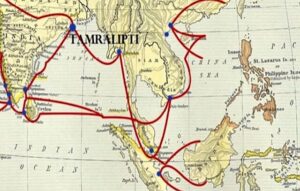
Ancient Indian maritime trade routes, by KhasEkadashTili, 5 January 2025, CCA-SA 4.0 International license.
The inclusion of a few scattered objects from a million-plus years ago is not the main problem with the agreement. The U.S.–India MOU and its accompanying 13 page Designated List of prohibited imports is not aimed at an ongoing looting crisis involving the U.S. market, as the Cultural Property Implementation Act (CPIA, 19 U.S.C. § 2601 et seq.) requires. Instead, it functions as a near-total blockade on Indian cultural objects unless they are accompanied by proof of pre-agreement export or a permit from the Indian government. And since India has never set up a functioning export system – those proofs rarely exist.
The CPIA was designed to strike a balance: to halt looting while preserving a lawful and vibrant art trade that benefits museums, American businesses, and the public. That balance has been lost.
Designated List is a Ban in Disguise

Hanging cotton, hand-drawn outlines, mordants and resists; dyed; painted details. Coastal South-east India for Madurai Nayaka court, ca. 1640-50. Royal Ontario Museum, Canada, public domain.
The agreement’s “Designated List” covers almost everything made in India before 1947, including:
- Coins from countless dynasties, from ancient Persian to Mughal issues.
- Mass-produced trade goods, such as textiles and bronzes, long exported in huge quantities.
- Architectural fragments, manuscript pages, and religious statuary, often still common in India and long dispersed worldwide.
Such sweeping coverage transforms a law meant to protect at-risk heritage into a de facto export ban on an entire nation’s artistic output over millennia.
State Department’s Four Findings
In authorizing the agreement, the State Department cited four statutory findings:
-
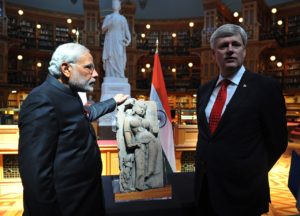
Prime Minister, Shri Narendra Modi, presentation of Parrot Lady statue, in the library of Canadian Parliament with Canadian Prime Minister Stephen Harper, April 15, 2015. Government Open Data License – India (GODL)
India’s cultural patrimony is in jeopardy from pillage.
- The Indian government has taken measures consistent with the 1970 UNESCO Convention.
- U.S. import restrictions would help deter looting, and no less drastic remedies are available.
- The restrictions serve the general interest of the international community in cultural exchange.
The Assistant Secretary of State also determined that the material meets the statutory definition of “archaeological or ethnological material of the State Party” (19 U.S.C. § 2601(2)).
On paper, this appears to be just one more questionable cultural heritage measure, adding India to the list of more than 30 countries whose art is now subject to virtually permanent U.S. import restrictions. In reality, it is neither justified under U.S. law nor defensible as public policy. This is a politically motivated agreement that will do little to protect heritage genuinely at risk and much to damage the lawful market in Indian art—a market that today has almost no connection to looting.
A Political ‘Gift’ that Can Last Generations

Biden and Modi celebrate return of dozens of Indian artifacts, September 22, 2024. Times of India.
A bilateral cultural property agreement without specific import restrictions was signed July 26, 2024, just months before Prime Minister Narendra Modi’s state visit to Washington. It then took a year to produce an import ban so expansive that it covers virtually every coin issue, every recognized period of Indian art, and even material from ancient civilizations—such as Harappan and Gandharan—that were centered in another country – in what is now Pakistan or Afghanistan.
The result is a thirteen-page, three-column list in the Federal Register banning imports from every era of Indian material culture. This is the opposite of the CPIA’s intended “targeted, temporary” approach.
Congress envisioned restrictions lasting five years, renewable only with proof that the looting crisis persisted—not blanket bans rubber-stamped into perpetuity. These “five year” agreements to help countries get a handle on looting are almost never terminated. Some have gone on for more that 30 years, long outlasting their relevance except as political tradeoffs for issues of greater importance to the U.S., such as arms smuggling or drug interdiction. Congress’s intent was clear: MOUs are not to be used as diplomatic tools or permanent controls over entire categories of cultural objects regardless of risk, nor as a means to erase centuries of lawful trade.
No Evidence of a U.S. Market for Looted Indian Art

Subash Kapoor, imprisoned in Tamil Nadu, India, 08-19-2022, India TV.
There is no significant U.S. market for freshly looted Indian objects. Indian antiquities have been subject to export controls for decades, and major U.S. museums will not acquire objects without clear provenance. The smuggling scandals involving Vaman Ghiya and his successor, Subhash Kapoor, made global headlines, but they were exceptional — and years in the past.
Most Indian material circulating worldwide today left the country long ago, often with official blessing, and is lawfully held in private and institutional collections. The State Department’s claim that restricting imports will deter looting ignores that whatever archaeological looting takes place today in India is driven by domestic factors and lack of government effort — weak site security, lack of museum funding, and corruption — not by U.S. demand.
India’s Deep Trade History

Indian painted, block printed, and resist dyed cotton textile for the American market, 1725-75. The Elisha Whittelsey Fund, 1959. Metropolitan Museum of Art, NY.
Until the mid-20th century, there was no concept of an “Indian nation” in the modern sense. The subcontinent was a patchwork of kingdoms, empires, and princely states. To describe what is India, one can start from The Indus Valley Civilization (3rd millennium B.C.E.), proceed through Hindu, Buddhist, Jain, and Islamic kingdoms, explore regional dynasties such as the Cholas, Vijayanagara rulers and Marathas, and empires from the Mughals to the British Raj.
Trade — not isolation — was the norm. Indian goods, from the cotton textiles that were the currency of the East Asian spice trade to bronze sculptures for religious and decorative use were manufactured in India for trade with Southeast Asia, the Middle East, and Europe.
The 19th and early 20th centuries saw the rise of an Indian elite deeply engaged in collecting art from across the subcontinent. Indian dealers like Radha Krishna Bharany supplied both domestic collectors and Western museums. Ananda Coomaraswamy, the great Indian art historian, brought his collection to Boston’s Museum of Fine Arts, sparking a huge wave of U.S. interest. Indian dealers sold to both domestic and foreign buyers. Many of today’s great Indian collections in U.S. museums were built with the participation of Indian scholars and collectors.
After independence in 1947, the government imposed restrictive laws on art ownership and export, discouraging private collecting in India. In desperation, a number of important private collections were sold abroad after Indian museums refused to buy them. Enforcement was uneven: Jawaharlal Nehru himself facilitated the export of Indian and Nepalese art collected by Stella Kramrisch, much of which is now at the Philadelphia Museum of Art. Many categories of antiques continued to be openly exported. The result: much of India’s finest art is now outside its borders — preserved, studied, and exhibited for the public benefit.
Colonial Beginnings of India’s Cultural Heritage Laws
-

An old ticket of the Heritage Monuments of India issued by the Archaeological Survey of India (ASI), from a personal collection, Photo by Billjones94, 2 June 2022, CCA-SA 40 International license
1810 & 1817: Early Bengal regulations protecting historic buildings.
- 1863: Law protecting privately owned historic buildings; Religious Endowments Act regulating waqf properties.
- 1878: Indian Treasure Trove Act, modeled on British law, vesting found precious objects in the Crown.
- 1861: Founding of the Archaeological Survey of India (ASI) — tasked with excavation, research, and monument preservation.
Post-independence, the key law remains the Antiquities and Art Treasures Act, 1972, passed in the spirit of the 1970 UNESCO Convention. It grants the state ownership over virtually all antiquities more than 75 years old and requires licenses for dealing or export. However, India never set up the more flexible, supervised export schemes envisioned under the Convention.
The CAG Audit: India’s Heritage System in Collapse
The CPIA requires that a requesting country take self-help “measures consistent with the Convention” to protect its heritage. Yet three decades of Indian parliamentary audits and government reports paint a picture of systemic neglect.

Ghantai Temple, one of the temple ruins at Khajuraho. 21 October 2012, Photo Patty Ho. CCA 2.0 Generic license.
In 2013, the Comptroller and Auditor General (CAG) released a devastating audit of the Archaeological Survey of India (ASI), finding that the nation’s heritage agency is chronically underfunded, understaffed, and mired in bureaucracy:
- There was no comprehensive inventory of monuments.
- No inventory of antiquities in ASI possession; 95% never displayed or catalogued.
- Ninety-two monuments out of 1,655 that were inspected – out of the official list of over 3000 key monuments – were “missing”– simply no longer there.
- There were records of 131 antiquities stolen from sites; 37 from site museums — with only ineffective recovery efforts.
- There was rampant encroachment of sites and monuments by building development, roadbuilding, and squatters on heritage sites, with little enforcement.
- No conservation policy newer than 1915; many monuments arbitrarily chosen for work while others crumbled.
- Only 1% of budget was spent on excavation or exploration.
- No guards at 2,500 of 3,650 protected monuments.
- Thousands of site museums and storage facilities without basic security or climate control.
Parliamentary committees have been warning of these problems since the 1980s. Successive governments have promised reform, but little has changed. A recent revisit of the performance audit found the same problems, many even worse. The CAG Audit bluntly concluded that “no major corrective actions” had been taken in decades.
Museums in Disrepair

Tank at Hampi, India, ASI monument number N-KA-B49, photo Jonathan Freundlich, 13 November 2011, CCA-SA 3.0 Unported license.
ASI’s forty-four site museums — and New Delhi’s National Museum itself — suffer from overall poor documentation and lack of authenticity verification. There is an absence of climate control placing almost all objects at risk of damage, and security gaps making theft easy. Objects repatriated from abroad often end up in police warehouses or “Icon Preservation Centres” — where conditions actually hasten their destruction.
Tamil Nadu’s Icon Centres were meant to secure stolen or at-risk temple bronzes. Instead, bronzes are stacked together without humidity control. “Bronze disease” is rampant — a corrosive reaction that can turn artifacts to powder within years. Inspections found fakes substituted for genuine icons, suggesting theft from the Centres themselves. Officials were often reported to be absent during mandated inspections.
In 2018, Madras High Court justices warned they would close all icon centres rather than see the contents rot.
Political Manipulation of Cultural Heritage

Kar Sevaks demolishing Babri Mosque in 1992. Wikimedia Commons.
Since Narendra Modi’s BJP came to power in 2014, cultural heritage policy has been intertwined with Hindu nationalist politics. Muslim monuments are neglected or deliberately demolished by local and provincial governments, history is rewritten to fit Hindu nationalist narratives, and high-profile temple projects are built atop destroyed ancient mosques.
- Destruction of Muslim Monuments: The 16th-century Babri Masjid was demolished by mobs in 1992; in 2019 the Supreme Court allowed a Hindu temple to be built on its site. Similar campaigns now target other mosques.
- Recent Examples: Shahi Masjid in Prayagraj bulldozed in 2023; Akhondji Mosque in Delhi razed in 2024.
- Textbook Revisions: Muslim contributions to Indian history minimized or erased.
- Renaming of Cities: Aurangabad to Chhatrapati Sambhaji Nagar, among others.

Modi Unveils grand Ram Temple on site of destroyed Babri Mosque in Ayodhya. PIB.
The U.S. Commission on International Religious Freedom (USCIRF) in 2024 criticized India’s “egregious religious freedom violations” and targeting of minorities. This is the political environment in which the U.S. is now pledging to help “protect” India’s heritage.
Indian officials openly frame repatriation demands not in terms of stopping current looting, but in “bringing home” objects removed during colonial rule — even when they left a century or two ago. These returns are exploited to score political points – but the objects often go into storage instead of public museums. An MOU is not a tool for colonial restitution; it is legally limited to addressing present-day pillage.
The Wrong Tool
The CPIA was created to help countries facing genuine, present-day looting crises and to protect specific endangered materials—not as a political instrument or a mechanism for colonial-era restitution.

Site of icon centre, Thyagarajar temple Thiruvarur, India, photo by Ssriram mt, 5 January 2019, CCA 4.0 International license.
India’s heritage is indeed at risk, but mainly from neglect, politicization, and corruption. This MOU does not solve those problems. It does:
- Restrict legitimate U.S.–India cultural exchange.
- Establish a precedent for overbroad, effectively permanent bans.
- Align U.S. policy with practices that undermine minority heritage and religious freedom.
If the U.S. wishes to help protect India’s heritage, it should focus on targeted assistance: securing vulnerable sites, funding conservation training, improving museum infrastructure, and supporting collaborative exhibitions that share India’s culture with the world—not on granting a sweeping, open-ended import ban that ignores the CPIA’s letter and spirit.
See also: Kate Fitz Gibbon, 2024 India Report: U.S. Art Blockade Inevitable Despite Destruction and Neglect, Cultural Property News, February 20, 2024.
and Global Art and Heritage Law Series – INDIA, Committee for Cultural Policy in Collaboration with Thomson Reuters Foundation, May 2020.