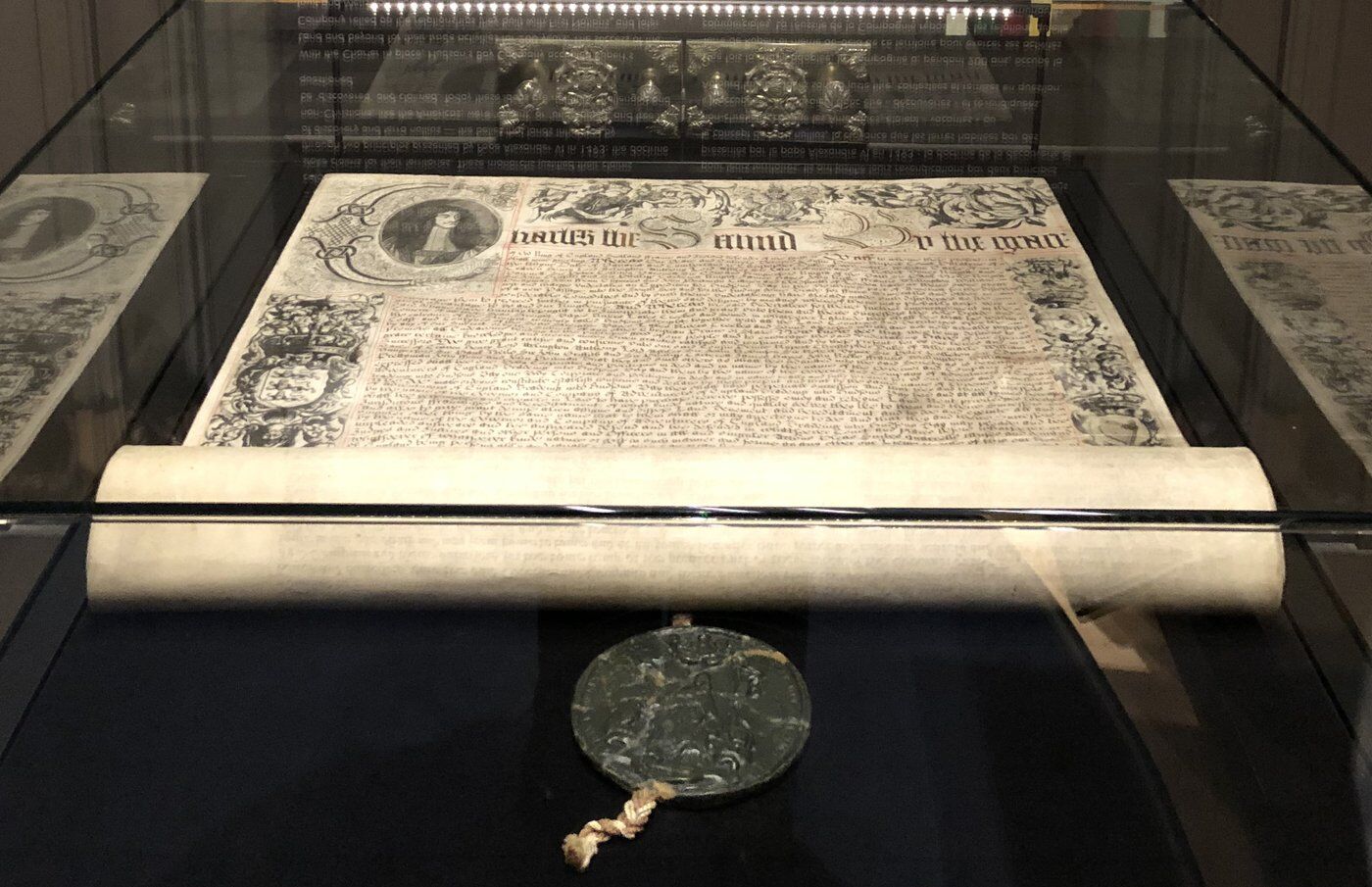
 The 1670 royal charter signed by King Charles II establishing Hudson's Bay displayed at the Manitoba Museum. 2020 handout photo, Manitoba Museum.
Rindisbacher, Peter, 1806-1834, Hudson’s Bay Company express canoe, 1825, Library and Archives Canada, Acc. No. R9266-346 Peter Winkworth Collection of Canadiana, public domain.
Canada’s oldest and most historically significant corporation, the Hudson’s Bay Company (HBC), is at the center of an unfolding cultural heritage controversy. Following its declaration of bankruptcy in March 2025 and court-supervised efforts to liquidate assets, the company has received legal authorization to begin the process of auctioning off more than 4,400 artworks, artifacts, and rare documents—which may or may not include items now deemed sacred to First Nations communities.
The company, founded in 1670 under a royal charter from King Charles II, once held vast political and economic power across Rupert’s Land,[1] an area encompassing over one-third of North America. Now reduced to six remaining stores, Hudson’s Bay Company has become a symbol of colonial legacy and its long-standing entanglement with indigenous cultures and land. The company’s proposed sale of historic items through Heffel Gallery Ltd. has raised legal, ethical, and political concerns across Canada and beyond.
On April 24, 2025, Ontario Superior Court Justice Peter Osborne approved Hudson Bay Company’s request to begin organizing an auction of its private collection. The collection includes the original 1670 royal charter that created the company, 1,700 artworks, and more than 2,700 other artifacts.[2] Osborne emphasized that the auction process must be transparent and flexible, with allowances for removing items if they are found to have unresolved claims or cultural significance.

Delivering Fur for the Hudson’s Bay Company, Lower Fort Garry, Manitoba, Canada, before September 1913. Valentine & Sons Ltd., Montreal + Toronto, public domain.
“There is nothing obligating Hudson’s Bay to sell all of the pieces,” said the company’s lawyer, Maria Konyukhova. “There is nothing meant to tie up the assets in any way.”[3] The court also required Hudson’s Bay Company to provide catalogues of the items to both the Attorney General of Canada and the Assembly of Manitoba Chiefs (AMC), following their concerns that public and Indigenous interests may be harmed by the sale.
Federal government lawyer Asad Moten, representing Canadian Heritage and other agencies, stated that while “Canada cautiously does not oppose” the auction, it has not had adequate opportunity to review or catalogue the items, some of which may be of national importance or cultural sensitivity.[4]
The Assembly of Manitoba Chiefs[5], representing 63 First Nations and more than 172,000 citizens, has taken a leading role in objecting to the proposed sales. Grand Chief Kyra Wilson demanded that all sales be halted until a full public inventory is released and Indigenous communities consulted.
“These artifacts are not simply ‘valuable assets’ or one-of-a-kind collectibles but pieces of living history,” Wilson stated. “Some of these items may be sacred, stolen from First Nations or properly First Nations-owned.”[6]
The Assembly of Manitoba Chiefs has invoked the principles of the United Nations Declaration on the Rights of Indigenous Peoples (UNDRIP), which Canada adopted in 2016 and began implementing into federal law in 2021. UNDRIP affirms Indigenous peoples’ rights to repatriate ceremonial and cultural objects and requires states to consult and cooperate in good faith before taking actions that affect their heritage.
Cultural Significance of the Collection
In fact, while the collection has, in itself, significant historical value, any claims that it contains sacred or stolen items are purely speculative. Very little is publicly known about the specific contents of the Hudson’s Bay Company collection, which has remained in corporate possession. According to anonymous sources cited by The Canadian Press, the collection includes early colonial paintings from the 1650s, historic “point blankets” with the iconic Hudson’s Bay Company four-color stripe, paper documents, ceremonial items, trade goods, and even collectibles such as vintage Barbie dolls.

Henry Alexander Ogden, Indians trade 90-lb packs of furs at a Hudson’s Bay Company trading post in the 1800’s. Archives of Manitoba’s Hudson’s Bay Company Archives public domain.
Nonetheless, experts warn that this lack of transparency undermines the ability of Indigenous nations, academics, and cultural institutions to assess potential claims. “Artifacts gain meaning through associated records. Ditto the reverse,” said Dr. Norman Vorano, Associate Professor of Art History at Queen’s University. “Objects without documentation lose cultural value.” [7]
Point blankets were widely distributed by Hudson’s Bay Company throughout its trading empire. While they are now emblematic of Hudson’s Bay Company branding, to many, they also symbolize economic exploitation, and the spread of disease – often unwittingly – through trade. These blankets were sometimes presented in ceremonial contexts and may hold cultural or spiritual significance to Indigenous communities.
“There is every likelihood that the collection includes items traded or gifted during formal diplomatic relationships with Indigenous leaders,” Vorano said. “These were often part of ceremonies, not just commerce. That means many could be culturally or spiritually significant.”

Agnes Deans Cameron, Hudson’s Bay Company pack horses at Telegraph Creek, British Columbia, 1900-1911, Canadian Museum of History.
Although Hudson’s Bay Company donated its corporate records to the Province of Manitoba in 1994 – they are now housed at the Archives of Manitoba and inscribed on UNESCO’s Memory of the World Register[8] – its artifact and artwork holdings remained private. The archival collection includes 130,000 photographs, corporate meeting minutes from 1671 to 1970, architectural drawings, cartographic records, and early audio and film materials. Many of these records have provided evidence in land claims, genealogical research, and environmental studies.
Vorano and other scholars stress that separating physical artifacts from their corresponding documentation undermines scholarly and Indigenous knowledge systems. “From a curatorial and archival perspective, keeping the objects together is essential for understanding Canada’s colonial history and for enabling community-based stewardship,” he wrote in The Conversation (2025).[9]
Canada’s Cultural Property Export and Import Act (CPEIA)
The sale and potential export of these items are governed by Canada’s Cultural Property Export and Import Act (CPEIA),[10] enacted in 1977 in response to growing global awareness of cultural theft and the need to regulate the movement of heritage materials. Under CPEIA, objects considered of “outstanding significance and national importance” can be subject to export restrictions if they meet age and value thresholds.

Unidentified Inuit man looking at 1937 Hudson’s Bay Company calendar. 1936. Photographer- Richard Hourde. 1936, Hudson Bay Company learning, http://www.hbcheritage.ca/hbcheritage/learning/calendar-gallery, public domain
In Canada, exporters apply to the Canadian Cultural Property Export Review Board (CCPERB). Canada does not ban export but allows for temporarily delayed export to permit public institutions or Indigenous communities the opportunity to match the object’s fair market value. The government offers grants to Indigenous groups to acquire significant objects. The valuation is set by the exporter, ensuring market fairness and avoiding uncompensated takings. Thus, there is clarity and due process. Definitions of cultural significance are rooted in expert assessments and statutory criteria. Canadian law balances individual property rights with cultural heritage concerns and avoids privileging any religious claims.
Private sales within Canada do not activate CPEIA’s review process. Critics argue that this creates a loophole through which Canadian collectors and museums could acquire culturally significant items without public accountability.
Ines Akué, spokesperson for Canadian Heritage, confirmed that federal cultural institutions are reviewing a copy of the Hudson’s Bay Company’s catalogue under non-disclosure agreements. “Canada’s national museums, with the relevant collecting mandates, and Library and Archives Canada are examining the information available on the art and artifacts in the collection,” she stated.[11] However, she would not confirm whether the catalogue would be made public or whether museums would be able to act on any urgent claims.
In the meantime, many institutions—including the Manitoba Museum and the Indigenous Council of the Canadian Museums Association—have called for a halt to sales until there is greater transparency about the auction and meaningful consultation with Indigenous peoples.
Comparing Canada’s Workable System with that of the U.S. Under the STOP Act
Whatever challenges lie ahead for the future distribution of the Hudson’s Bay artifacts, the Canadian system is unquestionably more likely to foster cultural preservation in tribal and indigenous communities than the U.S.’s new regime under the pending Safeguard Tribal Objects of Patrimony (STOP) Act, passed in 2022.
The STOP Act seeks to prevent the export of sacred or culturally important Native American items. However, as of 2025, its proposed implementing regulations face criticism for lack of transparency, high costs, and potential constitutional violations. Under the STOP Act’s proposed export permitting system:
-
- Each object proposed for export must undergo a permitting process through U.S. Customs and Border Protection (CBP), subject to classified tribal review.
- There is a $500 per item fee — often exceeding the retail value of many Native-made items.
- Tribes have unilateral discretion to determine whether an item is “sacred,” “cultural patrimony,” or “non-commercial,” without having to follow a consistent national standard.
- Tribal decisions are made without public disclosure and can expunge prior agency decisions at will.
- The regulations reverse the burden of proof, requiring the object’s owner to demonstrate its legality rather than the government to show that an item is illicit, undermining due process protections.
- Law enforcement agencies, including CPB, lack the tools or guidance to apply shifting tribal standards, risking arbitrary or selective enforcement.
- Tribal decision making based upon undisclosed “traditional knowledge” encourages repatriation demands for broad categories of items.
- The policy favors tribal religious or cultural claims without a neutral review process, raising First Amendment Establishment Clause concerns.
In comparison, Canada offers a clearer, more transparent, and rights-respecting system under its Cultural Property Export and Import Act. The U.S. STOP Act regulations, in their proposed form, risk being unconstitutionally vague, procedurally arbitrary, and practically unenforceable. By contrast, Canada’s transparent, incentive-based system integrates cultural preservation with market mechanisms and financial support, encouraging collaborative repatriation rather than coercive enforcement — a model that protects both heritage and rights.
Hudson’s Bay Company Employees Kept in the Dark
Whatever decisions are made in the Hudson’s Bay bankruptcy, the financial result will hit thousands of former and retired employees very hard. Former Hudson’s Bay Company employees are demanding a more open process, in which they have a voice. Following its bankruptcy declaration in March 2025, former employees have raised concerns over the fairness and transparency of the legal process—particularly in how decisions are being made about the representation of workers and the choice of the auction house.

Athabasca Landing’s first Hudson’s Bay Company store, Leslie Wood (left) and two other HBC employees, Jock Irwin and Russell Bannerman, standing in front. Built 1886-87. Author unknown, Athabasca Archives, 00758, public domain.
At an April 2025 hearing in Ontario Superior Court, lawyers representing Hudson’s Bay Company employees criticized the company for selecting a law firm to represent its workforce without a transparent or competitive process. Hudson’s Bay chose the Toronto firm Ursel Phillips Fellows Hopkinson LLP, citing its experience in major retail insolvencies, including the Sears Canada and Nordstrom Canada bankruptcies.[12]
But Andrew Hatnay, a lawyer representing more than 400 former employees through the firm Koskie Minsky (the company had 9364 employees when it filed for creditor protection), argued that this selection process was flawed and excluded input from affected workers. Many of those he represents worked in Hudson’s Bay Company stores, warehouses, or corporate offices and are now facing joblessness, pension uncertainty, and loss of benefits.
Justice Peter Osborne agreed that picking a firm without input was “a very significant and important issue,” and appointed retired Ontario judge Herman Wilton-Siegel to oversee the selection process and ensure impartiality. Further, the judge acknowledged the importance of the art collection and ordered Hudson’s Bay to provide both him and the Manitoba Chiefs with a complete catalog as soon as possible.
In addition to concerns over legal representation, some former employees have expressed skepticism about the company’s partnership with Heffel Gallery Ltd., the auction house managing the sale of over 4,400 items, including Hudson Bay Company’s original 1670 Royal Charter. Employees questioned whether the selection of the auction house was made through an open, competitive process and whether any consideration was given to public institutions or Indigenous groups before engaging a private, for-profit seller.

Hudson’s Bay Company man Larson and his trading post, Baillie Islands, Amundsen Gulf, North West Territories, 26 July 1916, Canadian Museum of History, public domain.
As the Hudson’s Bay Company’s bankruptcy unfolds, critics are saying the lack of transparency about the contents of the collection and the absence of public input fuel fears that culturally significant or sacred objects may be sold to the highest bidder without regard for public or Indigenous claims.
Some have suggested a formal moratorium on the sale of any objects linked to Indigenous communities until provenance research is complete. This could be coupled with expanded funding mechanisms through the Department of Canadian Heritage, enabling Indigenous governments or tribal museums to acquire objects that may be denied export permits.
A similar precedent exists in Canadian tax law: Cultural Property Export and Import Act-certified donations to public institutions qualify for significant tax deductions. If the Hudson’s Bay Company – or future buyers – were to donate items to tribal or national institutions, these incentives could ease the burden of preservation and facilitate restitution.
As a result of this case, Indigenous activists are calling for new legislation or emergency amendments to give Indigenous-led institutions priority rights over cultural property originating in their communities – which they say would follow the spirit of the United Nations Declaration on the Rights of Indigenous Peoples[13] and Canada’s Truth and Reconciliation Commission recommendations.[14]
SOURCES:
- Deschamps, Tara. “Hudson’s Bay auction of items including 1670 royal charter can go ahead, judge rules.” The Canadian Press, April 24, 2025.
- Noakes, Taylor C. “Canada: First Nations heritage comes up for grabs in Hudson’s Bay bankruptcy auction.” The Art Newspaper, July 4, 2025.
- Vorano, Norman. “HBC’s artworks and collections help us understand Canada’s origins — and can be auctioned off.” The Conversation, 2025.
- Canadian Heritage. Statements retrieved via Yahoo Finance and The Art Newspaper, July 2025.
- UNESCO Memory of the World Register. Archives of Manitoba – HBC Collection, 2007.
- Government of Canada. Cultural Property Export and Import Act (R.S.C., 1985, c. C-51).
- United Nations. UN Declaration on the Rights of Indigenous Peoples, 2007.
- Truth and Reconciliation Commission of Canada. Calls to Action
NOTES:
[1] The territory was named after Prince Rupert, the company’s first governor. It included parts of today’s Quebec, Ontario, Manitoba, Saskatchewan, Alberta, and Nunavut. Rupert’s Land was sold to Canada in 1869.
[2] Deschamps, Tara. “Hudson’s Bay auction of items including 1670 royal charter can go ahead, judge rules.” The Canadian Press, April 24, 2025.
[3] Id.
[4] Id.
[5] Assembly of Manitoba Chiefs, https://manitobachiefs.com/.
[6] Assembly of Manitoba Chiefs, AMC Calls for transparency and Consultation with First Nations regarding Hudson’s Bay Company’s Auction of Artifacts, press release April 24, 2025, https://manitobachiefs.com/press_releases/amc-calls-for-transparency-and-consultation-hbc/
[7] Noakes, Taylor C. “Canada: First Nations heritage comes up for grabs in Hudson’s Bay bankruptcy auction.” The Art Newspaper, July 4, 2025.
[8] UNESCO Memory of the World Register. Archives of Manitoba – HBC Collection, 2007, https://www.unesco.org/en/memory-world/register2023.
[9] Vorano, Norman. “HBC’s artworks and collections help us understand Canada’s origins — and can be auctioned off.” The Conversation, 2025.
[10] Cultural Property Export and Import Act (R.S.C., 1985, c. C-51), https://laws-lois.justice.gc.ca/eng/acts/c-51/
[11] Noakes, Taylor C. “Canada: First Nations heritage comes up for grabs in Hudson’s Bay bankruptcy auction.” The Art Newspaper, July 4, 2025.
[12] Deschamps, Tara. “Hudson’s Bay auction of items including 1670 royal charter can go ahead, judge rules.” The Canadian Press, April 24, 2025, https://ca.finance.yahoo.com/news/hudsons-bay-seek-court-permission-080036066.html
[13] Implementing the United Nations Declaration on the Rights of Indigenous Peoples Act, https://www.justice.gc.ca/eng/declaration/index.html
[14] Truth and Reconciliation Commission of Canada, Truth and Reconciliation Commission of Canada: Call to Action, https://www2.gov.bc.ca/assets/gov/british-columbians-our-governments/indigenous-people/aboriginal-peoples-documents/calls_to_action_english2.pdf