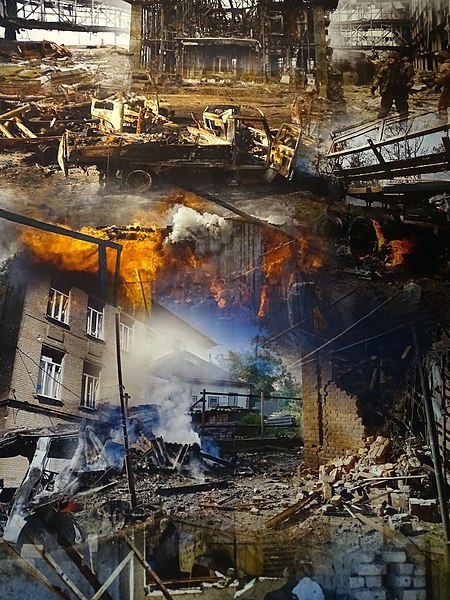
 Collage of photos from 2014-15 War in Eastern Ukraine, Museum of History of WW2, Kyiv, photo by Adam Jones from Kelowna, BC, Canada, CCA-SA 2.0 Generic.
 Ukrainian attorney Roman Shpyrka describes his personal experience as Advisor to the Prosecutor General of Ukraine (2023–2025), showing how Ukraine is strengthening accountability and the rule of law amid full-scale war – through prosecutorial reform, anti-corruption enforcement, and the pursuit of justice for grave international crimes.
I never set out to become an expert in war crimes against cultural heritage. Until 2022, I was a managing partner at my law firm, serving business and foreign investment clients. But when Russia launched its full-scale war against Ukraine, my priorities transformed overnight. I shifted from corporate litigation to international humanitarian law, focusing on the unthinkable: the prosecution of war crimes against culture. In 2023, I joined the Prosecutor General’s Office as Advisor to the Prosecutor General and helped establish a specialized unit dedicated to prosecuting the systematic destruction and looting of Ukrainian cultural heritage.
It has been both an honor and a grave responsibility to speak and act on behalf of the Ukrainian legal community in this fight. Honestly, I wish I had never gained this tragic expertise – but Russia’s war decided for me.
Culture at the heart of the conflict
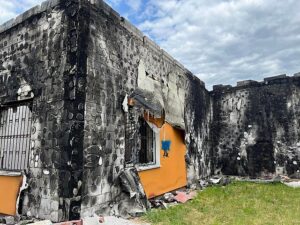
Ivankiv Historical and Local History Museum (Kyiv region) after Russian shelling on 25 February 2022 Author Ministry of Culture and Information Policy of Ukraine, CCA 4.0 license.
Russia’s war on Ukraine is not just about territory, resources, geopolitics – it is also war on Ukrainian identity and memory. Long before the first missiles fell, the Kremlin’s propaganda machine was denying the very existence of a unique Ukrainian culture. Officials and state media spread narratives claiming that Ukrainians “never existed” as a separate nation, that our language, history, and heroes were merely regional variations of Russian culture.
Russian propagandists made these false claims despite the fact that Kyiv was founded many centuries before Moscow and that the culture in the territory of modern Ukraine is ancient and distinctive. Ukrainian and Russian cultures developed along different paths – Ukraine developed its identity as a separate nation more open to humanitarian and democratic ideals, while Russian identity was often built on opposition to and domination over neighboring peoples.
The Russians tried to absorb our heritage as their own – even erecting monuments in Moscow to medieval Kyiv rulers and mislabeling famous Ukrainian artists like Kazimir Malevich and Ivan Aivazovsky as “Russian.” This cultural falsification was a prelude to invasion. When propaganda failed to convince the world, Russia turned to force – first in 2014, and then with a full-scale onslaught in 2022.
From the outset of its aggression, Russia deliberately targeted Ukraine’s cultural treasures. After 2014, and especially since the 2022 invasion, Russian forces have launched direct attacks on museums, monuments, churches, and historic buildings – even those far from any battlefield. In Odesa, Lviv and other cities hundreds of miles from the front, they destroyed cultural sites that had zero military value. The intent was brutally clear: to destroy not just our people and infrastructure, but our identity also. I firmly believe that while roads and buildings can be rebuilt, culture is the seed that regrows a nation – if you uproot it, the nation cannot easily recover. By destroying culture, the aggressor aims to destroy Ukraine’s identity and spirit.
Building a legal response amid war

Khanenko Museum in Kyiv during the 2022 Russian invasion of Ukraine. The paintings are taken off the walls and moved to shelters. Photo Kyiv City State Administration, Oleksiі Samsonov, 13 April 2022, CCA 4.0 International.
When the war first ignited in 2014, Ukraine’s legal system had to confront a challenge that was new nationwide for many lawyers. The prosecution of war crimes and violations of international humanitarian law (IHL) had been mostly theoretical for many lawyers up to that point. Not many lawyers or prosecutors work with IHL norms in their daily work in any other country, even today. Suddenly, prosecutors, judges, and attorneys found themselves handling cases of armed conflict. We faced a steep learning curve. Over the next few years, Ukraine methodically built the foundations for accountability in the midst of conflict.
By the time Russia launched its full-scale invasion in February 2022, our justice system was well prepared to deal with war crimes. Courts remained open and the rule of law, though under fire, held its ground. We had already established a War Crimes Investigation Department in the Prosecutor General’s Office, and dozens of judges, investigators, and attorneys had undergone trainings in international humanitarian law and war crimes investigations. This preparedness paid off: as the atrocities multiplied, we scaled up rather than collapsed. To date, around 190,000 incidents of war crimes have been registered in Ukraine – a staggering caseload that no nation should ever face.
Prosecuting crimes against cultural heritage: challenges and innovations

Historic apartment house in Lviv before the Russian bombing, with its Blue Shield cultural heritage designation. Ludwik Hirsch built it for his family in 1911-1912, designed by architect Jan Bagieński in Late Secessionist style. Instagram.
Amid this onslaught, we made a conscious decision in 2023 to give crimes against cultural heritage a high priority. I and my colleagues believe that protecting cultural memory is as critical as protecting human life – indeed, the two are deeply intertwined. We created a dedicated unit at the Prosecutor General’s Office to focus exclusively on cultural heritage war crimes, and assigned specialized investigators to do the same. By concentrating expertise and resources, we sent a message that these cases are not footnotes to the war – they are central to why we fight.
Investigating cultural war crimes brings unique difficulties. More than 1,600 cultural heritage sites (museums, historic buildings, and monuments) have been confirmed destroyed or damaged across Ukraine, along with over 2,400 cultural infrastructure objects. Each ruined site is a crime scene, yet many lie in territory still under occupation, unreachable by our investigators. Critical evidence and eyewitnesses are often scattered across continents – refugees who fled to Europe or beyond, curators who saved what they could before escaping. In many cases we must rely on remote methods to document damage: analysis of satellite imagery, videos on social media, even drone overflights when possible.
In fact, one of the greatest lessons since 2022 has been that we as lawyers are not alone in this fight. We’ve built an ecosystem of cooperation with civil society groups, historians, digital archivists, and open-source intelligence (OSINT) investigators around the world. Using new technology, we can document and present evidence in ways previously unimaginable. For instance, we create detailed 3D models of destroyed heritage sites to preserve a digital semblance of what was lost and to show courts the deliberate nature of the damage. Sophisticated databases and AI tools help us sift through massive amounts of photos, videos, and documents. These innovations have propelled our work forward dramatically – a stark contrast to 2014.
Of course, resources remain a constant concern. The sad reality is that cultural heritage protection often receives fewer resources than other efforts. Even so, we continue to improvise and press on. The importance of safeguarding our history far outweighs the obstacles. Every case of a burned archive or a looted museum that we can push forward is a signal that these acts will not simply be forgotten amid the larger war.
Confronting imperfect international law mechanisms

After the September 4, 2024 bombing. Seven people including a mother and her three daughters were killed, another 25 injured.
Working on these cases has also exposed glaring gaps in international law and enforcement. The world does have treaties – the 1954 Hague Convention and others – meant to protect cultural heritage in war. Ukraine has done everything by the book: we mark our historic sites with the Blue Shield emblem, we report attacks to UNESCO, we document violations meticulously. Yet these mechanisms often feel tragically inadequate against a violator as brazen as Russia. A year ago, a Russian missile struck a historic residential building in Lviv for example, killing many civilians and obliterating the top floors. Mounted by the entrance was a Blue Shield plaque indicating this was protected cultural property – but the symbol itself can do nothing to prevent the destruction or to bring justice. Standing in front of that ruined building, I was haunted by a painful question: Russia – a member of UNSC, UNESCO and signatory to the 1954 Hague Convention – had blatantly broken the rules, so where was the justice? Where was the swift international action to hold the perpetrators accountable for this cultural atrocity?
Moments like that force us to admit that the current international humanitarian law system is far from perfect. The conventions and protocols are decades old, crafted in an analogue era that never imagined satellite-guided bombs or state-sponsored disinformation in digital era. It is not enough to have declarations on paper and plaques on buildings if there is no effective deterrence or punishment. We urgently need to reform and reinforce these mechanisms for the 21st century. That means faster investigative support, stronger sanctions, and perhaps new international tribunals or legal frameworks specifically for cultural crimes. Otherwise, we set a dangerous precedent.
Despite all the challenges, I remain convinced of one core principle: sustainable peace is impossible without justice. This war began, in part, as an assault on culture – and so culture must be part of the peace. Ukrainian cultural heritage is a silent victim of this conflict, unable to speak for itself. It falls to us – lawyers, scholars, NGOs, people from all over the world – to be its voice. We owe it to the victims of war, to history, and to future generations to ensure that those who burn books, rob museums, and shell churches are held accountable. If peace were declared tomorrow without addressing these crimes, it would be a false peace – a colossus with feet of clay ready to collapse. True peace requires that the truth be told and justice done.

Roman Shpyrka
Roman Shpyrka is a Ukrainian attorney, managing partner of Solid Partners Law firm, expert and consultant to international organizations, and was Advisor to the Prosecutor General of Ukraine (2023-2025).