Musée chinois in the Palace of Fontainebleau, France, artifacts from Qing dynasty China, the Kingdom of Siam, and other Asian countries, including plunder from the Second Opium War. 17 August 2019, photo Boubloub, CCA-SA 4.0 International license.
 France has taken another step toward a permanent administrative procedure “for the declassification of cultural property” from French museums for its restitution to a foreign state. This procedure is limited to property that has been established or is strongly suspected of having been unlawfully appropriated between June 10, 1815, and April 23, 1972. The law excludes property with a military function or taken as a military necessity and archaeological property that was part of an official excavation or partage agreement or acquired through a scientific exchange.
The Sénat’s bill‘s official title is:
“Projet de loi relatif à la restitution de biens culturels provenant d’États qui, du fait d’une appropriation illicite, en ont été privés”. (PJL n° 871) (2024-2025)
The bill would replace the “one statute per object” bottleneck on restitution of certain museum-owned objects with a repeatable administrative process for making unlawfully appropriated museum property (1815–1972) alienable – no longer in public ownership – and able to be restituted to a country of origin. 1815 is the date of the Congress of Vienna, marking the end of the Napoleonic Wars; 1972 is the year that France adopted the 1970 UNESCO Convention on the Means of Prohibiting and Preventing the Illicit Import, Export, and Transfer of Ownership of Cultural Property.
(Today, the adoption of the 1970 UNESCO Convention is treated as if its signing instantly transformed global perspectives on national ownership and restitution of cultural heritage. In fact, the 1970 Convention had little recognition and almost no practical effect on the circulation of objects and their legal import for at least the next quarter century. Even in the U.S., where an implementing law was passed early on, the 1983 Cultural Property Implementation Act only partially adopted the terms of the Convention and left decision-making on restitution to the United States. Laws in most art consuming nations began to reflect the Convention’s concerns only in the late 1990s and 2000s.)

Royal statue of King Béhanzin of Abomey with features of a shark. Artist Sossa Dede. Formerly collection Musee du Quai Branly – Jacques Chirac, now in Dahomey, Benin.
After approval by the Sénat, the upper chamber of France’s Parliament, a modified bill enabling repatriation of certain museum objects now goes to the lower chamber, the Assemblée nationale, where it is Projet de loi n° 2408 (17e législature). If the bill is approved there, a process will be created in which objects that left foreign countries between 1815 and 1972, including gifts and bequests, can be ‘declassified’ and lose their inalienable character, and then repatriated to foreign countries of origin. They must still meet specific criteria and follow a specific process that includes a ‘scientific’ review.
Many archaeological holdings in French museums come from authorized digs and partage arrangements between 1815 and 1972. There is a carve-out in the bill that removes these archaeological items in public collections from the new procedure. They remain inalienable. However, archaeological objects obtained through purchase or donation can be subject to the new law.
If a foreign state’s claim is that an object was stolen or illicitly exported from 24 April 1972 onward, the Sénat report is explicit that those cases should be handled by the existing judicial route (Code du patrimoine, art. L.124-1), in which the museum (the public owner) would go to a judicial judge to annul the acquisition and seek the object’s restitution. The difference now is that this could happen more frequently because for objects exported post-23 April 1972, this judicial route can be utilized regardless of whether or when the state of origin ratified the 1970 UNESCO convention.
It’s about removing the shield of ‘inalienability.’
According to a summary of the process adopted by the legislature and published by it:
“The derogation from the principle of the inalienability of the public domain is justified by an unprecedented reason of public interest. The bill establishes a special procedure for the removal of cultural property from public collections, the sole purpose of which is the restitution of such property to a foreign state from which it has been unlawfully deprived. This exception is justified by the need to allow the people of that state to reclaim property that constitutes fundamental elements of their heritage.”
On 28 January 2026, following what was described as a “turbulent process,” the French Sénat adopted (with six amendments) the government’s bill on restitution of cultural property “from states which, due to illicit appropriation, were deprived of it.” The text has now been transmitted to the Assemblée nationale for first reading.

African Hall, Musée du Quai Branly – Jacques Chirac, Paris, France, photo Andreas Praefcke, Wikimedia Commons
The political headline “simplifying restitution” can obscure what the bill actually changes in legal terms. In France, most objects in public museum collections are part of the “domaine public” (public domain of public property). Once an item is in that category, it is protected by “inaliénabilité” (inalienability): it cannot be transferred or disposed of unless it is first legally removed/declassified from the public domain . That rule is explicit for “musées de France” collections under the Heritage Code: these goods are in the public domain and “inalienable,” and any declassification decision normally requires the formal involvement of the Haut Conseil des musées de France.[1]
This is why colonial-context restitutions have often required a specific statute to be passed for each return: Parliament had to create a one-off exception to inalienability so each object could be legally taken out of the public domain and transferred. The Senate’s own plain-language explainer describes the current situation as a bottleneck: for objects that entered public collections before later legal regimes came into play, “a law must provide, for each cultural object, a derogation” from inalienability.

A Moai ancestor’s head, Easter Island (11th–15th c), carried to France in 1872 by French Rear-Admiral Lapelin, Musee du Quai Branly – Jacques Chirac, Paris, France, 6 August 2014, photo SiefkinDR, CCA-SA 3.0 Unported license.
What’s new is the process – and that it’s a pathway or pipeline that does not require a separate bill for each declassified object.
What the 2026 bill does is replace that repeated “one law per object” model with an ongoing administrative pathway. The Senate explains the structure of this pathway in simple procedural terms: a request would be tested against objective criteria (first admissibility, then “restituability”), and if those conditions are met, the removal from the public domain could be ordered by decree of the Conseil d’État.
The Conseil d’État would not simply hand over restituted objects. That phrase “décret en Conseil d’État” refers to a particular kind of government decree adopted through a process that requires review by the Conseil d’État. In the Senate-adopted text, the decree is the legal instrument that performs the key step: removing the object from the public domain so restitution becomes legally possible.
The Senate’s amended bill tightens the expert-review that must take place for the decree to become effective. Under the adopted text, the requesting state’s claim is examined first by a bilateral scientific committee whose members are agreed upon in consultation with the requesting state – essentially to represent both states in a balanced manner. The whole record pertaining to the request then goes to a new, permanent “commission nationale des restitutions,” created through the Haut Conseil des musées de France, which must issue a public, reasoned opinion.
What are the new criteria?
Substantively, the criteria for restitution are narrow and explicit. The object must:
(1) originate from the current territory of the requesting state;
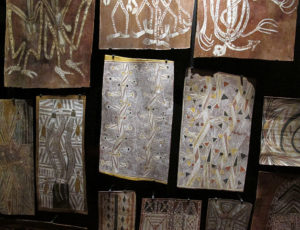
20th C Aboriginal art displayed at the Musée du Quai Branly, Paris, Author: Sailko from Wikimedia Commons
(2) there must be evidence (or the claim must be supported by “serious, precise and concordant… indications”) that the object was illicitly appropriated between 20 November 1815 and 23 April 1972 by theft, pillage, or transfers/gifts obtained by pressure or violence (or given by someone lacking authority to dispose of it); and
(3) not already be governed by an international agreement France concluded before the new law enters into force.
The Senate added further exclusions: for archaeological items, the object must not come from partage de fouilles (sharing of excavations) or exchange of artifacts for scientific study, and the object must not have contributed to military activities by its nature, destination, or use.
The bill is explicit about who can ask and who decides. Restitution is framed as state-to-state: the procedure is triggered by a request from a foreign state, and the Senate stresses that restitution remains an ability or opportunity that is open to public owners, not a mandatory obligation. Where the object belongs to a public legal entity other than the French state (for example, a local authority), the decree cannot be issued unless that owner approves the object’s removal from its own public domain.

Fragment of a Buddhist mural from the Kizil Caves in Xinjiang, China. Musee Guimet, Paris.
The legislation does not automatically make everything taken in a colonial context subject to its restitution procedure. The Senate stresses that the derogation from inalienability is limited to precise cases.
What about objects that left countries of origin after 24 April 1972?
It also does not replace court pathways for later thefts or illicit transactions. The bill’s time window is central to its design, and the Senate explicitly treats it as a special procedure for a defined historical period, while other laws and legal regimes continue to apply outside it.
If the requesting country says the item was stolen or illegally exported on or after 24 April 1972, the Sénat’s approach is to treat it as a court matter under the heritage code (Code du patrimoine, art. L.124-1). In practice, the French public body that holds the object would bring the case before a judicial court to have the acquisition set aside and the object returned.
What about objects donated or willed to French museums?
Another important and controversial part of the bill is how it deals with donations and bequests. The Senate text extends the new mechanism to objects incorporated into public collections through donation or bequest unless the gift included a clause forbidding deaccession. It also establishes a notification and publicity process after which consent can be presumed if the donor/heirs do not respond within six months of the last required step, thus allowing the restitution procedure to move forward.

View from the ground floor of the Musee Guimet, Paris, France, 3 September 2006, photo Kuxu76, CCA-SA 3.0 Unported license.
What other legislation on repatriation is new?
The bill is meant to complete a trilogy of French restitution laws. In 2023, France adopted a standing procedure for returning cultural property spoliated during anti-Semitic persecutions (1933–1945) and another for returning human remains held in public collections. Both of these also revolve around the same core legal step: creating a structured exception so leaving the public domain can occur under defined conditions.
Politically, the government continues to present the bill as part of the post-2017 “change of paradigm” announced by Emmanuel Macron, moving cultural institutions from a mindset of perpetual retention toward a managed possibility of return. In her Senate speech introducing the text, Minister of Culture Rachida Dati explicitly linked the bill to Macron’s 2017 commitment and to a broader debate extending beyond the culture ministry.
What remains, for now, is to complete the parliamentary process. The Senate has passed a clarified procedure with a stronger emphasis on expert review and public input; the National Assembly must now examine the bill and decide whether to retain that structure, revise it, or to otherwise reshape the balance.

Bodhisattva, Fondukistan, Afghanistan, 7th C CE, 25 June 2017, photo Rama, Musee Guimet, Paris France. CCA-SA 3.0 France license.
[1] The Haut Conseil des musées de France (High Council of French Museums) is a consultative body established to advise the French Ministry of Culture on museum policies regarding acquisition, conservation, and museum programming and on whether a museum meets the standard to be officially recognized as a “musée de France.”
See: La Loi en Clair: https://www.senat.fr/travaux-parlementaires/textes-legislatifs/la-loi-en-clair/projet-de-loi-relatif-a-la-restitution-de-biens-culturels-provenant-detats-qui-du-fait-dune-appropriation-illicite-en-ont-ete-prives.html