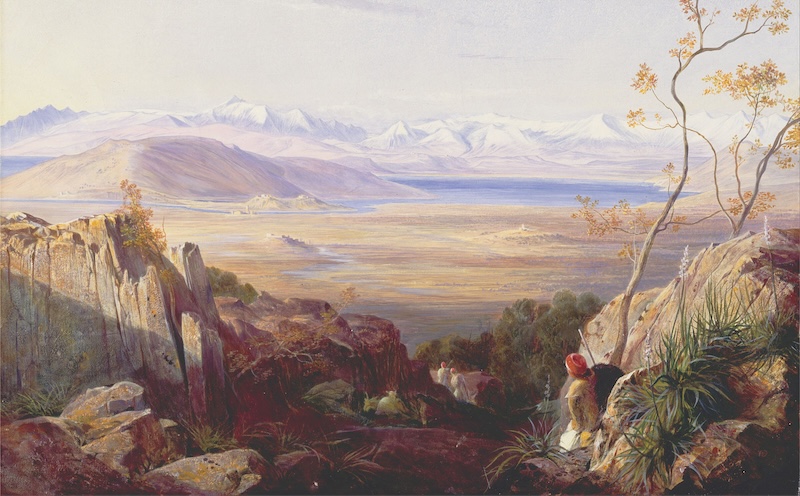
 Edward Lear, Butrinto, Albania, 1861, Yale Center for British Art, Yale University, New Haven, CT, USA. Public domain.
 The Committee for Cultural Policy, Inc. and Global Heritage Alliance, Inc. submitted detailed comments to the Cultural Property Advisory Committee at the Department of State on July 5, 2026, concerning Albania’s request for a five year renewal of that country’s current cultural property agreement with the United States. A public hearing was held on July 14, 2026.
The CPIA requires evidence of current pillage, proof of a significant U.S. market, and meaningful protective measures taken by Albania, and support for international cultural exchange. What follows is a brief summary of the principal facts and issues; the full submission is linked here: Commentary on Albania MOU Renewal Request
Summary: Albania Seeks Protection Abroad While Neglecting Heritage at Home
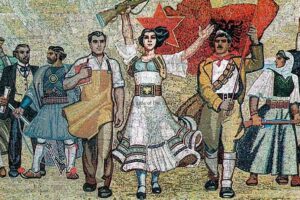
Original of the Mosaic of the National History Museum of Albania, photo Clemens Schmillen, 4 August 1990, CCA-SA 4.0 Int’l license.
Albania has extraordinary archaeological sites, historic buildings, museums, religious monuments, and cultural collections. Yet the record supporting continued broad U.S. import restrictions says surprisingly little about what the Albanian government itself is doing to protect them.
The central problem is not a lack of laws. Albania has a highly centralized heritage system, national institutions, licensing and inspection powers, export controls, and rules against unauthorized excavation and metal detecting. But these structures have not been matched by adequate funding, legal enforcement, or public accountability.
Heritage protection receives limited government support
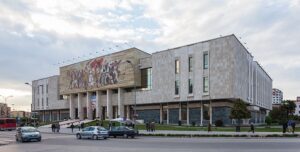
National Museum of History, Tirana, Albania, photo Diego Delso, delso.photo, License CC BY-SA.
Albania’s National Strategy for Culture acknowledged that cultural institutions depend heavily on the state, while funding for independent cultural organizations is inadequate. It also identified a shortage of professional training inside the country, noting that specialists often must go abroad to develop needed skills.
The record does not provide national employment figures for archaeologists, conservators, museum staff, or heritage managers. It does, however, describe insufficient budgets, serious capacity gaps, and few resources outside the central government structure. These conditions make it difficult to retain trained professionals or develop the workforce needed to care for Albania’s heritage.
In 2019, Albania’s Ministry of Culture received only 0.68 percent of the state budget. Roughly half was absorbed by 28 subordinate institutions, leaving the remainder for ministry programs and independent cultural operators.
There is still no clear, current public accounting of spending on conservation, inventories, archaeology, customs training, or site guards. Without that information, it is difficult to treat heritage protection as a demonstrated national priority.
Preservation has reached only part of the country’s heritage
Between 2014 and 2018, Albania reportedly allocated about 68 million Albanian lekë—roughly $600,000 to $630,000 at the time—to preservation work involving 689 monuments.
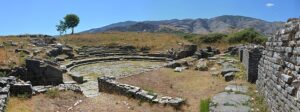
The ruins of the antique theater of Hadrianopolis near Sofratika, Albania. Photo by Pasztilla aka Attila Terbócs, 14 August 2017, CCA-SA 4.0 Int’l license.
Albania’s own strategy said this work reached only about 24 percent of the country’s monuments. The public information does not show whether it included basic protection such as guards, fences or documentation of continuing damage.
Limited repairs are not the same as a functioning national protection system. Long-term preservation requires professional staff supported by realistic budgets. The record does not show that these elements are in place.
The European Union has paid for most of the visible progress
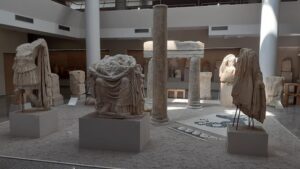
Durrës Archaeological Museum, Restored by EU, photo Adert, 15 June 2022, CCA-SA 4.0 Int’l license.
Many of Albania’s most prominent recent heritage projects were not primarily financed by the Albanian government. They were supported through the European Union’s €40 million EU4Culture program following the 2019 earthquake.
EU funding and supervision supported work at the Durrës Archaeological Museum, the Durrës Amphitheatre, the National Gallery of Art in Tirana, castles, museums, and religious monuments. The program reportedly restored or revitalized 23 heritage sites and generated about 64,000 working days.
The Durrës Archaeological Museum, Albania’s largest archaeological museum, was restored through EU4Culture after earthquake damage and took four years to reopen. This was an important achievement, but it also shows Albania’s dependence on foreign financing and outside project management for major cultural work.

Durrës Archaeological Museum, photo NaileZ, 14 February 2023, CCA-SA 4.0 Int’l license.
European assistance can repair buildings and create temporary employment. It cannot replace a permanent national system year after year.
When the largest and most visible successes are paid for by the European Union, they should not be presented as proof that Albania is adequately financing or administering heritage protection. They suggest that without outside support, major projects may be delayed or never undertaken.
Government decisions have endangered heritage
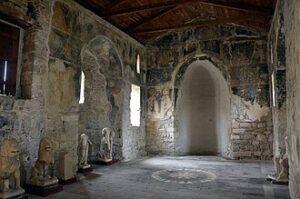
The refectory of the St Mary Church, Pojan, Albania, photo Pasztilla aka Attila Terbócs, 20 September 2015, CCA-SA 4.0 Int’l license.
The destruction of the historic National Theatre in Tirana shows the gap between Albania’s heritage laws and government practice. The theatre was demolished in 2020 after two years of public protests. Albania’s highest court later ruled that the law used to transfer the property to the municipality was unlawful. The site was tied to plans for both a replacement theatre and private high-rise development. Five years after the demolition, replacement plans were reportedly still nearing completion.
This case highlights a broader problem. Albania argues that cultural material needs protection from foreign markets, yet some of the clearest threats come from domestic underfunding and failures to enforce existing laws.
Corruption and limited institutional capacity can also affect construction approvals, museum acquisitions, inventories, and the treatment of protected sites.
Museums need professionals, not just buildings
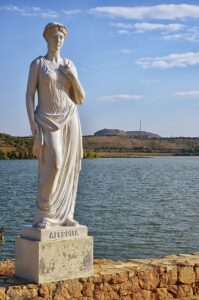
Reproduction of statue of Aphrodite in Seferan, by Liqeni i Rumbullakët. Photo Pasztilla aka Attila Terbócs, 13 October 2018, CCA-SA 4.0 Int’l license.
A functioning museum system requires more than renovated galleries. It needs trained museum professionals. These professionals need stable employment, continuing education, and basic equipment.
The record does not show that Albania has built this professional infrastructure. It identifies major shortages in domestic training but provides no detailed information on working conditions. A restored museum may reopen, but without adequately supported professionals it will struggle to preserve objects, organize exhibitions, conduct research, detect theft or deterioration.
Albania needs sustained domestic investment
Albania’s cultural heritage deserves support, but U.S. import restrictions cannot repair weaknesses inside Albania’s institutions. They do not hire conservators, create stable museum careers or secure archaeological sites.
Albania can demonstrate a serious commitment by publishing current spending and staffing data, investing consistently in museums and conservation, employing qualified specialists, and enforcing its own laws.
European programs have preserved important sites and supplied badly needed resources. But emergency projects and foreign grants should support Albania’s national system, not substitute for it. Until Albania develops reliable domestic funding and a professional heritage workforce, its cultural institutions will remain dependent on outside organizations to perform work that should be a continuing responsibility of the Albanian government, not dependent on foreign support.
Read the full commentary: Commentary on Albania MOU Renewal Request