Bamiyan Province, Afghanistan. Two schoolgirls watch as soldiers from the Bamyan Malaysian Contingent install a water system on their school grounds, June 6, 2012. There were then more than 120,000 children enrolled in school in the province, nearly half of them girls. Photo Sgt. Ken Scar, public domain.
 Introduction

Ethnographic map of Afghanistan, Hazarajat in green. CIA, 1979, public domain.
The persecution of the Hazara people of Afghanistan is one of the most enduring and least acknowledged genocides of the modern world.
Understanding the Hazara tragedy means understanding Afghanistan itself: its geography, its complex history, and its long struggle between cultural diversity and centralized political domination. The story of the Hazara persecution begins with a nineteenth-century Afghan ruler’s empire-building. It continues through Afghanistan’s 20th century modernization, through the Soviet Union’s invasion to the terror inflicted by the Taliban and ISIS PK – to today’s bombings of maternity clinics and forced deportations.
But the Hazaras’ place in Afghanistan’s history begins long before.
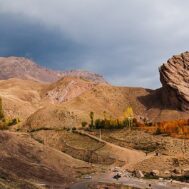
Their story is inseparable from that of their traditional heartland, the rugged central highlands of Afghanistan known as the Hazarajat. This landscape seems remote today, but long ago it was an ancient crossroads of civilization.

Sunrise over Bamiyan Valley, photo by Afghanistan Matters from Brunssum, Netherlands. CCA 2.0 Generic license.
Hazara people often have almond eyes and distinctive facial features that have led them to be mythologized as descendants of Chingiz Khan’s Mongol armies.[1] Modern studies indicate that they were in Afghanistan long before the thirteenth century and suggest a mix of lineages: elements of ancient local populations with traces of Turkic and Mongol admixture reflecting centuries of intermarriage with neighboring groups. It is probably more accurate to say that the Hazara represent one of the region’s ancient peoples, deeply rooted in the central highlands and repeatedly shaped by conquest and migration.
Archaeological evidence reveals human settlements stretching back thousands of years to the Bactrian Bronze Age (roughly 2000–1500 BCE). In ancient times, Afghanistan, one of the sole sources of lapis lazuli, also produced worked turquoise, agate and gold. Precious objects from the Central Asian world passed east to the Indus and west to the Mediterranean through ancient corridors of trade.
Over the centuries, the central highlands were absorbed into and influenced by a succession of empires: the Greco-Bactrian kingdoms, the Parthians, the Kushan Empire.

Band i Amir lakes in Hazarajat, photo by Françoise Foliot, 1974-1975, CCA-SA 4.0 International license.
Under the Kushans, Mahayana Buddhism, a religion for all, spread along trade routes all the way to China, leaving behind cave monasteries and hundred-foot-tall statues carved into the cliffs of the Bamiyan Valley. Urban oases were surrounded by pastoralists, and east-west trade nourished smaller city-states until the Islamic conquests of the eighth and ninth centuries CE.
Thereafter, dynasties rose and fell. In turn, Samanids, Ghaznavids, Ghurids, and Khwarezmshahs built powerful kingdoms. In the thirteenth century, Chingiz (Genghis) Khan brought near-total destruction to Balkh, the mother of cities, to Samangan, Bamiyan and other towns across the region.
Chingiz Khan’s descendants carried the Mongol Empire to the very borders of Europe. Empires built in Central Asia by his sons and grandsons were succeeded by Timur Leng, known in the West as Tamerlane, in the fourteenth century. Timur made Samarkand and Herat, to the north and south of the Hazarajat, the most brilliant cities of their age. A minor Timurid prince, Babur, who was disappointed in his hopes of ruling Bukhara and Samarkand, went south and took Kabul instead. From there he led his soldiers east across the Hindu Kush mountains to found the Mughal Empire in India.
This kaleidoscope of civilizations shaped the genetic, linguistic, and cultural mosaic of Afghanistan, including its central highlands.
State Formation and the Seeds of Persecution

Founders of the Durrani empire, Ahmad Shah Durrani, Dost Mohammed Khan, Abdur Rahman Khan.
To understand why the Hazara have suffered such persistent violence, we must look to the formation of the modern Afghan state. From the sixteenth century onward the various Pashtun tribes of southern and eastern Afghanistan served as soldiers – both for and against the Mughals and Persians. Taking advantage of the weakness of both empires in the eighteenth century, a number of Pashtun tribes came together under Ahmad Shah Durrani, who established the first Afghan Pashtun empire in 1747.
From the mid-18th century onward, Afghanistan has been ruled by a hereditary Pashtun elite, first from the Sadozai and then the Barakzai branches of the Durrani confederation. These rulers tried to forge a centralized, Pashtun-dominated monarchy to rule Afghanistan’s patchwork of peoples, including Pashtuns, Tajiks, Hazaras, Uzbeks, Turkmen, Nuristanis, and many smaller linguistically and ethnically-distinguished communities.

Engraving from Alexander Burnes’ Travels into Bokhara. The Colossal Idols at Bameen, by L. Haghe for Burnes’ Travels into Bokhara, 1834.
This centralizing project reached its brutal climax under Amir Abdur Rahman Khan, known as the “Iron Amir,” who ruled from 1880 to 1901. Abdur Rahman consolidated power through war, patronage, and ruthless repression. He used ethnic and sectarian divisions as tools: rewarding loyal tribes, crushing resistant ones, and recasting the state as both an ethnically-Pashtun monarchy and a Sunni Muslim religious project.[2]
The Hazara were especially vulnerable. Several factors marked them out: their appearance and distinctive dress, their Persian/Dari language, spoken in a unique Hazaragi dialect, their predominantly (Twelver) Shiʿa and Ismaʿili religious identity in a majority-Sunni country.[3] Under the Iron Amir’s calculus, they were targeted not only for their difference but in order to take their assets: the fertile agricultural and grazing lands in the central highlands were much coveted by Pashtun tribes.
The Hazara War (1890–1893): A Forgotten Genocide

Abdur Rahman Khan, King of Afghanistan from 1880 to 1901, published 1907, public domain.
The Hazara War of 1890–1893 was a genocide, marking one of the darkest chapters in Afghanistan’s history. Using the term “genocide” acknowledges victims’ suffering and that of their descendants. It highlights the gravity of the crimes. It also reinforces the need for accountability, especially amid ongoing attacks.
Some Hazara communities had served as loyal soldiers during Abdur Rahman’s push to consolidate power over Afghanistan’s diverse population. They attempted to work with the Amir once he felt secure. He took the opportunity instead to cast them as infidels and imposed punitive and arbitrary taxation, seized lands, animals and crops,[4] destroyed orchards, demanded forced labor, encouraged assaults on women and girls, enslaved whole tribes[5] and killed any who resisted.
These abuses pushed the Hazara into open revolt. Although the initial uprising was brutally suppressed, many Hazaras continued to resist the Afghan ruler’s regime. During the 1890-1893 period, he struck back even harder. Importantly, even those who surrendered peacefully – or who remained loyal soldiers on the side of the government, including Hazaras from the Behsud, Day Zangi, Day Kundi, and Ghuri clans – were subjected to the same harsh treatment.
“…[p]rior to the advent of the government army [Hajaristan district] had more than two laks [viz., 200,000] of willow and plane trees . . . [b]ut with the invasion of the army all were cut down and other than the stumps no sign remain[ed] of these trees [and] [t]he crops of its extensive fields [were] all destroyed.”[6]
Hazara elders wrote to Abdur Rahman to list their grievances in a desperate plea for justice. Instead of addressing these abuses, the Amir sought religious cover. He secured fatwas (decrees) from Sunni clerics declaring jihad against the Shiʿa Hazaras, portraying them as heretics and less than fully human.[7]

Group of Hazaras, 1878-1880, photo Sir Benjamin Simpson, public domain.
What followed was a campaign of extermination and enslavement. Entire communities were massacred and villages were burned. Tens of thousands of men, women, and children were enslaved and sold in Afghan markets or distributed as booty. Hazara lands were confiscated and granted to Pashtun tribal allies and religious endowments.[8] The destruction was so complete that many Hazara had no choice but to try to flee and those who could not, starved or died in the winter cold.
During Abdur Rahman’s rule, over a twelve-year period, 400,000 Hazara families were displaced and only 10-20 percent of these were able to escape. Over seven thousand Hazara were sold each year as slaves in Kandahar and ten thousand were sold in Kabul. The numbers are recorded as the government collected a tax on the sale of slaves.
Modern scholars such as Mehdi J. Hakimi estimate that at least sixty percent of the total Hazara population was killed, enslaved, or forcibly displaced during Abdur Rahman’s campaigns. Some estimates are even higher, suggesting that more than 80 percent of the Hazaras of Hazarajat were killed or removed from their lands. In the most hard-hit areas such as Uruzgan, many tribes were completely destroyed. According to a United Nations publication, a government report of that time stated that in Behsud, only 6,200 families remained out of 20,000.[9]

Peshawar Valley Field Warriors Resting Against a Hillside, 1860s-1870s, photo John Burke, Google Art Project.
Those who survived often did so by accepting servitude and losing their land or by fleeing to India (now Pakistan) especially to the town of Quetta, and to Iran (notably Mashhad), forming diasporic communities that remain to this day.[10]
The aftermath of these massacres institutionalized a continuing discrimination. Sunni Muslim judges and clerics were imposed in Shiʿa regions. Public Shiʿa religious rituals, such as Ashura processions, were banned. Hazaras were forced to pay the jizya, a tax normally levied on non-Muslims, signaling that they were outsiders in their own country.[11]
A caste-like system emerged, with Hazaras occupying the lowest rung of Afghanistan’s ethnic hierarchy. This was the foundational genocide: a deliberate attempt by the Afghan state to destroy the Hazara “in whole or in part,” decades before Raphael Lemkin coined the term genocide.
The 20th Century: Inequality as a System

Hazara in Kabul, photo Herbert Maeder, 1967, Appenzell Ausserrhoden, Switzerland, CCA-SA 4.0 International license.
Throughout the 20th century, Hazaras remained marginalized and largely excluded from political power, higher education, and the bureaucracy. Hazara laborers worked as servants, porters, and sharecroppers for wealthier Pashtun and Tajik landowners. Hazara children were trafficked as domestic servants and even as bonded labor. Derogatory terms and stereotypes normalized violence and humiliation.
Anthropologists like Robert L. Bacon and H.B. Schurmann, writing in the mid-20th century, noted internal diversity among Hazaras – some Sunni, others Twelver Shiʿa or Ismaʿili – yet even as co-religionists with the Sunni Pashtuns, the legacy of subjugation persisted.[12]
Meanwhile, Hazara communities quietly rebuilt. They established local schools and religious seminaries. They supported traders, teachers, and clergy and invested in literacy and communal organizations. They maintained distinct forms of poetry, music, embroidery, and oral history that preserved a sense of identity despite systemic racism. This was not a time of overt mass killing, but of structured inequality – the “slow violence” that prepares the ground for future atrocities.
The Soviet Era and Mujahideen Politics

Soviet troops in Afghanistan, early 1980s, shown seizing Afghan civilians suspected of protecting mujahideen.
The Soviet invasion in 1979 and the subsequent jihad fractured Afghanistan state and society. For the Hazara, it was both a moment of opportunity and danger.
Shiʿa Hazara resistance groups – many marginally supported by Iran – emerged in the central highlands, fighting the Soviet-backed PDPA communist government on both religious and communal grounds. A few Ismaʿili leaders, such as Sayed Mansur Naderi, sometimes aligned with the government, adding another layer of complexity.
These rivalries fragmented Hazara politics, yet they also paved the way for a modern Hazara national consciousness. By the late 1980s, a Hazara resistance group, Hezb-e Wahdat-e Islami Afghanistan, under Abdul Ali Mazari, became a unifying force. Mazari reframed the struggle not simply as Shiʿa vs. Sunni, but as a fight for Hazara rights: equality, representation, and an end to the historic caste system. Hezb-e Wahdat argued that Afghanistan could only be stable if all ethnic groups, including Hazaras, shared power.
When Mazari was captured and killed by the Taliban in 1995, his mutilated body was thrown from a helicopter. He became – and remains – both a martyr and a symbol of Hazara unity.[13]
The First Taliban Era: Massacres in the 1990s

Hazara leader Abdul Ali Mazari, Head of Hezb e Wahdat and founder of the Islamic Unity Party of Afghanistan, died 13 March 1995.
The violence inflicted on Hazaras stands apart from many other historical genocides because it has not been confined to a single period. Instead, atrocities against this community have recurred since the late nineteenth century and continue into the present.
After enduring multiple large-scale massacres in the 1990s, Hazaras have faced increasingly widespread and systematic attacks in recent years. From the perspective of the perpetrators, targeting Hazaras with impunity has long been normalized, rendering such acts routine.
The rise of the Taliban in the mid-1990s unleashed a new wave of atrocities, many explicitly targeting Hazaras. The largest single massacre was a horrific slaughter in Mazar-i-Sharif, the largest city in northern Afghanistan, in August 1998. After seizing the city, Taliban forces went house to house in Hazara neighborhoods. Human Rights Watch documented how Taliban fighters seized Hazara men and boys and summarily executed them.[14] Estimates of the death toll range from 2,000 to as many as 20,000 people.[15]

Hazara freedom fighter, photo by Brycedona, 24 October 2024, CC0 1.0 Universal Public Domain Dedication.
Another massacre took place in Yakaolang, Bamiyan in January 2001. Taliban units retook the district and, over several days, rounded up local residents, particularly Hazara men, executing around 300 civilians in public. Other incidents in Bamiyan and neighboring districts involved mass arrests, disappearances, and the killing of Hazara elders who tried to negotiate with the Taliban.[16]
Taliban rhetoric in this period echoed Amir Abdur Rahman’s in the 1890s. Hazaras were called “infidels,” “slaves,” and “outsiders,” and mullahs openly invoked sectarian hatred to justify killings.[17]
At the same time, the Taliban destroyed the Bamiyan Buddhas in 2001, ignoring global appeals. For Hazaras, this was not just iconoclasm directed at “idols,” but a direct attack on their historical landscape and memory – another step in erasing them from their homeland.

Dr. Habiba Sarabi, a reformer of the reconstruction of Afghanistan, appointed Governor of Bamyan Province in 2005 – the first Afghan woman to become a provincial governor. Photo Sgt. Ken Scar, 18 June 2012, public domain.
After the Taliban regime collapsed in late 2001, Hazara communities experienced a brief resurgence. They had representation in parliament, even a woman governor, Dr. Habiba Sarābi, in Bamiyan province. Hazaras gained increased access to schools and universities; education has always been seen as an essential path to a better life. There was a blossoming of media and music, and the rebuilding of Bamiyan and other towns. But the underlying structures of discrimination and vulnerability never disappeared – terrorism against Hazara communities in Afghanistan continued, and in Pakistan, worsened.
The Return of the Taliban (2021–Present): Rule by Fear
Since August 2021, Afghanistan has again come under the rule of the Islamic Emirate of Afghanistan (IEA). Power is concentrated in a secretive leadership centered in Kandahar under Taliban emir Mawlawi Hibatullah Akhundzada.

Taliban hierarchy and a morality policeman beating a woman in the street.
This regime has abolished elected institutions and the constitution, dismissed most judges and civil servants and replaced them with loyalist clerics and fighters, banned girls and women from secondary schools, universities, and almost all forms of paid work. The Taliban re-empowered its Ministry for the Propagation of Virtue and Prevention of Vice, which replaced the former Ministry of Women’s Affairs. They now police women’s dress, movement, and quite literally, speech. Women must always be accompanied and are not allowed to speak openly in public.
In this system, the Hazara have no meaningful political representation in government bodies and no access to impartial justice as the judiciary has been purged and replaced by religious police. They have no protection from targeted attacks by ISIS-K or abusive Taliban units. They experience frequent bombings and killings and often face state participation in or indifference to these crimes.[18]
Ongoing Genocide: Violence Without End

Hazara women in Kabul protesting terrorist attack on students studying for exams. at the Kaaj Education Center in October 2022.
For Hazara communities, this is more than exclusion and isolation: it is an existential threat. Atrocities against Hazaras in the 21st century are not random; they form a pattern that fits the legal definition of genocide in the 1948 Genocide Convention: acts committed with intent to destroy, in whole or in part, a national, ethnical, racial, or religious group. These acts include killing members of the group, causing serious bodily or mental harm, deliberately inflicting conditions of life calculated to bring about physical destruction, and imposing measures intended to prevent births or forcibly transferring children.
Direct attacks on civilians

A mullah speaks to a crowd of villagers on the final day of Ramadan in the province of Day Kundi, Afghanistan, Sept. 20, 2009.
Since 2001, Hazara neighborhoods and institutions have been repeatedly targeted. There have been suicide bombings and shootings at Hazara mosques, buses, sports clubs, and pilgrimage processions. There have been repeated bombings in Dasht-e-Barchi, a heavily Hazara area of Kabul. The attack on the maternity ward of a hospital in Dasht-e-Barchi on May 12, 2020, saw gunmen massacre mothers, newborns, and staff – bypassing other wards to attack the maternity unit.[19]
On September 30, 2022, at the Kaaj Education Center in Kabul, a suicide bomber killed over fifty young students and injured more than 110 others, most of them Hazara girls preparing for university entrance exams.[20] [21]
ISIS-K has openly declared Shiʿa communities, including the Hazara, as legitimate targets for extermination. The Taliban, meanwhile, have repeatedly failed to prevent or effectively investigate such attacks. In some cases, Taliban units themselves have carried out extrajudicial executions of Hazara villagers in provinces such as Ghazni, Daykundi, and Ghor.[22]
Land dispossession and forced displacement

Hazara immigrants in Iran, photo Fars News Agency, 2017, CCA4.0 International license.
Patterns from the 1890s have returned in new form. Hazara farmers and villagers in central and northern Afghanistan have been subjected to forced evictions. Lands in provinces like Maidan Wardak, Ghazni, Daykundi, Uruzgan, and Balkh have been confiscated and handed over to Pashtun Kuchi nomads or other Taliban supporters. There has been widespread destruction of the farms, orchards, and irrigation systems that are the basis of Hazara livelihoods.[23]
The constant threat of attack has created a pervasive state of fear. Students in Hazara neighborhoods go to school not knowing if their classroom will be bombed. Families must decide whether a chance at education is worth the risk of death. Hazara women face layered discrimination both as women under Taliban gender apartheid and as members of a targeted minority. When hospitals, schools, exam centers, and cultural gatherings become the favored sites of slaughter, and when authorities deny protection or justice, this is not “ordinary insecurity.” It is genocidal practice.
Naming the Crime: From “Risk” to Recognition
International bodies are increasingly willing to use the word genocide in regard to the Hazara. The Hazara Inquiry (2022), led by UK parliamentarians and legal experts, concluded that Hazaras in Afghanistan are at serious risk of genocide at the hands of the Taliban and ISIS-K.[24] [25] The U.S. Holocaust Memorial Museum has warned that escalating attacks against Hazaras, on top of a long history of persecution, demand urgent preventive action.[26]
In 2024, the American Bar Association adopted Resolution 501, urging all governments to “recognize, stop, and prevent further acts of genocide perpetrated against the Hazara people in Afghanistan.”[27] Research institutions and advocacy groups, including New Lines Institute and various genocide-prevention NGOs, now explicitly describe the cumulative pattern of massacres, forced displacement, and structural discrimination against Hazaras as genocidal.[28]
In other words, the world has been warned. The question is whether it will act.
The Hazara Across Borders: Persecution in Pakistan and Beyond

Hazara women and girls protest in Quetta, photo by ABNA, CCA 4.0 International license.
The Hazara diaspora has not escaped violence. In Quetta, the capital of Balochistan province in Pakistan, a long-established Hazara community has faced repeated bombings of buses, markets, and mosques, drive-by shootings and targeted assassinations of Hazara professionals and students, and geographic segregation into ghettoized neighborhoods ringed by checkpoints and walls.[29]
Sunni extremist organizations such as Lashkar-e-Jhangvi have openly vowed to turn Pakistan into a “graveyard of Shiʿa,” singling out Hazaras for extermination.[30] In recent years, political debates in Pakistan’s parliament, as well as reports by its National Commission for Human Rights, have acknowledged that Hazaras bear a “disproportionate burden” of sectarian violence in Balochistan.[31]
Meanwhile, mass deportations of Afghan refugees from Pakistan and Iran, many of them Hazara, are pushing people back into the hands of the very perpetrators they fled, in clear violation of the principle of non-refoulement of refugees. Iran recently acknowledged forcibly deporting 345,000 Afghans – after having forced young Hazara men into the military and used them as cannon fodder against Iraq![32] The same fanaticism, intolerance, and political manipulation of religion that destroyed Hazara lives in Afghanistan thus extends across borders.
Resilience and Redefinition of Identity
And yet, through all of this, the Hazara endure.
Across Afghanistan, Pakistan, Iran, and a growing global diaspora, they build schools and community centers, even when those schools are targets. They invest heavily in education, especially for girls, because they understand that knowledge is both survival and resistance. They create literature, music, film, and scholarship that narrates their own history rather than waiting for others to tell it.

Hazara man in Khulm, photo Wendy Tanner, AUgust 7, 2007, CCA 2.0.
They are also redefining their identity. Many young Hazaras are moving beyond sectarian labels, Shiʿa, Sunni, or Ismaʿili, toward a broader Hazara identity rooted in shared history and shared danger.
Movements such as the Enlightenment Movement (Junbesh-e Roshnayi) established in 2016 capture this shift. When the government rerouted an electricity transmission line to bypass Bamiyan, thousands of Hazaras mobilized in the name of justice and inclusion for all marginalized regions. The protest was bombed, killing at least 86 people and wounding hundreds. Yet the movement did not die; it transformed into a symbol of Hazara civic courage.[33]
Despite suffocating restrictions imposed since the return of the Taliban, a small constellation of NGOs and UN agencies still works on the ground to keep a thread of normal life and education alive in Hazara areas. UNICEF and UNESCO support community-based and village literacy classes that reach thousands of children, the vast majority of them girls, in rural communities, a fragile substitute for the secondary schools the Taliban have closed.[34] [35] Doctors Without Borders continues to run maternity wards and hospitals in Kabul, Herat, and Lashkar Gah, where Hazara women are among those seeking care.[36] Hazara-led and diaspora organizations, such as the Shuhada Organization and the Bamyan Foundation, work with local teachers to keep community schools open and provide scholarships for Hazara girls and boys who can still access higher education.[37] [38]

Hazara girl in festive dress, photo by Shamsheri, 21 May 2017, CCA-SA 4.0 International license.
All of this takes place against a backdrop of Taliban decrees that bar most Afghan women from working for NGOs, carving out only narrow exceptions for health, nutrition, and some primary education, and allow armed men to interfere with where and how aid is delivered.[39]
One example of this delicate balancing act is the work of the Comitato Arghosha Faraway Schools, which since 2005 has helped build sixteen schools in remote districts of Bamiyan and Daikundi, serving roughly 8,000 pupils – girls under thirteen years up to grade six and boys to grade 12, in partnership with Afghan NGOs.[40] Another girls’ school is in the pipeline.
Arghosha’s Afghan partners work diligently to ensure that every project is accomplished through a positive relationship with the new authorities, keeping schools registered within the Taliban-controlled Ministry of Education, respecting the ban on formal secondary schooling for girls, and shifting some of their support toward primary schools, midwifery training, and scholarships for older girls who can still study outside the country. Arghosha’s founders describe these years as challenging but hopeful. For now, all their village schools remain open, and hundreds of younger Hazara girls still file into classrooms each morning.
Conclusion: The Meaning of Survival
A mullah speaks to a crowd of villagers on the final day of Ramadan in the province of Day Kundi, Afghanistan, Sept. 20, 2009.
The persecution of the Hazara is not a closed chapter in a history book. It is a living genocide, unfolding in slow motion before our eyes – in the highlands of Hazarajat, in the alleyways of Dasht-e-Barchi, in the walled neighborhoods of Quetta, and in the refugee camps and detention centers where Hazara families wait to see if they will be deported back to danger. It is an attempt to destroy a people not only physically but spiritually: by erasing their culture and historical landmarks, by attacking their schools, their hospitals, their children, their mothers; and by denying them political voice, livelihood, and dignity.
And yet, what is most astonishing is their resilience. Against a government built on ignorance, they insist on learning. Against a system that denies their humanity, they insist on compassion and solidarity. Against erasure, they insist on memory. The Hazara story challenges all of us to bear witness and to act.

Hazara boy in Bamiyan with traditional bread. Photo by Tahirshah999, May 15, 2006, CCA-SA 4.0 International license.
If, as Raphael Lemkin wrote, genocide is “the destruction of the essential foundations of the life of national groups,” then every Hazara poem recited, every classroom opened, every protest march, every memorial ceremony is an act of resistance and rebirth.
The question, then, is not only what will become of the Hazara? It is also: What will become of us, if we see all of this – and do nothing?
The author wishes to thank the Criminal Law Committee of the International Law Section of the American Bar Association for enabling her participation in a recent webinar on the Hazara Genocide, “Disturbing the Peace: Examining Persecution Against the Hazara.”
NOTES AND RESOURCES
[1] Susannah Kelly, The Hazaras: An Overlooked Humanitarian Crisis in Afghanistan, July 31, 2025, https://newlinesinstitute.org/political-systems/the-hazaras-an-overlooked-humanitarian-crisis-in-afghanistan/
[2] Hakimi, Mehdi J., The Afghan State and the Hazara Genocide , July 20, 2023. Harvard Human Rights Journal, Vol. 37 (2024), https://journals.law.harvard.edu/hrj/wp-content/uploads/sites/83/2024/06/03_HLH_37_1_Hakimi81-116.pdf.
[3] EUAA European Union Agency for Asylum, 3.14.2 Individuals of Hazara ethnicity and other Shias, May 2024, https://euaa.europa.eu/country-guidance-afghanistan-2024/3142-individuals-hazara-ethnicity-and-other-shias
[4] Hakimi, 99-100, and fn 156, citing to Sirāj al-Tawārīkh, 1912, by Faiz Mohammad Katib Hazara.
[5] Hakimi, 102-106. One fifth of the takings belonged to the throne. He notes that taxation was so high that Hazara families were frequently forced to sell their wives and daughters. Failure to pay taxes was punished by taking Hazara women and children and selling them as slaves, primarily to Pashtun men, but even as far away as India.
[6] Hakimi, fn 157, quoting citing to Sirāj al-Tawārīkh, at [819].
[7] United Nations Human Rights Office, “Systemic Discrimination and Advocacy of Hatred in the Hazara Community based on religious beliefs in Afghanistan,” https://www.ohchr.org/sites/default/files/documents/issues/religion/cfis/advocacy-hatred/subm-advocacy-hatred-based-cso-canadian-hazara-advocacy-group.pdf.
[8] Wikipedia, “Hazara genocide,” https://en.wikipedia.org/wiki/Hazara_genocide.
[9] Id.
[10] National Commission for Human Rights (Pakistan), Understanding the Agonies of Ethnic Hazaras, Islamabad: NCHR, 2018, https://nchr.gov.pk/wp-content/uploads/2023/09/Understanding-the-Agonies-of-Ethnic-Hazaras.pdf.
[11] Coalition for the Prevention of Hazara Genocide, “Situation of the Hazara Ethnic Group in Afghanistan,” submission to the UN Human Rights Council, October 10, 2023, https://uprdoc.ohchr.org/uprweb/downloadfile.aspx?file=EnglishTranslation&filename=12686
[12] Niamatullah Ibrahimi, The Hazaras and the Afghan State: Rebellion, Exclusion and the Struggle for Recognition (Oxford: Oxford University Press, 2017); see also Ali Ehsassi, Enduring and Overcoming: The Struggle of the Hazaras in Afghanistan, House of Commons of Canada, 2024, https://www.ourcommons.ca/Content/Committee/441/FAAE/Reports/RP13256076/faaerp27/faaerp27-e.pdf
[13] Id.
[14] Human Rights Watch, Afghanistan: The Massacre in Mazar-i Sharif , New York: Human Rights Watch, 1998, https://www.hrw.org/report/1998/11/01/afghanistan-massacre-mazar-i-sharif
[15] “1998 Mazar-i-Sharif massacre,” Wikipedia, https://en.wikipedia.org/wiki/1998_Mazar-i-Sharif_massacre.
[16] Human Rights Watch, “Afghanistan: Massacres of Hazaras,” Human Rights Watch report, vol. 13, no. 1(C), February 2001, https://www.hrw.org/reports/2001/afghanistan/afghan101-02.htm
[17] Hakimi, supra n. 2.
[18] Human Rights Watch, supra, n.16.
[19] Wikipedia, “Hazara genocide,” supra, n.8.
[20] Scholars at Risk, “Afghanistan: Attack on Kaaj Educational Center,” October 2022, https://www.scholarsatrisk.org/report/2022-09-30-kaaj-educational-center/.
[21] Georgetown Institute for Women, Peace and Security, “Preventing Another School Attack in Afghanistan, Urgent Actions to Protect Afghan Women, Girls and Minorities” https://giwps.georgetown.edu/2022/12/16/preventing-another-school-attack-in-afghanistan-urgent-actions-to-protect-afghan-women-girls-and-minorities/
[22] United States Holocaust Memorial Museum, “Afghanistan – 2024-25 Statistical Risk Assessment for Intrastate Mass Killing,” Early Warning statement, https://earlywarningproject.ushmm.org/countries/afghanistan.
[23] Enduring and Overcoming: The Struggle of the Hazaras in Afghanistan, Standing Committee on Foreign Affairs and International Development (FAAE), House of Commons of Canada, 2024, https://www.ourcommons.ca/Content/Committee/441/FAAE/Reports/RP13256076/faaerp27/faaerp27-e.pdf
[24] Report of the Hazara Inquiry into the Plight of the Hazara Minority in Afghanistan, 2022, https://www.davidalton.net/2022/09/03/report-of-hazara-inquiry-into-the-plight-of-the-hazara-minority-in-afghanistan-published-at-westminster/
[25] Genocide Response Coalition, “The Hazara Inquiry: Risk of Genocide in Afghanistan,” https://www.hazarainquiry.com/_files/ugd/525f48_c697e483f02c4c10a7eb04947eefb72b.pdf
[26] United States Holocaust Memorial Museum, “Afghanistan,” https://www.ushmm.org/genocide-prevention/countries/afghanistan
[27] House Resolution 501 and Report, American Bar Association, “Broken Frame, Shattered Glass: Recognizing Crimes Perpetrated against the Hazaras of Afghanistan,” 2024, https://criminallaw.international/wp-content/uploads/2024/10/b3c5f-501.pdf
[28] Mehdi J. Hakimi, Hazara Genocide: An Examination of the Breaches of the Genocide Convention in Afghanistan since August 2021, New Lines Institute for Strategy and Policy, https://newlinesinstitute.org/rules-based-international-order/hazara-genocide-report/.
[29] Human Rights Watch, “‘We Are the Walking Dead’: Killings of Shia Hazara in Balochistan, Pakistan,” June 29, 2014, https://www.hrw.org/report/2014/06/29/we-are-walking-dead/killings-shia-hazara-balochistan-pakistan
[30] Shia Rights Watch, “The Targeted Hazara of Pakistan,” January 7, 2021, https://shiarightswatch.org/the-targeted-hazara-of-pakistan/
[31] National Commission for Human Rights (Pakistan), Report on Pakistan’s Compliance with CERD, 2024, https://nchr.gov.pk/wp-content/uploads/2024/07/Report-on-Pakistans-Compliance-with-CERD-NCHR-Pakistan.pdf
[32] Ayaz Gul, “Taliban: Iran Deports Almost 350,000 Afghans Within 3 Months”, VOICE OF AMERICA (December 11, 2023), https://www.voanews.com/a/taliban-iran-deports-almost-350-000-afghans-within-3-months/7392705.html.
[33] Committee on Foreign Affairs and International Development (FAAE), Supra, n. 23.
[34] Zahid Mamood and Salma Abdelaziz, “The school is like a light for me” October 5, 2023, https://www.cnn.com/2023/10/05/asia/afghanistan-girls-hidden-schools-taliban-intl-cmd
[35] UNESCO, “Four years on 2.2 million girls still banned from school,” UNESCO Afghanistan, https://www.unesco.org/en/articles/afghanistan-four-years-22-million-girls-still-banned-school
[36] Médecins Sans Frontières (Doctors Without Borders), “Afghanistan: MSF Activities in Kabul, Herat and Lashkar Gah,” https://www.msf.org/afghanistan
[37] Bamyan Foundation, “Support Girls Education in Afghanistan (Bamyan Foundation),” https://www.globalgiving.org/projects/supporting-girls-education-in-afghanistan/
[38] Shuhada Organization, “Our Projects: Schools and Health Clinics in Central Afghanistan,” https://shuhada.org.af
[39] Amnesty International, “Afghanistan: ‘Death in Slow Motion’: Women and Girls under Taliban Rule,” 2022, https://www.amnesty.org/en/documents/asa11/5685/2022/en/
[40] Comitato Arghosha per le Scuole dei Villaggi Lontani Arghosha, “Schools in Afghanistan,” https://www.arghosha.org/