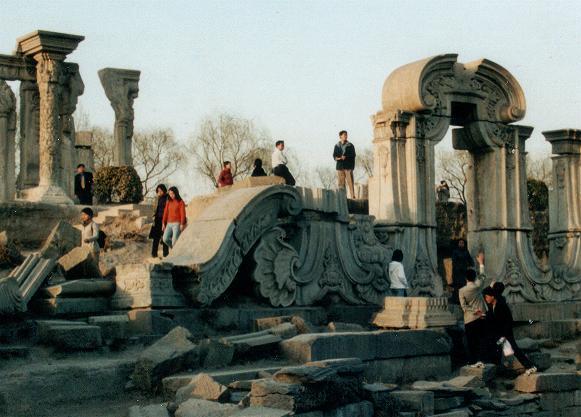
 Old Summer Palace/Yuanming Yuan, photo by de:Benutzer:Dr. Meierhofer, public domain dedication, Wikimedia Commons.
 Antique and ancient artworks from the sacking and burning of the the Yuanming Yuan, or Old Summer Palace, are among the most sought after objects for Chinese public and private collections. Objects thought to have been looted from the Yuanming Yuan are not only highly sought after in the Chinese market; many Yuanming Yuan artworks are among the objects stolen in a series of recent European museum heists. Why does foreign ownership of these items in particular resonate so strongly in contemporary Chinese culture?
The Chinese government has long portrayed the 1860 sacking of the Yuanming Yuan by British and French troops as a heinous act of colonialist oppression. China has decried non-Chinese ownership of art and artifacts from the Palace as a continuing insult to the people of China. Its government has demanded cancellation of auctions and repatriations when artworks from the Yuanming Yuan have appeared on the European market.
The palace and gardens were initially sacked, then burned, on the order of British High Commissioner Lord Elgin in retaliation for the torture and execution of European and Indian prisoners by the Chinese. A diplomatic deputation of European officials and their retinue were seized and then killed by Chinese officials after extensive torture; the murdered individuals included two official envoys and a journalist from the Times of London. Elgin decided that it would have little effect on the elite Chinese government officials if he attacked the city of Beijing; he attacked the center of power instead. What the English and French saw as retribution for murdering their diplomats, the Chinese considered a flagrant abuse of foreign power. (The Chinese government itself has historically been one of the greatest destroyers of cultural heritage for political reasons; for example, after its invasion of Tibet, Chinese government forces destroyed over 90% of the monasteries and other religious institutions there.)
Some of the most famous of the Yuanming Yuan objects in Europe were a set of bronze zodiac heads that had originally decorated an elaborate clepsydra, or water clock, in the Yuanming Yuan garden of the Old Summer Palace under Emperor Qianlong (1736-1795). The heads were originally looted during the destruction of the Old Summer Palace in October of 1860.
Strangely, for objects deeply associated with national patrimony, the zodiac heads are not actually Chinese in conception or execution. They were designed by a Milanese Jesuit missionary in China, Brother Giuseppe Castiglione, who had trained as a painter before traveling to China in 1715. The Emperor Quianlong supported and encouraged Castiglione. Castiglione developed a syncretic, blended European-Chinese style and worked under the Chinese name Lang Shih-ning.
Two zodiac heads, of a rabbit and a rat, were sold at the 2009 auction of the Yves St. Laurent and Pierre Bergé collection at Christie’s in Paris. (The Chinese government was said to have been infuriated when co-owner Pierre Bergé offered to bring the objects in person to China in exchange for a pledge to honor human rights in Tibet.) Prior to the 2009 Christie’s sale, five other heads had been sold at auction or purchased privately-the head of the ox (Christie’s 2000), the head of a monkey (Christie’s 2000), the head of a boar (Sotheby’s 1987), the head of a tiger (Sotheby’s 2000), and the head of a horse (purchased by Stanley Ho, 2007). A number of the heads were purchased by the arts and entertainment subsidiary of the Poly Group, a diversified corporate enterprise that grew out of the Peoples Liberation Army and which is China’s largest arms manufacturer.
(To some degree, the current importance of the items from the Old Summer Palace – and particularly the zodiac heads – arises from popular culture. In 2005, there was a Chinese television series called Palace Artist about Castiglione, in which Castiglione was played by a very popular actor, Mark Roswell, who is known as Dashan in China. At the time, Jackie Chan also expressed anger over the Paris sale of the bronzes and said he planned to make a movie about art thieves.)
At the 2009 Christie’s auction, the rabbit and rat heads were bid up to an extraordinarily high value – about 20 million dollars each. Then the buyer, a Chinese collector and auctioneer named Cai Mingchao, refused to pay as a protest. Later, in 2013, François-Henri Pinault, whose company, Kering, owns Christie’s as well as Chateau Latour, Gucci, Stella McCartney, Balenciaga, and other high-end consumer lines, presented the two heads to China as a good-will gesture.
Image: Yuanming Yuan, By de:Benutzer:Dr. Meierhofer (Self-photographed) [Public domain], via Wikimedia Commons