Your tax dollars at work. In January 2026, the U.S. repatriated seven artifacts to Egypt. Egypt’s Repatriation of Antiquities Department said that the objects include two mummified fish and a falcon head dated to the Ptolemaic period (304–30 b.c.). These artifacts were seized by U.S. customs in 2017. In 2018, investigating U.S. officials recovered a bronze amulet of Set, a basalt heart-shaped scarab, and a carving of a human face, which had all been illegally smuggled into the country. A painted ushabti figurine and a stone head turned into the Egyptian embassy in Washington by an American citizen were also returned. Photo credit Office of the Manhattan District Attorney.
 The past year was another difficult one for collectors, the trade, and museums. Despite the Trump administration’s “America First” rhetoric, repatriation on demand—framed as a “soft power” remedy for “past wrongs”—remains the default posture of the State Department, law enforcement, and, increasingly, U.S. museums.
U.S. Import Restrictions under the Cultural Property Implementation Act
The Cultural Property Implementation Act (CPIA) authorizes the executive branch to enter into cultural property agreements (CPAs) with foreign governments, but only if specific statutory findings are met. Except in emergency cases, the government must find that:
- the requesting country’s cultural heritage is in jeopardy;
- the country has taken meaningful “self-help” measures;
- the U.S. action is part of a multilateral effort with other market nations;
- no less restrictive remedy would be effective; and
- the measures are consistent with the exchange of cultural property for scientific and educational purposes.[1]

Senators Bob Dole and Patrick Moynihan give a joint ‘thumbs down’ on The David Brinkley Show, 1980s. Together, Doyle and Moynihan crafted the CPIA, bipartisan legislation intended to safeguard threatened archaeological sites while protecting U.S. museum and collector interests.
In “emergency” cases, these requirements are relaxed, but the restricted material must either be a newly discovered, site-specific type of significant importance, or the subject of a defined crisis threatening the archaeological record of a particular culture—one that temporary import restrictions can plausibly address.[2]
Once a CPA is signed, U.S. Customs and Border Protection (CPB) prepares designated lists of objects subject to repatriation that are published in the Federal Register.[3]
Over time, the statutory findings meant to impose real substantive and procedural limits on executive authority have devolved into a “check-the-box” exercise, and mission creep has steadily expanded the program’s scope.
What began as a forward-looking effort to protect vulnerable archaeological sites and culturally significant artifacts has morphed into a sweeping regime aimed at “clawing back” and repatriating most archaeological and ethnological objects made or found within a country—from prehistory through the early twentieth century.
The scale of CPIA enforcement is hard to quantify because CBP has consistently resisted FOIA requests, but seizures likely number in the thousands, with more to come as AI is increasingly used to screen shipments.

U.S. President Biden and Indian President Modi celebrate the return of dozens of Indian artifacts, September 22, 2024. Times of India.
Most consequentially, restrictions now commonly reach everyday collectibles such as historical coins—objects that circulated regionally and internationally as commerce for centuries and are widely collected today. Yet under current enforcement practices, CBP can simply “assume” that ancient coins—many now appearing on multiple, overlapping designated lists for different countries—are subject to detention, seizure, and forfeiture.
By contrast, a fair reading of the CPIA suggests that, before “designated material” may be seized, forfeited, and repatriated, the government must at least have probable cause to believe it was first discovered within—and remains subject to export control by—the State Party, and that it was exported after the effective date of the governing regulations.[4] The Fourth Circuit, however, foreclosed meaningful judicial review, treating the issue as a foreign-policy matter largely beyond the courts’ reach.
As a result, CPIA restrictions are no longer applied narrowly to illicit exports made after regulations take effect under § 2606. Instead, they are often enforced against virtually any post-effective-date import into the United States—functioning as an embargo rather than targeted, prospective restrictions. This approach harms legitimate trade, especially with Europe, because common objects such as coins frequently lack the documentation needed to qualify for the statute’s limited safe harbor (proof the item was outside the source country before the restrictions took effect).

Delegation from the Peoples Republic of China at the Cultural Heritage Center at the US Department of State. US Department of State.
And despite the rollback of many long-running State Department international programs, the cultural-property “soft power” status quo is still alive and well at Trump’s State Department. In 2025 alone, the second Trump administration carried forward Biden-era requests imposing restrictions on virtually all archaeological and ethnological material from India, war-torn Lebanon, and Uzbekistan. At the same time, renewals were underway for Taliban Afghanistan, Chile, Colombia, Costa Rica, Italy, Morocco, and Turkey, with new CPAs under consideration for Cameroon and Communist Vietnam.
The Special Case of Coins
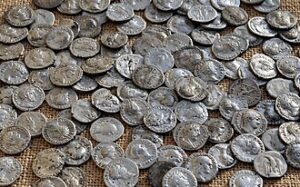
Roman Coin Hoard, Oswestry, Birmingham Museums Trust, Benedict Pond, 2013-07-09, Roman Coin Hoard: Oswestry. A group of 92 silver coins were found with the aid of a metal detector. It was legally reported in June 2008 under the Portable Antiquities Scheme and subsequently excavated by the finder and the Finds Liaison Officer, Peter Reavill on 10th of June. Legally processed through the Portable Antiquities Scheme, British Museum, FindID_232170-2.
Of particular concern to coin collectors is the push to extend import restrictions to widely collected Roman Imperial coins. Despite the tiny share of such coins found in Afghanistan, Pakistan, and Ukraine, the Biden administration added Roman Imperial issues to the designated lists for those countries. In 2025, the State Department held CPAC hearings on renewing existing CPAs with Italy and Turkey and signed the Italy renewal in December 2025—renewals that could be used to justify expanding restrictions to cover these coins as well.
The second Trump administration will likely continue the Obama-era restrictions on ancient Greek, Punic, and early Roman Republican coins as part of those renewals. What remains unclear is whether it will also press forward with the Biden administration’s effort to restrict Roman Imperial coins.
At a State Department CPAC hearing in May, Cultural Property Observer and other representatives of collectors and the trade opposed any expansion, citing scholarship showing that Roman Imperial coinage circulated widely—from Britain to Sri Lanka—and that fewer than 6% of validated Roman Imperial coin hoards (nearly seven million coins) have been found in Italy. Under those circumstances, CBP should not be able to presume that any particular Roman Imperial coin was excavated in Italy and illicitly exported after the effective date of new regulations. Whether that kind of undisputed evidence will outweigh “soft power” considerations remains to be seen.
A Committee of Die-Hard Repatriationists
More evidence that the status quo has not changed can be seen in the lack of turnover in the Cultural Property Advisory Committee (CPAC), which reviews requests for cultural property agreements, and continued State Department funding of archaeological advocacy groups, notably the American Society of Overseas Research (ASOR).

Yemen Embassy announcement August 31, 2023, thanking Antiquities Coalition for organizing roundtable discussion prior to signing Yemen-US cultural property agreement. Despite legal requirement, no public hearing was held.
CPAC’s current membership—which the statute says should fairly represent the distinct interests of the public, the trade, archaeology and anthropology, and museums—remains entirely composed of Biden appointees. Most, if not all, of these political appointees have prioritized cultural property agreements (CPAs) and “soft power” over protecting American collectors and encouraging legitimate trade.
State Department funding for ASOR and related archaeological organizations is largely channeled into conservation programs in countries with CPAs. Some of it, however, has also supported the drafting of reports used to justify more controversial CPAs, including one involving an armed faction in Libya. This creates a structural conflict of interest: these groups represent archaeologists who can excavate in such countries only with government permission. Unsurprisingly, they are reluctant to criticize local corruption, mismanagement, or sweeping laws that assert state ownership or control over nearly anything deemed “old.” The State Department, for its part, has little incentive to push back. The selective “evidence” presented at CPAC hearings then helps the bureaucracy satisfy—on paper—the CPIA’s statutory requirements, clearing the way for additional “soft power” CPAs.
In the past, this “collaboration” went so far as to bypass CPAC review and public comment when renewing a CPA with a Saudi-backed faction in Yemen. Instead, the agreement was signed at an “invitation-only” event sponsored by the Antiquities Coalition—another advocacy group that has received substantial State Department funding.
As the new Trump administration enters its second year, there is only a faint hope of a real rethink: that the State Department will stop privileging “soft power” over Americans’ private property and due process rights. As it is now, current import restrictions severely constrain lawful cultural exchange—exchange that today is primarily with Europe.
Threats of Criminal Liability to Force Repatriations

Cosmetic spoon returned to the Palestinian Authority by the Manhattan D.A., Purchased by Michael Steinhart in 2003, said to be from the Khirbet al-Koum area in Hebron. Photo Manhattan DA’s Office.
More troubling than the continued expansion of CPAs are the hardball tactics of Alvin Bragg’s Manhattan District Attorney’s office—the same office that prosecuted President Trump for falsifying business records. Matthew Bogdanos, an assistant DA there, has gained notoriety for using the threat of New York criminal charges to pressure museums and collectors into “voluntarily” repatriating objects to countries as varied as Communist China, Italy, Greece, the Islamic Republic of Iran, Libya, and Turkey. In Bragg and Bogdanos’s view, any object a foreign state claims under its own laws is treated as “stolen” under New York law, even if it left that country decades ago.
Nor does the object need to be in New York today. If it passed through New York—or if any related transaction occurred there—even fifty years ago, the office asserts jurisdiction. And because each day of possession is treated as a fresh offense, ordinary limitations periods effectively never expire.
In 2025, the forced repatriation of bronze statues traced to a Roman Imperial–era sanctuary at Boubon, Turkey, brought many of these tensions into focus. The statues were apparently illegally excavated by local townspeople and smuggled out of Turkey in the 1960s—before the 1970 UNESCO Convention created a widely used legal framework for repatriation. They were then openly sold and displayed as museum highlights for decades, until archaeological activists gained Matthew Bogdanos’s attention. He subsequently demanded that the Cleveland Museum of Art return a prominently displayed example. The museum initially resisted, but reconsidered after scholarly evidence indicated the statue did, in fact, originate in Turkey.

Handover of Tibetan objects to China, NY County Assistant District Attorney Matthew Bogdanos and PRC Deputy Minister of Culture and Tourism and head of the National Cultural Heritage Administration Li Qun. Xinhua.
Since then, with assistance from archaeological activists, Bogdanos has worked to locate other bronzes from the same group. Most recently, he asserted a claim over another statue held by a California collector. The collector initially countered by filing his own federal suit, but ultimately dismissed it and surrendered the object after being indicted by the Manhattan DA’s office. Whatever the merits of a collector’s legal arguments, the prospect of criminal liability is a powerful incentive to capitulate.
Once again, the press narrative told only part of the story. Although the collector reportedly backed down after evidence emerged that he knew the statue had been smuggled from Turkey, unresolved questions remained about the Manhattan DA’s jurisdiction over an object that had been in California for decades.
A further complication is Turkey’s effort—especially under an increasingly authoritarian government—to present itself as a perpetual cultural “victim.” The history is more mixed. Ottoman Turkey was an imperial power that enriched its palaces with cultural goods taken from oppressed subject populations, and Erdoğan’s Turkey has shown comparable imperial ambitions. The Turkish state has encouraged looting and destruction of cultural heritage beyond its borders, including in places such as Cyprus and Syria; converted historic churches, including Hagia Sophia, into mosques; and promoted treasure hunting in formerly Christian and Jewish regions. That record raises an uncomfortable question: should Turkey benefit from repatriations of objects removed decades ago and displayed openly ever since, given its own “unclean hands” today?
Voluntary Repatriations from Museums
2025 was another banner year for “voluntary” museum repatriations. In some circumstances—especially where returns involve Indigenous communities or identifiable victims—such repatriations can be appropriate. The problem is that returns justified on “ethical” grounds to nation-states or other governmental authorities are too often driven by a selective reading of the record.

The Philosopher, bronze, Hellenistic Greek or Roman, circa 150 BCE to 200 CE, Cleveland Museum of Art.
Museums are public institutions, and trustees have a duty to steward collections for the public. Many objects were donated by private citizens on the understanding that they would be preserved and displayed in the United States—not shipped abroad decades later.
Several years ago, activists associated with the Archaeological Institute of America persuaded the Association of Art Museum Directors to adopt stricter acquisition guidelines. Under these guidelines, member museums generally should not acquire an object unless provenance research shows it was outside its country of probable modern discovery before 1970, or legally exported after 1970. At the time, the 1970 cutoff was promoted as a practical safe harbor for present and future acquisitions. In practice, however, that assurance has increasingly vanished—especially in the Manhattan DA’s framing. And despite the second Trump administration’s rhetoric about museums, the “1970 Rule” is being displaced by a far more subjective standard of “ethical returns,” increasingly invoked whenever an object is alleged to be connected to “colonial exploitation.”
Ethics matter—but provenance research must tell the whole story, not a curated version designed to justify a preordained return. Recent repatriations from the Smithsonian and other institutions, including the Museum of Fine Arts, Boston, of Benin “bronzes” illustrate the point. These returns to the Oba, a traditional ruler in Nigeria, are routinely framed as redress for colonial wrongs stemming from a British punitive expedition that seized the bronzes as war prizes. Often omitted, however, is that the Oba’s wealth was built on the slave trade, and that many bronzes incorporate metal from melted “manilla” currency used in the purchase and sale of enslaved people. That history is relevant—particularly where repatriation deprives Americans descended from those enslaved by the Oba’s regime of tangible evidence of their own victimization.
Legislative initiatives

Roman Imperial Denarius of Emperor Marcus Aurelius, obverse. AR Denarius struck 161 AD, Rev. Felicitas stg. Purchased from Germania Inferior 3/19/16.
It is not all gloom and doom—at least for coin collectors. In April 2024, near the end of the 118th Congress, Rep. Beth Van Duyne (R–Texas) introduced a technical correction to the CPIA, H.R. 7865. The same proposal was reintroduced in the 119th Congress on January 21, 2025, as H.R. 595. It currently has fourteen cosponsors—ten Republicans and four Democrats—making it bipartisan.
The bill’s “safe harbor” would allow importation of coin types on designated lists when there is evidence that the material was lawfully acquired, is of a known type, and is not the direct product of illicit excavation in a UNESCO State Party after the effective date of any coin-related import restrictions. Supporters hope to attach H.R. 595 to a larger trade bill that typically moves each Congress. There is concern, however, that the month-long government shutdown may leave no suitable legislative vehicle this year—requiring yet another reintroduction next term.
Even if enacted, H.R. 595 would address only a slice of the problem. Much more ambitious reforms would still be needed to rein in the State Department and the Manhattan DA’s office, and to protect collectors’ due process and private property rights.
Peter K. Tompa is a Washington, DC based attorney, semi-retired. Peter contributed to Who Owns the Past?” (K. Fitz Gibbon, ed. Rutgers 2005). He formerly served as Executive Director of the Global Heritage Alliance and now is a member of its Board of Directors. He currently serves as the Executive Director of the International Association of Professional Numismatists. This article is a public resource for general information and opinion about cultural property issues and is not intended to be a source for legal advice. Any factual patterns discussed may or may not be inspired by real people and events. The opinions stated in this article are the author’s alone and should not be attributed to any affiliated organization.. He is the author of the well-known heritage blog Cultural Property Observer, https://culturalpropertyobserver.blogspot.com/.
For Further Reading
For coverage of 2025 CPAs, CPAC hearings and import restrictions Under the CPIA, see the Cultural Property Observer Blog, Blog Archive 2025, available at https://culturalpropertyobserver.blogspot.com/2025/ (last visited January 2, 2026).
For a discussion of the ACCG’s past effort to seek judicial review of the decision to impose import restrictions on coins, see An Epic Battle: U.S. v. 3 Knife-Shaped Coins, Cultural Property News (October 15, 2018), available at https://culturalpropertynews.org/an-epic-battle-u-s-v-3-knife-shaped-coins/ (last visited January 2, 2026).
For a discussion of State Department funding of archaeological advocacy groups, see Peter K. Tompa, Careful Collector No. 22-Your Tax Dollars at Work, Cultural Property News (December 28, 2023), available at https://culturalpropertynews.org/careful-collector-no-22-your-tax-dollars-at-work/ (last visited January 2, 2026).
For a FOIA release related to the “invitation only event” to sign a CPA with a Yemeni faction, see The ACCG has secured important evidence about the extent of cooperation between the State Department and archaeological advocacy groups, most notably, the mysteriously well-funded Antiquities Coalition, Ancient Coin Collectors Guild Website, News, available at https://www.accguild.org/news/13420183 (last visited January 2, 2026).
For more on the Manhattan DA’s repatriation of a statute to Turkey, see Tom Mashberg and Grahm Bowley, Collector Surrenders ‘Nude Emperor’ Statue Identified as Looted, The New York Times (December 8, 2025), available at https://www.nytimes.com/2025/12/08/arts/design/nude-emperor-statue-met-marble-head-turkey.html#:~:text=But%20the%20Manhattan%20district%20attorney’s,it%20too%20had%20been%20looted. (last visited January 2, 2026).
For more about the 1970 Rule, see 2013 Guidelines on the Acquisition of Archaeological Material and Ancient Art, Association of Art Museum Directors Website, Standards and Practices (January 29, 2013), available at https://aamd.org/standards-and-practices (last visited January 2, 2026).
For more about the Smithsonian’s ethical returns policy, see Shared Stewardship and Ethical Returns Policy, see Smithsonian National Museum of Asian Art, available at https://asia.si.edu/explore-art-culture/collections/collections-policies/shared-stewardship-and-ethical-returns-policy/ (last visited January 2, 2026).
For more about the legal complexities of the return of the Benin bronzes based on “ethical considerations,” see Channa M. Norman, Benin Bronzes Highlight Complexity of Repatriation Decisions, Shook, Hardy and Bacon Website, available at https://www.shb.com/intelligence/publications/2025/q4/norman-benin-bronzes (last visited January 2, 2026).
For more about H.R. 595, see HR 7865, a Bill to Facilitate the Lawful Trade in Collectors’ Coins, Reintroduced as HR 595, Ancient Coin Collectors Guild Website, News, available at https://www.accguild.org/news/13463512 (last visited January 2, 2026).
For more about the legislative reform needed, see Peter K. Tompa, Opinion: It’s Time to Make Collecting Great Again! Cultural Property News (April 3, 2025), available at https://culturalpropertynews.org/time-to-make-collecting-great-again/ (last visited January 2, 2026).
[1] 19 U.S.C. § 2602(a)(1).
[2] Id. § 2603.
[3] Id. § 2604.
[4] Id. §§ 2601, 2606.